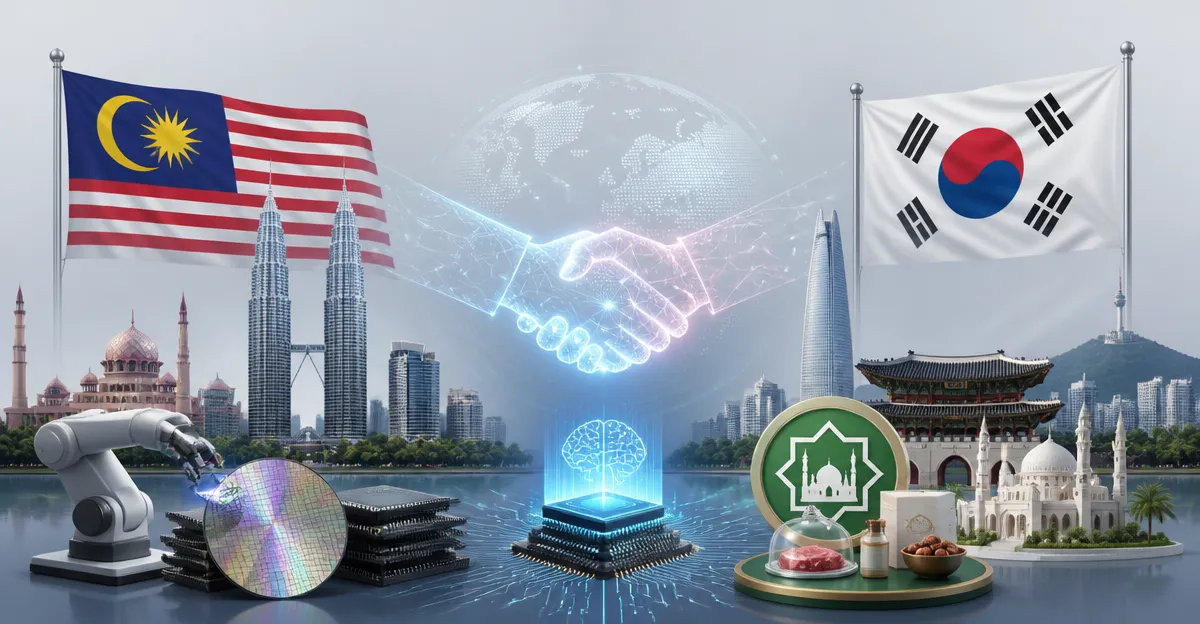
August 10, 2026, (Inside AI) — Malaysia is aggressively courting South Korean investment in semiconductors, artificial intelligence, and halal products, framing itself as the strategic launchpad for the broader Asean market.
In a joint interview with The Korea Times, senior officials from the Malaysian Investment Development Authority (MIDA) and the Malaysia External Trade Development Corporation (MATRADE) detailed a new phase in the bilateral economic relationship. They emphasized that South Korean firms stand to benefit from Malaysia’s position as both a manufacturing hub and a gateway to Southeast Asia’s 670 million consumers.
MIDA director Redzuan Abd Rahman and MATRADE trade commissioner Mohamad Termizi HJ Piee underscored the depth of existing ties: South Korean companies have invested a cumulative US$11.7 billion across more than 400 projects, generating nearly 50,000 jobs as of 2025. Key sectors include chemicals, transport equipment, electronics, petroleum, and basic metals.
“Malaysia and South Korea have built a strong and enduring economic partnership over the past several decades,” Redzuan said. “We believe the greatest opportunities lie in deepening collaboration in industries that are shaping the future of our economies.”
Redzuan pointed to a rare alignment of national strategies. South Korea is doubling down on its dominance in semiconductors, AI, advanced manufacturing, mobility, batteries, and green tech. Malaysia is rolling out the New Industrial Master Plan 2030, the National Semiconductor Strategy, and the National Energy Transition Roadmap to pivot toward high-value, innovation-driven industries. This convergence, he argued, creates a natural opening for joint investments and technology partnerships.
The semiconductor push is particularly timely. Global chip demand is projected to hit $1 trillion by 2030, and Malaysia already accounts for 13% of global chip testing and packaging. South Korean giants like Samsung and SK hynix are under pressure to diversify supply chains beyond Taiwan and China. Malaysia’s established ecosystem in Penang and Kulim offers a lower-cost, geopolitically neutral alternative.
AI collaboration is also gaining traction. Malaysia recently launched its AI Roadmap 2021-2025 and is courting hyperscalers for data center investments. South Korea’s expertise in memory chips and AI accelerators dovetails with Malaysia’s ambitions to become a regional AI hub. However, competition is fierce: Vietnam, Thailand, and India are all vying for the same Korean capital.
The halal sector adds a unique dimension. Malaysia’s globally recognized halal certification and its position as a top 10 halal exporter give it an edge in food, cosmetics, and pharmaceuticals. South Korean firms seeking to tap the $3 trillion global halal market can use Malaysia as a certification and production base, bypassing the steep learning curve of Islamic compliance.
Yet challenges persist. Malaysia’s talent pipeline, while improving, lags behind South Korea’s in advanced R&D. Bureaucratic hurdles and policy inconsistency have historically frustrated foreign investors. And the U.S.-China trade war, while benefiting Malaysia as a “China Plus One” destination, also raises the stakes for supply chain resilience.
The officials’ pitch comes as South Korea’s outbound investment in Southeast Asia surges, driven by the Korea-ASEAN Solidarity Initiative. Bilateral trade reached $26.7 billion in 2024, and both sides are exploring upgrades to the Korea-Malaysia Free Trade Agreement. For South Korean firms, Malaysia’s appeal lies in its English-proficient workforce, robust infrastructure, and strategic location along the Malacca Strait.
In a related move, Malaysia recently approved $1.2 billion in tax incentives for high-tech investments and is fast-tracking visas for skilled workers. These measures aim to sweeten the deal for companies like LG Energy Solution, which is expanding its battery plant in Johor, and Samsung SDI, which operates a major facility in Negeri Sembilan.