August 14, 2026, (Inside AI) — The global AI boom has minted trillion-dollar valuations and reshaped capital markets, but a growing chorus of economists and former regulators warns that the sector now resembles a financial structure built on belief rather than output.
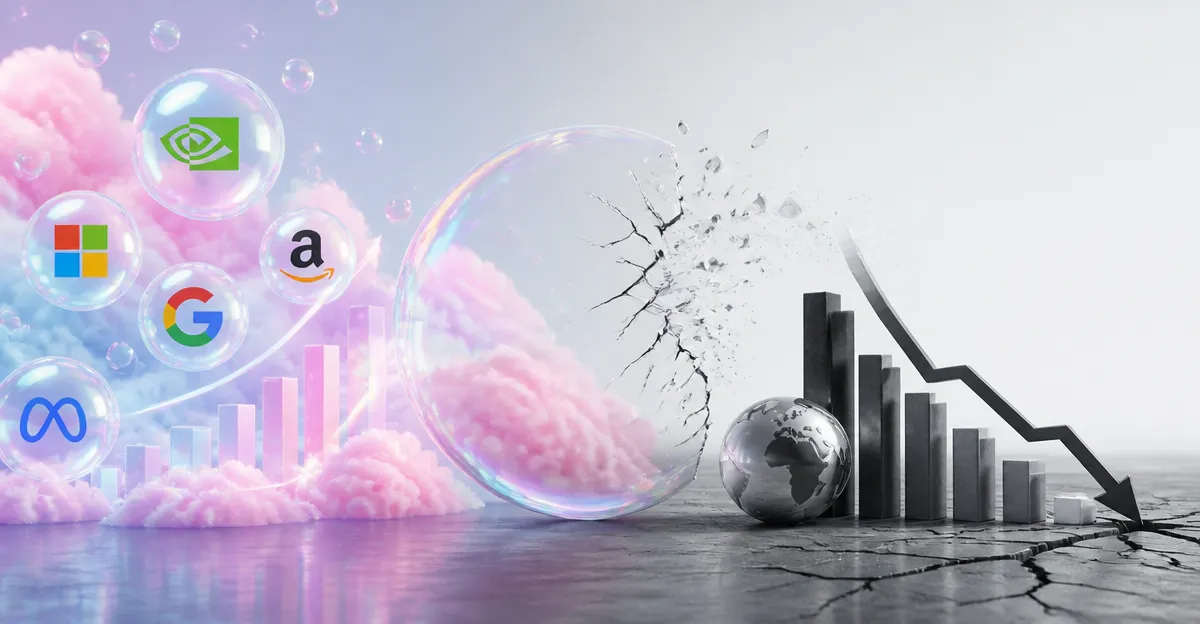
Andrew Sheng, a former central banker and financial regulator currently distinguished fellow at the Asia Global Institute, University of Hong Kong, argues that the AI economy has become the latest iteration of what he calls the “candyfloss economy.” The term, popularized by journalist Gillian Tett, describes a market or system that looks big, sweet and attractive from the outside but is entirely hollow on the inside.
Tett cites an Islamic finance scholar as the originator of the term:
“Real assets – like houses – were being used to secure debt that was then rehypothecated multiple times, partly with derivatives, just as sugar is spun and re-spun into candyfloss.” Andrew Sheng, distinguished fellow, Asia Global Institute, University of Hong Kong
That description, originally applied to the 2008 financial crisis, now maps onto the AI investment cycle. Estimates by the McKinsey Global Institute suggest that the global balance sheet grew faster than GDP in the 50 years from 1970 to 2020, with the pace of that growth steadily increasing. Most of this happened after 2000, when asset valuations and credit expansion detached from GDP growth. In other words, finance is like candyfloss, pumped up by credit and the belief that valuations can only keep rising.
In the candyfloss economy, financial engineering is prioritised over real engineering or production. Financial derivatives are created essentially through leverage, based on contractual promises secured on assets such as real estate. Derivatives can be created as long as there are buyers who believe in the product or the issuer. The same logic now applies to AI infrastructure: data centers, GPU clusters, and model training runs are financed through debt and equity based on projected demand that has not yet materialized at scale.
The real danger in financial candyfloss is that buyers have a false sense of stability in values. Valuations gain momentum: they rise simply because more people believe they will continue to rise. But what goes up must eventually go down.
This dynamic is not new. The dot-com bubble of the late 1990s saw capital pour into internet companies with minimal revenue, driven by the belief that eyeballs and page views would eventually convert into profits. The 2008 housing crisis demonstrated how mortgage-backed securities and credit default swaps could inflate asset prices far beyond underlying value. In both cases, the correction was brutal and exposed the gap between financial valuation and real economic output.
Today’s AI sector shows similar patterns. Venture capital and corporate investment in AI reached record levels, with some estimates placing annual spending above $200 billion. Yet revenue from AI products remains concentrated among a handful of companies, and most startups have not demonstrated a path to profitability. The gap between capital deployed and cash flow generated is widening, not narrowing.
Critics point to the circular nature of AI financing. Large technology companies invest in AI startups, which then purchase cloud computing and chips from the same large companies. This creates reported revenue that flows between balance sheets without necessarily reflecting end-user demand. It is a modern form of rehypothecation, where the same underlying asset supports multiple layers of financial claims.
Supporters counter that AI is a genuine general-purpose technology, comparable to electricity or the internet, and that early losses are a normal part of building infrastructure. They note that Amazon lost money for years before becoming profitable, and that cloud computing eventually justified massive capital expenditure. The question is whether AI will follow the same trajectory or whether the current investment cycle is running ahead of actual adoption.
Danish philosopher Soren Kierkegaard said that life is understood backwards and lived forward. We look at history to guide us, but the only way to truly know the future is to live our lives. If our perception of reality is subjective, then what we experience is based on beliefs or judgments that can be detached from reality.
That philosophical warning now applies to AI valuations. The market has priced in a future that has not arrived. When belief and reality diverge, the correction is rarely gentle.