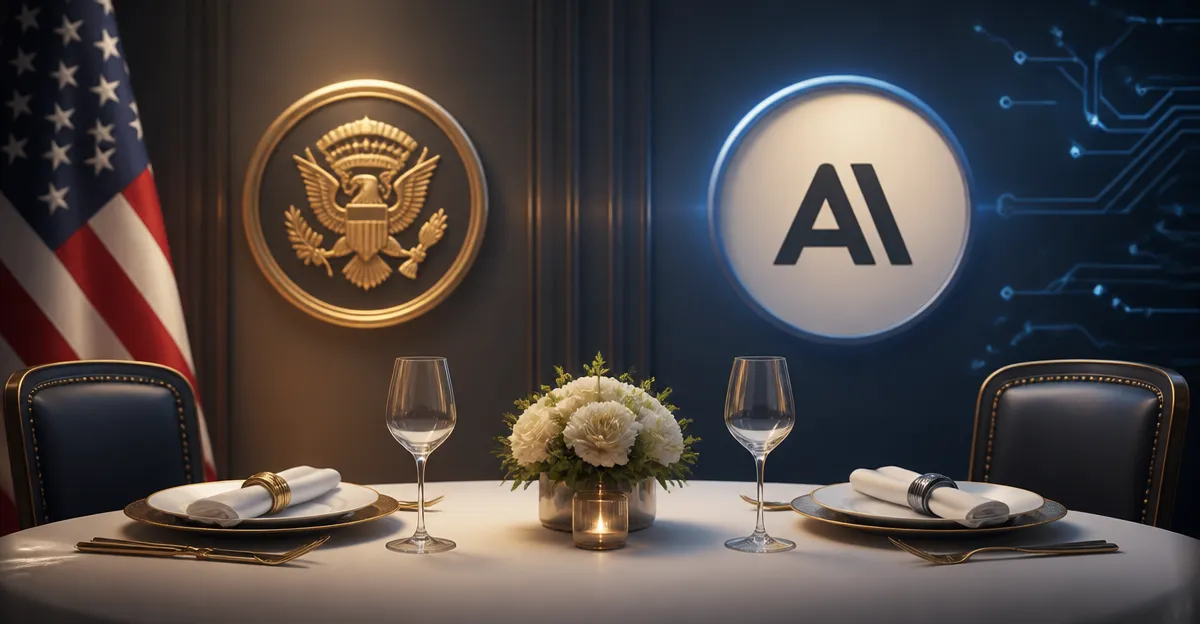
September 28, 2026, (Inside AI) — President Donald Trump met privately with Dario Amodei, CEO of AI safety-focused firm Anthropic, over dinner Sunday night at the White House. The meeting marks the first direct engagement between the two since Trump took office, following months of public friction over AI regulation and military use of the company's technology.
The dinner, confirmed by White House officials who spoke on condition of anonymity, comes just two days before Trump is scheduled to appear at a Washington event with other top technology executives. Neither the White House nor Anthropic has disclosed the topics discussed, but the timing suggests a potential shift in the administration's stance toward the AI safety community.
Amodei has been a vocal advocate for slowing down AI development, warning of existential risks and urging government guardrails. His position stands in stark contrast to Trump's deregulatory agenda, which has prioritized rapid AI advancement to maintain U.S. competitiveness against China. In recent months, Trump dismissed Amodei's concerns, calling Anthropic's leadership "Leftwing nut jobs" after the company sought to restrict military applications of its Claude model.
The Pentagon subsequently blacklisted Anthropic, barring the firm from defense contracts. That decision followed internal clashes over the company's refusal to allow its AI to be used for autonomous weapons or surveillance without human oversight. The standoff highlighted a growing divide between Silicon Valley's safety-first faction and the defense establishment's push for AI superiority.
Amodei is among the few major tech CEOs who had not sought access to Trump during his second term. Others, including Elon Musk of Tesla and Sam Altman of OpenAI, have visited the White House, announced investments, and dined with the president. Amodei's reticence had been interpreted as a silent protest against the administration's AI policies.
Sunday's dinner could signal a thaw. A person familiar with the matter, who requested anonymity to discuss private conversations, said the meeting was "cordial" but offered no further details. The White House press office declined to comment on the record.
Anthropic, valued at over $60 billion, has positioned itself as a responsible AI leader. Its Constitutional AI approach emphasizes harmlessness and transparency, attracting partnerships with major enterprises. However, its refusal to fully cooperate with the Pentagon has cost it lucrative contracts and drawn political ire.
Trump's broader AI agenda has focused on accelerating innovation. In January 2026, he signed an executive order streamlining approvals for AI data centers and chip fabrication plants. His administration has also proposed tax incentives for companies that develop AI models domestically. These moves align with his stated goal to "win the AI race" against China.
Yet the safety community warns that unchecked speed could lead to catastrophic outcomes. Amodei has repeatedly called for international coordination on AI governance, comparing the risk to nuclear proliferation. His stance has earned him both praise and criticism, with some accusing him of alarmism.
The dinner raises questions about whether Trump is reconsidering his hardline approach. A former White House official, speaking on condition of anonymity, said the president often uses informal meetings to gauge industry sentiment. "He wants to hear all sides before making big decisions," the official said. "But he also expects loyalty."
Anthropic's blacklisting remains in effect, and the Pentagon has not indicated any plans to reverse it. However, a defense official, who spoke on condition of anonymity, noted that the department is "constantly evaluating" its vendor list based on evolving needs.
Tuesday's tech event in Washington will bring together CEOs from Microsoft, Google, and Amazon, among others. Trump is expected to announce new public-private partnerships on AI infrastructure. Whether Amodei will attend remains unclear.
The meeting also comes amid heightened global competition. The European Union recently passed its AI Act, imposing strict rules on high-risk systems. China has accelerated its own AI development, with state-backed firms pouring billions into large language models. U.S. policymakers face pressure to balance innovation with security.
For Anthropic, the dinner could be a chance to advocate for its vision. The company has consistently argued that safety and competitiveness are not mutually exclusive. In a 2025 blog post, Amodei wrote that "AI could help solve humanity's biggest problems, but only if we build it carefully."
Read: Trump says he'll discuss AI with Xi but wants to 'leave it exactly where it is'
Trump has not publicly commented on the dinner. His schedule for Monday includes a briefing on AI and national security. The White House has not announced any follow-up meetings with Amodei.
Industry analysts remain skeptical of a lasting détente. "One dinner doesn't erase months of antagonism," said Sarah Kreps, a professor at Cornell University who studies technology policy. "But it does suggest that the administration recognizes Anthropic's influence."
Anthropic declined to comment beyond confirming the meeting. A spokesperson said the company "appreciates the opportunity for constructive dialogue."
As the U.S. races to maintain its AI edge, the relationship between Washington and safety-focused firms like Anthropic will be closely watched. Sunday's dinner may be a first step toward bridging a widening rift, or simply a brief pause in a longer conflict.