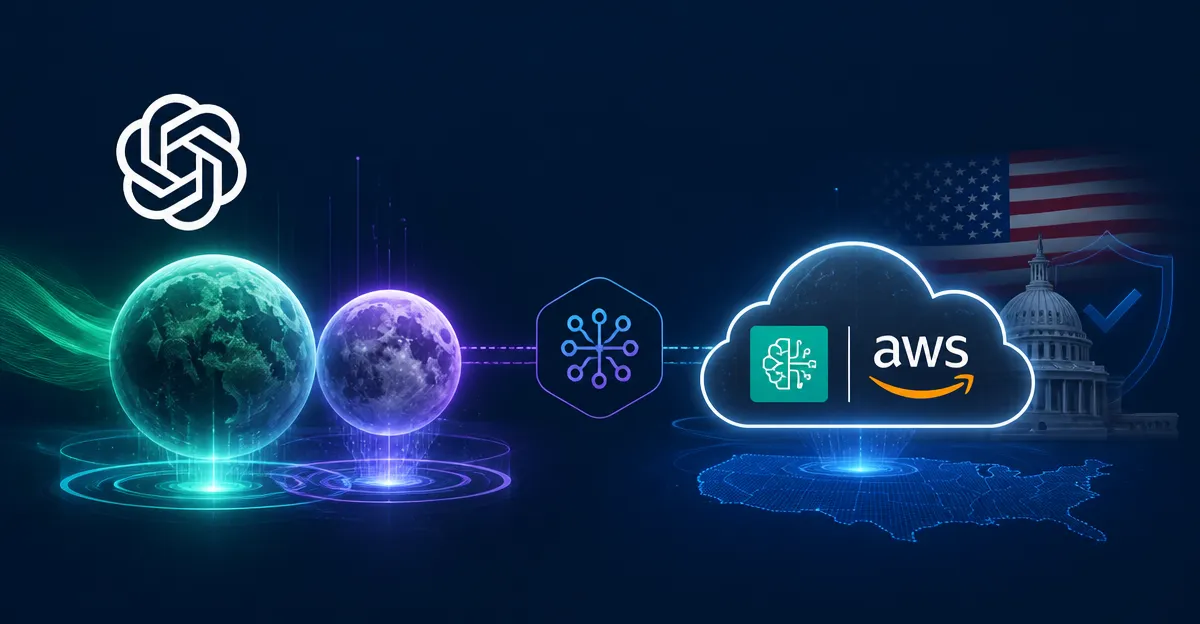
August 24, 2026, (Inside AI) — OpenAI has made GPT-5.6 Terra and GPT-5.6 Luna generally available on Amazon Bedrock in AWS GovCloud (US-West) and AWS GovCloud (US-East). The launch brings OpenAI’s latest model family to Bedrock’s next-generation inference engine, which AWS describes as built for high performance, security, and reliability.
The two models target different workloads. Terra delivers GPT-5.5-level performance at half the cost. Luna focuses on fast, cost-efficient inference at the lowest price point. Both support 1 million token context windows, allowing developers to process full codebases, lengthy documents, and multi-turn agent histories in a single request.
For government and regulated industries, this is a significant shift. AWS GovCloud is designed to host sensitive data and regulated workloads. Until now, OpenAI’s frontier models were not available in that isolated environment. The move signals growing demand for high-capability AI inside compliance-heavy sectors such as defense, healthcare, and public administration.
Why GovCloud changes the enterprise AI calculus
AWS GovCloud operates under strict regulatory frameworks, including FedRAMP High, ITAR, and HIPAA eligibility. Adding GPT-5.6 Terra and Luna means agencies and contractors can run advanced reasoning models without moving data outside approved boundaries. That removes a major barrier for workloads involving controlled unclassified information or export-controlled technical data.
The pricing structure is also notable. Terra cuts the cost of GPT-5.5-level intelligence by half. Luna lowers the floor further. For long-running agentic workflows, prompt caching with explicit cache breakpoints bills repeated context at a 90% discount. AWS says that discount does not compound cost as usage scales.
AWS positions the models for autonomous coding agents, long-horizon genomics and biology analyses, and advanced cybersecurity research. Those use cases often involve massive context and multi-step reasoning. The 1 million token window reduces the need for chunking, which can introduce information loss.
Context and competition in the Bedrock lineup
Amazon Bedrock already hosts models from Anthropic, Meta, Mistral, and Cohere. OpenAI’s presence on Bedrock is relatively recent, and this GovCloud expansion deepens that partnership. It also puts pressure on Anthropic’s Claude models, which have been a common choice for government AI workloads due to their safety positioning.
Developers can access Terra and Luna through the Amazon Bedrock Console or the Responses API on the bedrock-mantle endpoint. AWS has not yet published full regional availability details, but the company directs users to its regional availability page for updates.
This launch follows a broader industry trend of frontier labs partnering with cloud providers to reach regulated markets. Microsoft has offered OpenAI models through Azure Government, and Google has pushed Gemini into public sector clouds. AWS GovCloud support closes a gap for customers already standardized on AWS infrastructure.
The exact benchmark performance of Terra and Luna was not disclosed in the announcement. AWS says GPT-5.6 sets “a new standard for intelligence and efficiency,” but independent evaluations will be needed to verify those claims against competitors. For now, the key takeaway is availability: OpenAI’s latest models can now operate inside one of the most tightly controlled cloud environments in the United States.