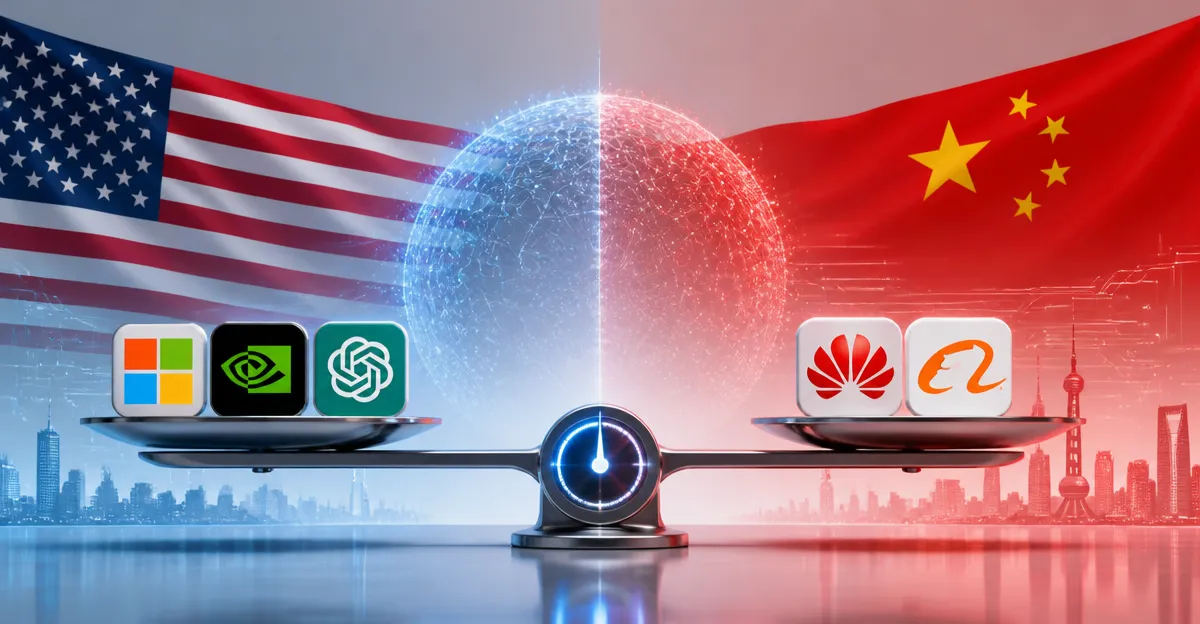
September 22, 2026, (Inside AI) — When US President Donald Trump and Chinese President Xi Jinping meet in Washington this week, the official agenda will center on trade, security, and artificial intelligence. Yet beneath the diplomatic choreography, a quieter story is unfolding in capital markets. Wall Street banks are underwriting Chinese AI listings at a record pace, while Chinese money pours into US semiconductor stocks. The two nations are building separate AI supply chains, but their financial systems remain deeply intertwined.
The numbers are striking. Wall Street banks have acted as bookrunners on 19 Chinese high-tech equity capital market deals worth $17.2 billion so far this year, according to LSEG data. That accounts for nearly 30% of the sector's total issuance. On the other side, the value of US equity held by Hong Kong residents and mainland Chinese has jumped 23% in the past year to top $750 billion, US data shows.
This mutual exposure creates a financial safety net. Both sides have an interest in keeping relations steady, which lowers expectations that the Trump-Xi meeting will produce a breakthrough. It also poses a risk. If US-China relations deteriorate further and AI development splits into two separate spheres, these connections could unwind painfully.
"US and Chinese businesses and investors continue to maintain connectivity and invest in each other despite highly volatile geopolitical conditions," said Fred Hu, founder and chairman of private equity firm Primavera Capital Group.
"The forthcoming Trump-Xi Summit can hopefully inject more certainty and energy to the essential financial connectivity and broader economic relationship."
The financial ties persist even as Washington restricts top-line chip exports to China and limits US investment in sensitive AI sectors. Those rules contain a carve-out for publicly traded securities. That loophole has allowed Wall Street to participate in China's AI listing boom, which is partly fueled by Beijing's push for self-sufficiency.
US Treasury Secretary Scott Bessent said he and Chinese Vice Premier He Lifeng discussed setting up a US-China AI dialogue this week, with a notification system for common goals and threats. The dialogue would mark a rare formal channel for AI discussions between the two governments.
Wall Street's Dual Role Draws Scrutiny
Wall Street banks this year advised on more than a dozen AI and chip listings and follow-on share sales, LSEG data showed. Optical parts maker Zhongji Innolight raised $6.8 billion in a Hong Kong listing, with Goldman Sachs, Morgan Stanley, and Citigroup among its joint global coordinators. Goldman and Morgan Stanley also worked on Hong Kong listings of AI developer MiniMax, chipmakers Montage Technology and Shanghai Iluvatar CoreX Semiconductor. J.P. Morgan underwrote the roughly $2.6 billion Hong Kong share sale by Victory Giant Technology, which makes printed circuit boards for AI servers.
US banks also appear in shareholder registers of chipmakers on Shanghai's Nasdaq-like STAR Market. These holdings typically reflect activity on behalf of clients and suggest the banks are conduits for global cash into the sector.
Read: Wall Street Futures Rise as AI Stocks Rebound, Oil Prices Slide
"Wall Street underwriting Chinese tech IPOs is about clipping the ticket on both sides of a cold war," said James Buckley-Thorp, founder and CEO of AI company Atlian.
"There'll be two internets, two chip stacks, two rulebooks, and your portfolio needs a passport for both," he said.
"The Shanghai punter buying Nvidia and the pension fund buying Zhipu in Hong Kong are making the same bet: that the politicians won't actually pull the trigger. That's the trade."
Chinese investment flowing to the US has also been strong where it can be tracked. US stocks, and tech shares among them, account for nearly half of the 1 trillion yuan ($150 billion) managed by China's outbound mutual funds. These funds invest under quotas controlled by China's foreign exchange regulator.
The value of Chinese holdings jumped this year in US chipmakers including Micron Technology, AMD, Sandisk Corp, Lam Research, and Applied Materials, according to data compiled by Sinolink Securities. According to S&P Global Market Intelligence, the total value of US AI funding rounds involving investors based in China or Hong Kong has climbed sharply from about $436 million in 2023 to roughly $8.9 billion through mid-September.
Yet the flows are shifting and frictions remain close to the surface. Thilo Hanemann, a partner at research firm Rhodium Group, said wealthy Chinese investors continue to invest in US tech companies through offshore funds, "but there is very limited visibility into these fund structures and thus the magnitude of exposure."
At least one US lawmaker has criticized JPMorgan Chase and Bank of America for underwriting the Hong Kong listing of Chinese battery giant Contemporary Amperex Technology Co, a company the US says has ties to China's military. Washington is also adding a growing number of Chinese tech companies to its list of companies it believes are aiding Beijing's military. And SpaceX's website and IPO materials were inaccessible in Hong Kong and mainland China ahead of its listing in June.
Still, investors on either side of the so-called 'Silicon Curtain' want to spread their bets, for now.
"There probably won't be a single winner in the U.S.-China AI race," said Xile He, a China-born-and-educated entrepreneur who's co-founder and CEO of AI start-up BrentX in San Francisco.
"From an investor perspective, I think betting entirely on one side is a big risk."
The financial connectivity between the world's two largest economies is not new. During the Cold War, US and Soviet economies remained largely separate. Today, the AI rivalry is different. Public markets, mutual funds, and cross-border listings have created a web of interdependence that neither government can easily sever. That interdependence may serve as a brake on escalation. It also means that any sudden decoupling would send shockwaves through portfolios on both sides of the Pacific.
For now, investors are hedging their bets. The Trump-Xi meeting may produce little in the way of grand bargains. But the quiet flow of capital tells its own story. The AI race is on, and Wall Street is financing both runners.