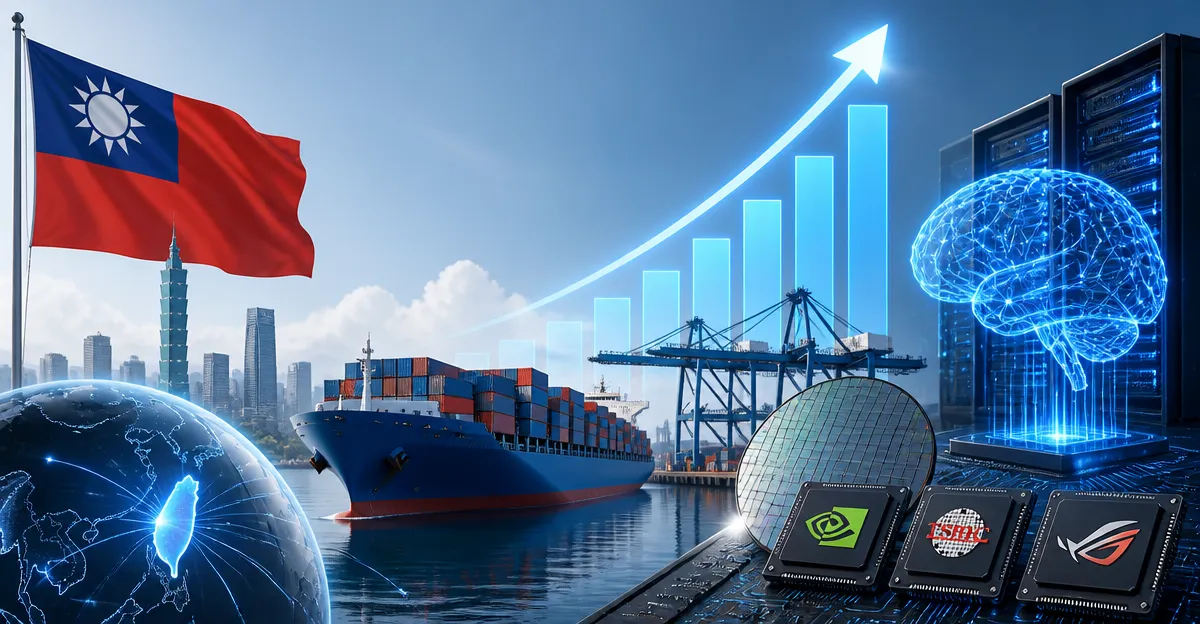
September 22, 2026, (Inside AI) — Taiwan's export orders surged past $100 billion for the first time in August, setting a record monthly high as global demand for artificial intelligence hardware continued to accelerate. The figure exceeded analyst expectations and underscored the island's pivotal role in the AI supply chain.
The milestone, announced Tuesday by Taiwan's Ministry of Economic Affairs, reflects the outsized influence of AI-related technology on the country's trade performance. Taiwan is home to Taiwan Semiconductor Manufacturing Company (TSMC), the world's largest contract chipmaker and a critical supplier to Nvidia, AMD, and Apple. Export orders serve as a leading indicator of actual shipments, often by two to three months, making the August data a signal of sustained momentum rather than a one-time spike.
While the ministry did not break down the share attributable to AI in its public statement, the record total aligns with a broader pattern: Taiwan's export orders have climbed steadily since early 2024, driven by demand for servers, graphics processing units, and high-bandwidth memory used in AI data centers. The August figure surpassed the previous high set in July, according to the ministry's release.
Why The $100 Billion Mark Matters
Crossing the $100 billion threshold is not merely symbolic. It signals that AI infrastructure spending, led by Microsoft, Google, Amazon, and Meta, remains resilient despite broader economic uncertainty. These companies have collectively committed tens of billions of dollars to data center expansion this year, and much of that hardware originates from Taiwanese manufacturers.
Read: SK Hynix Breaks Ground on $4 Billion Indiana AI Chip Packaging Facility
The August orders also highlight a geographic concentration risk. Taiwan produces over 60% of the world's semiconductors and nearly 90% of the most advanced chips. Any disruption, whether from geopolitical tension or natural disaster, would ripple through the global AI economy. The ministry's statement did not address this vulnerability, but industry analysts have repeatedly flagged it as a systemic concern.
"The AI demand wave is not slowing down, and Taiwan sits at the center of it," said an industry analyst who spoke on condition of anonymity because they were not authorized to comment publicly. "Every major cloud provider needs Taiwanese chips and servers. That gives the island enormous leverage, but also enormous exposure."
The record export orders come amid shifting trade dynamics. The United States has encouraged semiconductor manufacturing to move onshore through incentives like the CHIPS and Science Act, while TSMC has built fabs in Arizona and Japan. Yet advanced packaging and cutting-edge production remain concentrated in Taiwan. The August data suggests that diversification efforts have not yet reduced the island's central role.
Export orders are measured in value and reflect contracts placed with Taiwanese firms, not final shipments. The ministry compiles the data from monthly surveys of exporters. A sustained rise in orders typically translates into higher factory output and export revenues in subsequent months.
Taiwan's economy has outperformed many of its regional peers this year, largely due to the AI boom. The government has revised its 2026 growth forecast upward, citing stronger-than-expected technology exports. The August record adds weight to those projections.
Still, some economists caution that the AI investment cycle could cool if corporate spending on data centers slows. Nvidia's recent earnings beat expectations, but supply chain constraints and power availability in key markets remain unresolved. Taiwan's export orders may eventually reflect those bottlenecks.
For now, the August figures reinforce Taiwan's position as an indispensable node in the global AI supply chain. The ministry is scheduled to release September data next month. Whether the $100 billion mark becomes a new baseline or a peak will depend on how long the AI infrastructure buildout continues at its current pace.