November 5, 2026, (Inside AI) — The artificial intelligence boom is reshaping the financial fortunes of an unexpected corner of European industry: chemical and industrial gas suppliers. On Thursday, Belgian specialty chemicals company Syensqo beat third-quarter expectations, reporting that demand from semiconductor manufacturers continued to support its materials business. The company now expects a 25% second-half improvement in semiconductor sales over the first half of the year.
“We'll probably see a 25% second-half improvement in our sales in semiconductors over the first half,” CEO Mike Radossich told journalists.
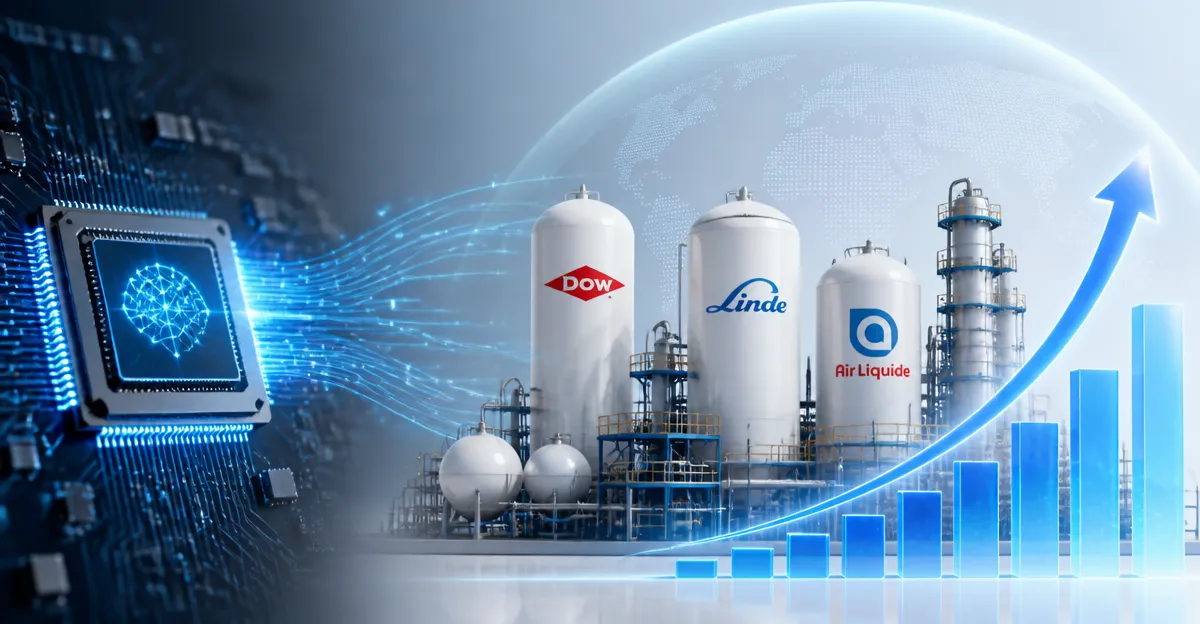
The results arrive alongside similar momentum at industrial gas giants Linde and Air Liquide, both of which reported forecast-beating third-quarter results last week. Their electronics businesses, which supply semiconductor manufacturers, posted double-digit sales growth. The pattern is clear: as AI data centers demand more silicon, the suppliers of ultra-pure gases and specialty chemicals are seeing a direct lift.
The scale of the shift is visible in capital commitments. Air Liquide said its electronics investments nearly doubled in the first nine months of 2026 compared with all of 2025. In August, the company agreed to buy South Korea's DIG Airgas for 2.85 billion euros. Linde committed $1 billion in July to supply a major semiconductor manufacturing facility in Arizona. Solvay, which spun off Syensqo in 2023, announced in September it would double capacity at an ultra-pure hydrogen peroxide plant in Taiwan's Tainan Science Park, where TSMC is expanding 3-nanometre chip production.
Read: Tokyo Electron Forecasts 87% Profit Jump Despite AI Return Jitters
Why AI Fabs Need Chemical Giants
Semiconductor fabrication is a chemical-intensive process. Each advanced node requires extremely high-purity gases and reagents to avoid contamination at the nanoscale. As AI chips grow more complex, the purity requirements tighten, and the volumes rise. Air Liquide recently announced a new plant in Taiwan and a commitment of nearly 200 million euros to support an SK hynix semiconductor project. These are not speculative bets. They are long-term supply contracts tied to specific fab expansions.
The current wave of investment echoes earlier semiconductor cycles, but with a different driver. Previous booms were fueled by smartphones and PCs. This one is anchored in AI servers, which require far more silicon per unit than traditional computing infrastructure. That intensity translates into higher chemical consumption per wafer, and it explains why suppliers are expanding capacity at a pace not seen in years.
For the chemical and gas companies, the AI trade is not about hype. It is about volume. Syensqo's materials business, Linde's electronics segment, and Air Liquide's electronics investments all point to a structural increase in demand. The suppliers are not selling AI software or chips. They are selling the invisible inputs that make chip production possible. That position gives them a stable, recurring revenue stream tied to fab utilization rates rather than consumer sentiment.
Yet the dependence cuts both ways. If AI chip demand cools, or if fab construction slows, these suppliers will feel it. The capital commitments are large and long-dated. Air Liquide's near-doubling of electronics investments in nine months is a bold bet on sustained growth. Linde's $1 billion Arizona commitment ties it to a single major facility. These are concentrated exposures.
Still, the third-quarter results suggest the momentum is real. Syensqo's beat, Linde's and Air Liquide's forecast-beating numbers, and the expansion announcements all point in the same direction. The AI boom is not just a story about chip designers and data center operators. It is also a story about the chemical and gas suppliers who make the fabs run.
Solvay's move to double ultra-pure hydrogen peroxide capacity in Taiwan is particularly telling. TSMC's 3-nanometre expansion is one of the most advanced chip production lines in the world. Supplying it requires meeting exacting purity standards. Solvay's investment signals confidence that the AI-driven demand for leading-edge chips will continue. The company spun off Syensqo in 2023, and both entities now find themselves benefiting from the same underlying trend.
For investors, the takeaway is that the AI supply chain extends far beyond the headline names. The chemical and gas suppliers are quieter, but their fortunes are increasingly tied to the same forces. The third-quarter results offer a glimpse of how that plays out in practice. The numbers are not explosive, but they are steady. And in a sector known for cyclicality, steady growth tied to a secular trend is a welcome change.
As AI chip demand continues to drive semiconductor investment, the companies that supply the materials and gases will remain essential. Their recent results and expansion plans suggest they are positioning themselves for a sustained period of growth. The question is whether the AI boom will last long enough to justify the capital commitments. For now, the suppliers are betting that it will.

If a research paper dropped this week, Mahesh has already read it. He covers AI tools and vibe coding for builders who need to know what is worth their time and what is not.