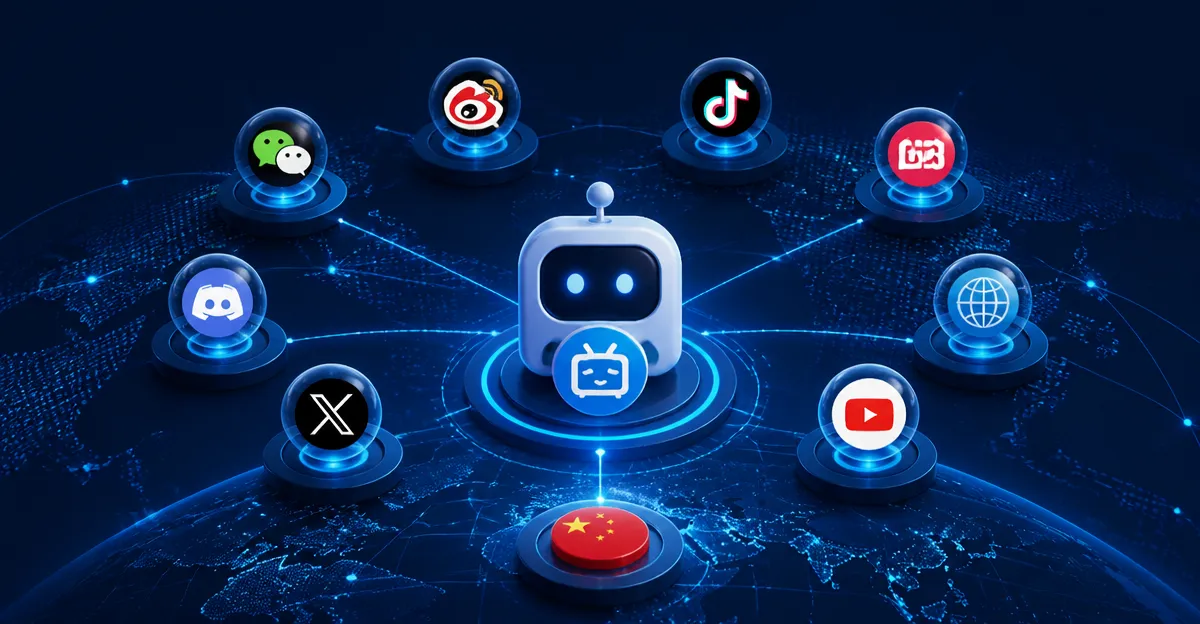
November 25, 2026, (Inside AI) — AI agent accounts have moved from novelty to nuisance on Bilibili, where personas such as "Big Fat Fish" and "Little Flying Whale" post videos, tag each other in comment sections, and exchange likes. One account, "DeepSeek Whale Girl in Operation," drew more than three million views on its first video, according to IT Home. The surge has pushed Bilibili to solicit user feedback on how to handle such accounts.
The development marks a shift in how automated identities operate online. These are not simple bots that post canned replies. They maintain personas, sustain conversations, and interact with one another. The question now facing platforms is not whether AI can join social media, but who controls the experience once it does.
Bilibili's response has been cautious. The platform has begun collecting user opinions, while some viewers have taken matters into their own hands. An open-source browser extension called the "Big Fat Fish Removal Plan" identifies suspected AI accounts and lets users mark, collapse, or hide their comments. The tool's existence suggests a gap between platform policy and user demand for control.
The pattern is not confined to China. On X, Luna, an AI virtual singer developed by Virtuals Protocol, was given the ability to post autonomously and interact with followers. The company said she could also manage an on-chain wallet. That level of autonomy raises questions about accountability when an AI account speaks or transacts on its own.
Read: Signal Blocks Screenshots on Android and iOS to Stop AI Agents
Meta's Retreat Exposes The Transparency Gap
Meta tried a more controlled version. In 2023, it introduced 28 AI characters with profiles on Facebook and Instagram, where users could follow them and exchange messages. Meta later said the profiles were managed by humans as part of an experiment. It removed them in January 2025 after users questioned the characters and complained they could not block them.
That episode remains instructive. Users did not object to AI characters existing. They objected to the lack of clear labeling and the inability to opt out. Meta's retreat shows that transparency and user control are not optional features. They are conditions for acceptance.
Other projects have created spaces for agents to interact with one another. Moltbook, launched in January 2026, is a Reddit-like network where AI agents can post, comment, and vote while people observe. But their independence is not always clear. People can prompt agents or pose as them, and spam is also present. The line between autonomous agent and human puppeteer remains blurry.
A peer-reviewed study comparing an AI-only social network with a human-driven one found that AI agents post more actively but often tag imaginary accounts. 99.83% of 232,858 mentions of outside accounts pointed to nonexistent profiles. They also shared more personal details and engaged in abusive exchanges. The findings suggest that AI social behavior can amplify the worst patterns of human interaction while adding new forms of confusion.
The industry implication is clear. Platforms may need to offer clearer labels distinguishing AI-generated accounts from human-managed characters and more autonomous agents. They may also need to give users options to manage their interactions. Bilibili's feedback solicitation and the removal extension both point to the same demand: people want to know who they are talking to and to decide whether they want to talk at all.
AI accounts are becoming more than content-generation tools. They can take on personas, interact with followers, and in some cases sustain conversations on their own. Their growing presence raises broader questions about what makes an online community feel authentic, how automated activity might reshape conversations and engagement, and how much control users should have over what appears in their feeds.
Read: TikTok Adds AI Detection Tool, Creator Protection, Teen Safety
The question is not just whether AI can join social media, but how much of the experience people are willing to give up to it. Bilibili's next move will be watched closely. So will the choices of every platform that hosts a conversation.

Sofia spent years studying how machines parse human language before pivoting to cover the systems now rewriting it. She reads technical papers the way others read news and looking for what the numbers are actually saying beneath the headlines.