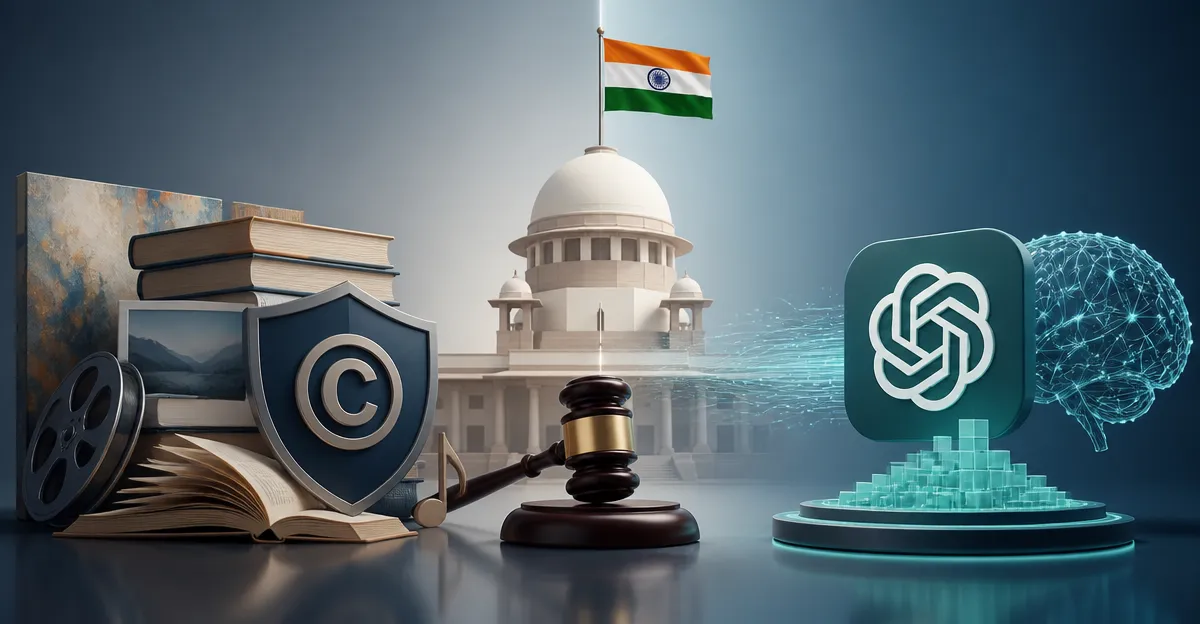
July 24, 2026, (Inside AI) — The Delhi High Court will deliver its verdict today at 2:30 PM on whether OpenAI can be restrained from using copyrighted material to train its large language models (LLMs). This interim injunction, if granted, would mark a pivotal moment in Indian copyright law, directly addressing the boundaries of fair use in AI training.
The ruling stems from a 2024 lawsuit filed by ANI Media Pvt Ltd, a news agency, against OpenAI Inc. and OpenAI OpCo LLC. ANI alleges that OpenAI infringed its copyright by using publicly available content to train ChatGPT, generating verbatim reproductions, and producing hallucinatory responses falsely attributed to ANI. Other media groups, including the Federation of Indian Publishers, Digital News Publishers Association, and Indian Music Industry, have joined as parties, broadening the case’s impact.
Justice Amit Bansal appointed advocate Adarsh Ramanujan and Dr. Arul George Scaria, a law professor at NLSIU, as amici curiae to assist the court. Their input may shape the court’s preliminary observations on fair use—a first for an Indian constitutional court.
OpenAI has mounted a multi-pronged defense. It argues that training occurs outside India, data is stored on foreign servers, and its models do not store data directly. The company likens training to reading a book, not copying it, and notes it has already blocklisted ANI’s domain to prevent future use. OpenAI also claims its models are refined to prevent regurgitation and lack access to original training data after a cut-off date.
This case tests India’s Copyright Act, 1957, which permits fair dealing for research and private study. India’s decision could influence other jurisdictions, especially as ChatGPT’s user base in India has surged to 100 million weekly users, making it the platform’s second-largest market.
The court’s observations may clarify whether scraping publicly available data constitutes infringement or fair use. ANI’s complaint about hallucinatory misattributions adds a reputational dimension, potentially setting a precedent for AI-generated disinformation liability. OpenAI’s reliance on foreign servers raises jurisdictional questions, echoing the NLSIU’s analysis of cross-border AI training.
Globally, similar battles are unfolding. The New York Times sued OpenAI in 2023, and Getty Images targeted Stability AI. India’s ruling may diverge, given its unique legal framework and the government’s push for AI innovation under the IndiaAI mission. The outcome could compel AI developers to license data or adopt technical safeguards like content filtering.
India’s Copyright Crossroads for AI Training
The Delhi High Court’s decision will resonate beyond ANI. If an injunction is granted, it could force OpenAI to halt or modify training practices immediately, impacting its operations in India. Conversely, a denial might embolden other AI firms to use copyrighted data without licensing, intensifying calls for legislative reform. The court’s interim ruling will not resolve the case but will signal judicial thinking on balancing innovation and creators’ rights.
OpenAI’s blocklisting of ANI’s domain suggests a willingness to accommodate, but the broader implications for publishers remain unresolved. The Indian Music Industry’s involvement hints at future disputes over audio and video content. As AI models become more pervasive, the line between inspiration and infringement grows blurrier, and today’s verdict could draw a sharper boundary.