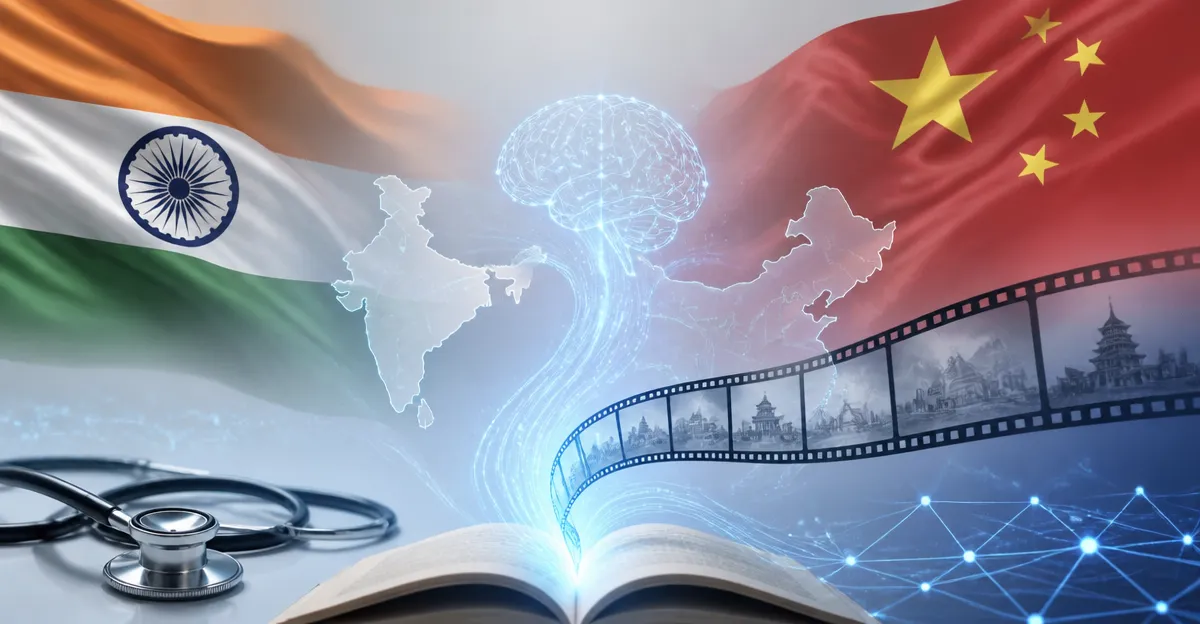
September 30, 2026, (Inside AI) — A senior faculty member at the Indian Institute of Technology (IIT) Bombay has publicly questioned whether India's examination system can survive the arrival of AI-assisted cognition, including futuristic neural implants. The critique, published as a personal essay, argues that surveillance technology is falling behind tools that can store or even implant information inside the human brain.
The central claim is stark. The foundational logic of the exam, which seeks a single definitive answer, has not changed in decades. Meanwhile, students now carry invisible gadgets and soon may use neural implants to assist recall. The writer, an assistant professor at the Ashank Desai Centre for Policy Studies (ADCPS), asks whether physical frisking or advanced detectors can ever keep pace.
This is not a distant hypothetical. Neural implants for cognition are already in early human trials globally. The essay draws on Rabindranath Tagore, the Nobel-winning Indian polymath, who asked why memorising a book without understanding it differs from hiding the book in one's clothes. Tagore's question, written decades ago, now reads as prophecy.
Tagore's Question Now Haunts Every Exam Hall
The professor quotes Tagore directly. "For what else but can we call the filching of a degree by memorising a book without understanding its contents; how is that any better than carrying the book itself into the examination hall, hidden in one's clothes?" (Rabindranath Tagore, writer and education philosopher)
Read: Punjab to Train 160,000 Teachers Under AI Curriculum
That quote anchors a deeper argument. The essay cites John Dewey, the American progressive education pioneer, who warned that a static, cold-storage ideal of knowledge swamps thinking. It also invokes Benjamin Bloom's taxonomy, which ranks learning from simple recall up to creation. Most Indian higher education exams, the professor writes, sit at the lowest rung: remember and recollect.
The technology gap is widening. Hidden earpieces, micro-cameras, and smart wearables already evade naked-eye invigilation. The essay notes that surveillance lags behind storage and assistive devices. Neural implants, which can assist cognition surgically, open what the writer calls a new Pandora's box. The question is not whether technology is desirable, but how a teacher should respond.
The professor admits to uncertainty. "My critical self-examination ends with more questions than answers. Who would help me find answers to seemingly 'nonsensical' questions -- my own old teachers, colleagues, students, parents, employers, the state, or a chatbot?" (assistant professor, ADCPS, IIT Bombay)
Policy has already pointed in a different direction. The National Education Policy 2020 urged moving away from high-stakes exams toward continuous and comprehensive evaluation. The professor calls that translation easier said than done. Continuous evaluation demands smaller class sizes, trained faculty, and reliable digital infrastructure. None of these exist at scale in most Indian institutions.
Inside AI could not independently verify the professor's claims about neural implant availability. However, commercial brain-computer interfaces are advancing. Companies like Neuralink and Synchron have implanted devices in patients for medical purposes. Consumer cognitive implants remain years away, but the trajectory is clear. Exam security based on physical searches will become obsolete.
The essay does not propose a solution. Instead, it asks whether teachers should redesign questions to test understanding, analysis, evaluation, and creativity. That shift would require retraining millions of educators. It would also challenge parents and employers who still treat marks as the primary signal of merit.
Read: As AI Accelerates, Governments Are Increasingly Left Behind
For now, the professor's self-examination stands as a warning. The AI generation will not be stopped by metal detectors. The exam system must change its questions, not just its surveillance.

Sofia spent years studying how machines parse human language before pivoting to cover the systems now rewriting it. She reads technical papers the way others read news and looking for what the numbers are actually saying beneath the headlines.