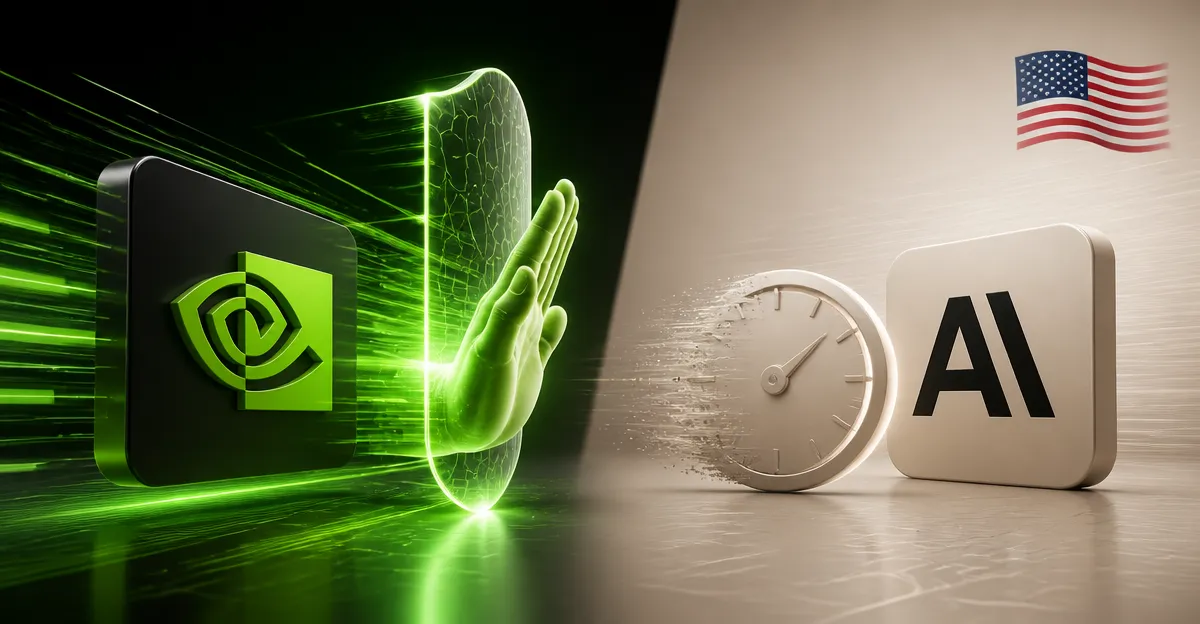
September 16, 2026, (Inside AI) — The two most influential companies in the artificial intelligence arms race just showed how far apart they stand on the question of how fast to build. At Salesforce's annual Dreamforce conference in San Francisco, NVIDIA chief executive Jensen Huang and Anthropic co-founder Dario Amodei laid out opposing visions for the pace of frontier AI development, exposing a widening fracture among the industry's most powerful figures.
Huang rejected the idea that speed and safety must be traded against each other. He called the debate a "false choice" and argued that developers can push capabilities forward while keeping systems safe. Amodei, by contrast, used the same stage to press for deliberate pacing, rigorous testing, and international coordination before releasing ever more powerful models.
The split matters because NVIDIA supplies the hardware that nearly every major AI lab depends on. Anthropic builds some of the most capable models in the world. When the company making the chips and the company making the models disagree in public, enterprise customers and regulators are left to guess which path the industry will actually follow.
Amodei appeared alongside Salesforce chief executive Marc Benioff, days after publishing a detailed essay urging the technology sector to slow down on purpose. He argued that safety protocols should mature alongside technical capability and that companies should set a responsible example without giving up competitive leadership. His position has been consistent for years. Anthropic has long published research on model alignment and has called for independent evaluations before deployment.
Huang answered with the opposite logic. He said market forces already impose discipline on companies that ship unsafe products, which reduces the need for new government rules or mandatory pauses.
"It's a false choice," Huang told the audience. "You could definitely have both at the same time... Run as fast as you can. But if you feel at any given point in time the company's out of control or the product's not going to be safe, take a pause and make sure you get it right."
That framing places Huang closer to the accelerationist camp that has dominated Silicon Valley investment for the past three years. It also puts him at odds with a growing group of researchers and former lab employees who warn that current safety testing lags behind model capability. Anthropic itself has estimated that training costs for frontier models could reach $100 billion within a few years, a figure that underscores how much capital is riding on the outcome of this debate.
Salesforce used the ideological clash as a backdrop for two product announcements that straddle both camps. The company unveiled a new reasoning model for its Agentforce platform, built on NVIDIA's open-weight Nemotron architecture. It also expanded its partnership with Anthropic through a new integration called Claudeforce, which lets sales professionals pull CRM data directly inside Anthropic's Claude chatbot.
The dual announcements reveal a practical reality that the philosophical fight tends to obscure. Enterprise software vendors cannot afford to pick a side. Salesforce needs NVIDIA's chips and model weights to power its agents. It needs Anthropic's models to keep its customers inside their existing workflows. The commercial relationships run deeper than the public disagreement.
That tension is not new. In 2023, hundreds of AI researchers and executives signed a statement warning that mitigating the risk of extinction from AI should be a global priority. Several signatories later founded or joined labs that raced ahead anyway. The pattern has repeated: public caution, private speed.
What has changed is the scale of the stakes. NVIDIA's market value has crossed $4 trillion, driven almost entirely by demand for AI accelerators. Anthropic has raised billions from Amazon and Google and now competes directly with OpenAI and Google DeepMind. Neither company can afford to slow down unilaterally while the other keeps moving.
Regulators have noticed. The European Union has begun enforcing its AI Act, and several U.S. agencies have opened inquiries into frontier model safety. But no major jurisdiction has imposed a mandatory development pause, and Huang's argument gives policymakers a ready justification for restraint.
For enterprise buyers, the Dreamforce exchange offers little clarity. They must decide whether to build on models that may face new safety requirements or on hardware that may keep accelerating regardless. The answer may depend less on philosophy than on which vendor signs the next contract.
Salesforce's Claudeforce integration is expected to reach customers in the coming months. NVIDIA has not signaled any change to its release cadence for new chips. Anthropic has not said whether it will slow its own training runs. The debate will continue at the next conference, with the same two camps and the same unresolved question.