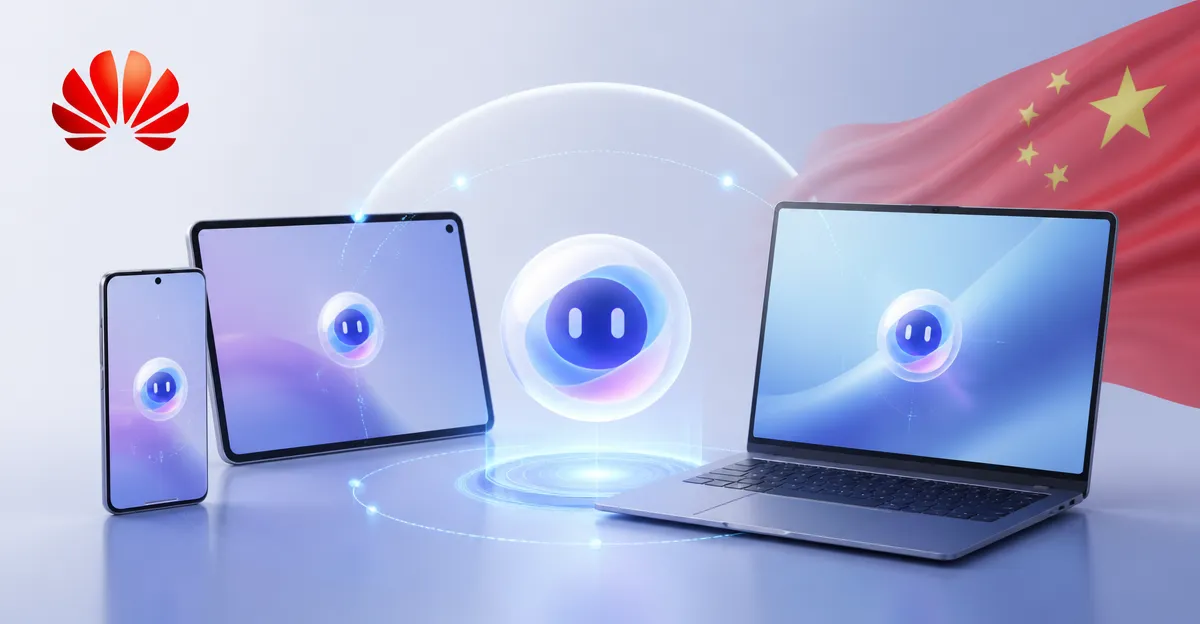
September 16, 2026, (Inside AI) — Huawei has quietly opened beta testing for XiaoYi Work, an AI assistant designed to handle office tasks, coding, and creative work across its HarmonyOS ecosystem of phones, tablets, and PCs. The move signals Huawei's intent to compete in the crowded productivity AI space, but with a twist: the assistant can delegate tasks between devices, including from a phone to a cloud or local PC.
The beta launch, first spotted by the Chinese tech outlet IT Home, positions XiaoYi Work as more than a simple chatbot. According to the company's description, the assistant can break a goal into steps, call tools, show progress, and request user review at key points. Users can assign tasks from a phone to a cloud or local PC, monitor execution, and receive synchronized files and results.
That device-to-device handoff is the most technically ambitious part of the announcement. Most AI assistants today operate within a single device or app. Huawei's approach treats the phone as a remote control for heavier compute on a PC, a strategy that could appeal to professionals who want to start a task on the go and finish it at a desk.
The beta is limited to HarmonyOS devices, which means it will not run on Android or iOS. Huawei has been building HarmonyOS as a standalone ecosystem since U.S. sanctions cut off its access to Google Mobile Services in 2019. The company has since invested heavily in native HarmonyOS apps and cross-device features like Super Device, which lets phones, tablets, and PCs share screens and files.
XiaoYi Work appears to be an extension of that strategy. By keeping the assistant inside HarmonyOS, Huawei avoids dependence on foreign cloud providers and can optimize performance across its own hardware. The company has not disclosed which large language model powers the assistant or whether it runs locally, in the cloud, or both.
That silence is notable. Competitors like Microsoft, Google, and OpenAI have faced scrutiny over where user data goes and how models are trained. Huawei's lack of detail may raise similar questions among enterprise buyers, especially in regulated industries.
The beta also arrives as Huawei faces renewed pressure in the global AI race. The company's Ascend AI chips are seen as a domestic alternative to Nvidia's GPUs, but U.S. export controls have limited its access to advanced manufacturing tools. A software assistant like XiaoYi Work could help Huawei differentiate its hardware without relying on cutting-edge silicon.
Still, the productivity AI market is brutal. Microsoft's Copilot is bundled with Office and Windows. Google's Gemini is woven into Workspace. Apple is integrating Apple Intelligence across its devices. Huawei's advantage is its control over both hardware and software, but its disadvantage is a smaller user base outside China.
Read: Tencent Makes WorkBuddy AI Agent a Top Strategic Priority, Ramping Up Ads and Resources
The beta test will likely focus on Chinese users first. Huawei has not announced a global release date or pricing. The company also has not said whether XiaoYi Work will be free, subscription-based, or bundled with hardware purchases.
For now, the beta is a signal. Huawei wants to show it can build agentic AI that works across devices, not just inside a single app. Whether that convinces users to stay inside HarmonyOS is another question.
The company's history offers some clues. Huawei has repeatedly turned constraints into features. When Google services were cut off, it built its own app store and maps. When chip supplies were restricted, it designed its own processors. XiaoYi Work follows that pattern: a software play that makes its hardware more valuable.
But software alone rarely wins loyalty. Users choose ecosystems for apps, services, and familiarity. Huawei's challenge is to make XiaoYi Work useful enough that people overlook what they lose by leaving Android or Windows.
The beta test will provide the first real data on whether that bet pays off. Until then, the assistant remains a promise: a glimpse of how Huawei imagines the future of work, one where your phone, tablet, and PC act as a single team.