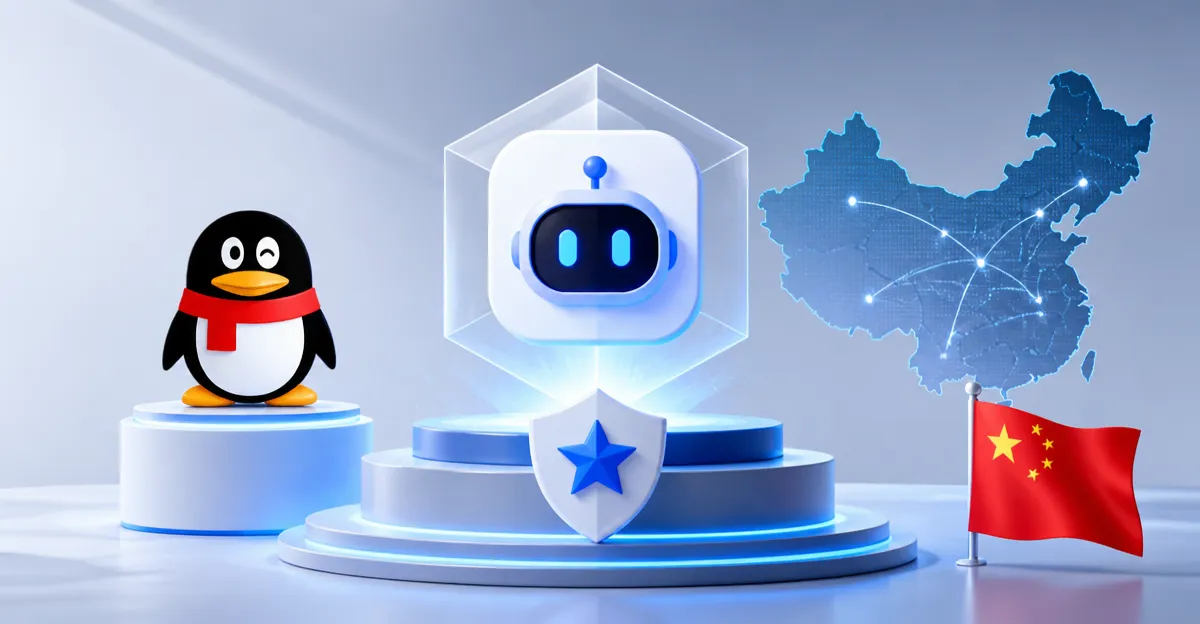
August 10, 2026, (Inside AI) — Tencent has elevated its desktop AI office agent WorkBuddy to a top strategic priority, pouring increased advertising, computing power, and organizational resources into the product, according to a report from IT Times.
The campaign has already materialized in high-visibility outdoor ads across Beijing and Shenzhen, alongside promotional placements inside major mobile apps. The push signals that Tencent sees WorkBuddy as more than a productivity tool. It is being positioned as a potential platform anchor.
WorkBuddy is an AI agent that operates on desktop environments, capable of breaking down complex instructions into multi-step workflows. It interacts with local files and delivers completed results, moving beyond simple chatbot interactions toward autonomous task execution.
Sources within Tencent’s Cloud and Smart Industries Group (CSIG) told IT Times that the product is being treated internally as a strategic bet on the scale of QQ and WeChat. That comparison is significant. QQ and WeChat are the twin pillars of Tencent’s consumer internet dominance, with WeChat alone serving over 1.3 billion monthly active users.
By framing WorkBuddy as a potential third pillar, Tencent is signaling a belief that AI agents will become as foundational as messaging and social networking. This is not a minor feature update. It is an attempt to own the interface layer where knowledge work gets done.
The resource allocation goes beyond marketing. Tencent is reportedly dedicating significant computing infrastructure to WorkBuddy, a non-trivial commitment given the ongoing global GPU shortage and the company’s need to power its own large language models. Organizational resources are also being shifted, suggesting dedicated teams and executive attention.
WorkBuddy enters a crowded but fragmented market. Microsoft’s Copilot is deeply integrated into Office 365, while Google’s Duet AI targets Workspace users. Startups like Adept and Imbue are building general-purpose AI agents, and OpenAI’s Operator aims to control desktop environments. Tencent’s advantage lies in its existing enterprise relationships through WeCom and Tencent Cloud, plus a massive user base that could be cross-sold.
Yet the agent space remains unproven at scale. Reliability, security, and user trust are open questions. Allowing an AI to manipulate local files and execute multi-step actions requires a level of confidence that most products have not yet earned. Tencent’s brand and distribution can drive adoption, but retention will depend on execution quality.
The outdoor advertising campaign is also notable. Beijing and Shenzhen are China’s political and tech capitals, respectively. Placing WorkBuddy ads there targets both government officials and industry decision-makers, a dual-pronged approach that hints at enterprise and public-sector ambitions.
Tencent has not publicly disclosed user numbers or revenue targets for WorkBuddy. The company’s last major AI product push was the Hunyuan large language model, which it has integrated across cloud services and WeChat. WorkBuddy appears to be the next phase: moving from model-as-a-service to agent-as-a-platform.
If successful, WorkBuddy could redefine how Chinese enterprises approach automation, shifting from rule-based RPA to AI-driven autonomous agents. But the path from strategic priority to market dominance is littered with ambitious products that never crossed the chasm. Tencent’s willingness to invest heavily suggests it believes the agent era is now.