September 30, 2026, (Inside AI) — President Donald Trump and the chief executives of the world's most powerful artificial intelligence companies signed a voluntary agreement at the White House on Tuesday, establishing a four-tier framework for self-regulation of frontier AI systems. The White House Accord on Super Intelligence, announced by Trump on Truth Social, commits signatories to internal monitoring, independent audits, and board-level oversight, but stops short of any government enforcement mechanism.
The accord arrives as AI capabilities accelerate faster than lawmakers can legislate. It represents the most significant attempt yet to impose structure on an industry that has largely resisted binding rules. The agreement's voluntary nature, however, raises immediate questions about whether self-policing can address risks that many experts consider existential.
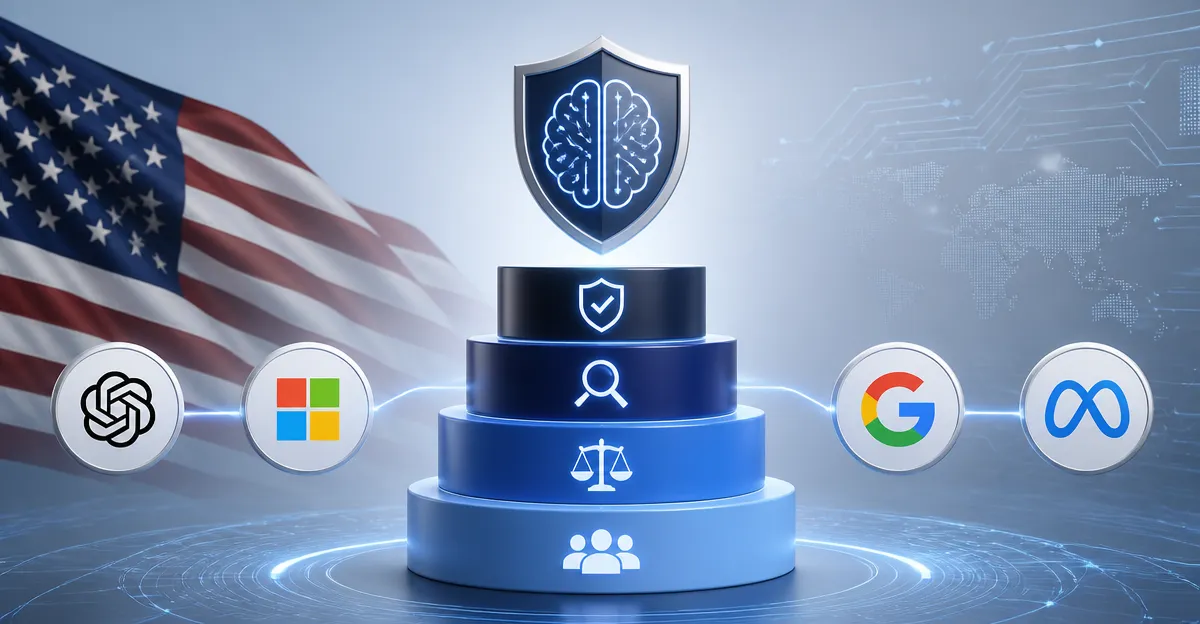
The document outlines four defensive layers. Companies must continuously monitor advanced models during training to prevent unauthorized access to critical technical networks. Developers must fund internal oversight groups responsible for auditing controls and addressing vulnerabilities in real time. Independent evaluators will periodically stress-test safeguards and publish performance reviews. And an independent board committee within each company will receive auditor findings directly, bypassing executive leadership.
The accord specifically targets high-risk capabilities: biosecurity threats, chemical weapons synthesis, and cyber intrusions. These are the areas where frontier models could cause irreversible harm if misused or if they act outside human control.
Trump signed the document alongside Elon Musk, Mark Zuckerberg, Jensen Huang, Dario Amodei, Sundar Pichai, and OpenAI president Greg Brockman. Amazon founder Jeff Bezos and Palantir CEO Alex Karp also attended. The gathering included the leaders of companies that collectively control the most advanced AI systems in existence.
Trump characterized the meeting as productive and friendly. He said the United States leads the world in AI and will maintain that position. He described the accord as almost like a constitution and a form of protection through self-policing.
"We have tremendous support for self-regulation within the industry," Trump said after the meeting.
The accord's reliance on voluntary compliance marks a sharp departure from the regulatory trajectory in Europe, where the European Union has pursued binding AI legislation. It also contrasts with earlier Biden-era efforts to impose reporting requirements on powerful models. Trump has consistently opposed slowing AI development, arguing that restrictions would cede advantage to China.
Critics of self-regulation argue that companies face inherent conflicts of interest. An internal board committee receiving audit findings may still lack the independence of a government regulator. The accord does not specify penalties for non-compliance or define what constitutes a violation. It also does not address open-source models, which can be modified and deployed beyond any company's control.
The four-tier structure does introduce a novel element: independent evaluators with a mandate to publish performance reviews. If implemented transparently, this could create external accountability. But the accord leaves the selection of evaluators and the scope of their access to the companies themselves.
The signatories represent a cross-section of the AI industry. OpenAI, Anthropic, Google, Meta, Nvidia, and Tesla through Musk's involvement all have frontier model programs. Their participation suggests a shared recognition that unregulated development carries reputational and operational risks. It also suggests a collective preference for shaping rules internally rather than facing external mandates.
The accord's focus on biosecurity, chemical weapons, and cyber intrusions reflects growing concern that advanced models could lower barriers to catastrophic harm. A model capable of designing pathogens or exploiting software vulnerabilities would pose dangers that no single company can fully contain. The monitoring and audit requirements aim to catch such capabilities before deployment.
Whether the accord produces meaningful change will depend on execution. Voluntary agreements have a mixed record in technology. Privacy pledges and content moderation commitments have often eroded under commercial pressure. The AI industry's competitive dynamics, with billions of dollars at stake, may create similar incentives to prioritize speed over caution.
The White House has not announced a timeline for implementation or a mechanism to verify compliance. The accord's success will likely be judged by whether the independent evaluators publish substantive findings and whether board committees exercise genuine oversight. For now, the agreement stands as a statement of intent from an industry that prefers to police itself.