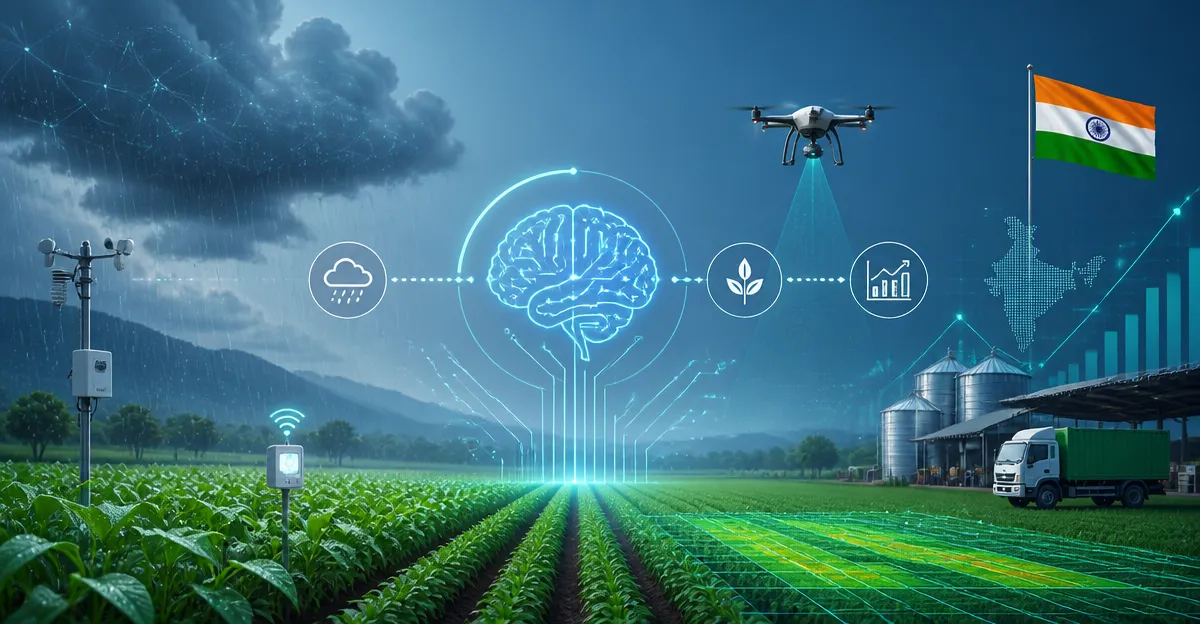
September 29, 2026, (Inside AI) — India's Union Budget 2026-27 has proposed Bharat-VISTAAR (Virtually Integrated System to Access Agricultural Resources), a multilingual AI platform designed to integrate AgriStack portals with the Indian Council of Agricultural Research (ICAR). The tool aims to deliver customised advisory support on soil types, climate zones, and crop varieties, and is built for deployment in low-connectivity rural areas through mobile phones and farm equipment.
The proposal marks a significant escalation in India's push to embed artificial intelligence into its agricultural policy architecture. It also raises a central question: can AI-driven systems meaningfully serve a sector where more than 86% of farmers hold very small landholdings?
According to a survey by the National Bank for Agriculture and Rural Development (NABARD), average landholding size fell from 1.08 hectares in 2016-17 to 0.74 hectares in 2021-22, a reduction of about 31% in just five years. For farmers operating at such scales, the benefits of AI depend on affordability, accessibility, and local relevance.
Bharat-VISTAAR builds on India's existing digital agriculture infrastructure. In 2024, the country launched the Digital Agriculture Mission as an umbrella scheme with two components: Agri Stack and the Krishi Decision Support System. Agri Stack envisages a farmer-centric Digital Public Infrastructure (DPI), including a farmers' registry with a unique farmer ID, geo-referenced village maps integrated with land records, and a Crop Sown Registry with digital seasonal crop sowing data.
Read: Indian Railways Deploys AI System to Inspect Freight Wagon Security
The Krishi Decision Support System monitors crops, soil, weather, and water resources in real time using geospatial data. The mission also aims to prepare detailed soil profile maps at a scale of 1:10,000 covering about 142 million hectares of agricultural land.
Other AI-driven initiatives include the National Pest Surveillance System (2024) for early detection of pest infestations and crop diseases, and Kisan e-Mitra (2023), an AI-powered chatbot for queries about government schemes.
Weather forecasting represents one of the most consequential applications. In India, only 55% of the net sown area is covered by irrigation, leaving the rest rain-fed and vulnerable to changing weather patterns. Traditional forecasting models required sophisticated infrastructure and high technological costs.
New-age AI-powered models such as Pangu-Weather and GraphCast can provide faster, accurate, localised forecasts at much lower costs. Once trained, these models can run on laptops instead of supercomputers.
India has already begun exploring such models. In the Kharif season of 2025, it conducted a pilot test of an AI-based model for local monsoon-onset forecasts across 13 states. Forecast information was communicated to farmers through SMS, and 31-52% of farmers adjusted their planting decisions accordingly.
The Food and Agriculture Organisation (FAO) is developing the world's first domain-specific foundational AI model based on its data and global expertise. The model is designed to provide real-time policy guidance, agronomic advice, and climate change-related strategies.
Precision farming is another area where AI is making inroads. AI-enabled surveillance systems, including drones, are used for monitoring crop health, identifying diseases, pests, or nutrient deficiencies. Satellite data, GPS, sensors, and drones generate high-resolution, real-time data that helps reduce waste, optimise resource use, and improve productivity.
Read: India Pilots AI Mental Health Helpline for BRICS Nations
Soil health monitoring is also being transformed. Conventional soil analysis required lab tests for nitrogen, phosphorus, potassium (NPK), and pH, or manual field-based classification. These methods are time and labour-intensive and require expert knowledge. AI and machine-learning tools now make it possible to monitor soil and crop health parameters with better accuracy in response to real-time environmental conditions.
For yield estimation, India is implementing the YES-TECH initiative (Yield Estimation System based on Technology) at the Gram Panchayat level for yield estimation and claim settlement under Pradhan Mantri Fasal Bima Yojana (PMFBY). It is used across 12 states for paddy, wheat, and soybean crops. Another initiative, FASAL (Forecasting Agricultural output using Space, Agro-meteorology and Land-based observations), is being implemented across 20 states for pre-harvest production forecasts of 11 major crops.
Remote sensing datasets such as high-resolution Sentinel satellite images are frequently used in yield prediction. Sentinel-2, for example, provides imagery at spatial resolutions of approximately 10 meters and a revisit time of about five days, enabling regular monitoring of crop conditions.
AI-led data-driven decision-support systems also help in supply chain optimisation. By offering information on production, price, demand, and logistics, such systems can support better post-harvest management and ensure better prices for farm produce.
Despite the promise, adoption faces hurdles. The digital divide remains a significant barrier. More than 86% of Indian farmers have very small landholdings. Historically, India's traditional agriculture lacked actionable data such as localised weather forecasts, crop types, and soil requirements. AI-led systems promise to reduce some of these gaps.
However, given that nearly 46% of the population depends on agriculture and the economic condition of the majority of farmers, ensuring that AI services remain available on affordable public platforms is important. Agricultural AI, therefore, needs to be treated as a public good, with efforts invested towards ensuring that the benefits of innovation reach farmers in distant villages.
As the global population is projected to reach 9.7 billion by 2050, meeting future food needs will require current global agri-production to grow by up to 70%. For India, the challenge is compounded by increasing weather uncertainty, extreme climatic events, declining farm sizes, and depleting groundwater.
Agricultural AI has the potential to make Indian agriculture more productive and climate-resilient. If implemented rightly with large-scale adoption, it can help realise the long-held dream of doubling farmers' income.