September 25, 2026, (Inside AI) — India has launched a pilot program to build a 24/7 mental health helpline and AI-driven support network for BRICS nations, aiming to address severe shortages of mental health professionals across member states. The initiative, which combines artificial intelligence with community-based counselling, was unveiled this week and marks one of the first coordinated efforts to use technology to scale mental health care across the bloc.
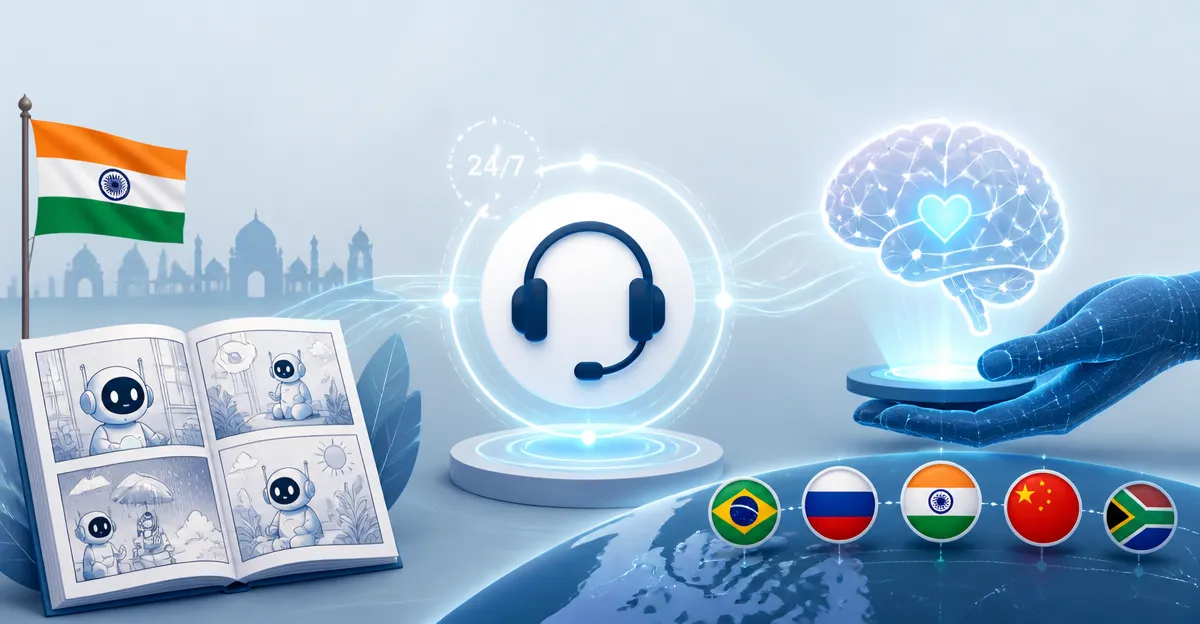
The program will deploy AI chatbots for initial triage and support, alongside a round-the-clock helpline staffed by trained counsellors. It also includes culturally adapted educational materials, such as manga comics, to reduce stigma in countries like China where mental illness often carries social shame. The pilot will initially run in India, China, Brazil, and South Africa, with plans to expand to other BRICS members.
Mental health systems in BRICS countries face critical gaps. India has just 0.3 psychiatrists per 100,000 people, according to World Health Organization data, far below the global average. China has about 2.2 psychiatrists per 100,000, but they are concentrated in cities. Brazil and South Africa report similar disparities. The COVID-19 pandemic worsened these shortages, with anxiety and depression cases rising by 25% globally in the first year alone.
India's pilot aims to fill that gap with technology. The AI component, developed by a consortium of Indian tech firms and academic institutions, will use natural language processing to offer immediate coping strategies and flag high-risk users for human follow-up. Privacy advocates have raised concerns about data security and algorithmic bias, but organizers say the system will comply with each country's data protection laws and include human oversight.
Read: OpenAI Academy Launches Community Trainer Program After 4 Million Engagements
The initiative also borrows from China's successful use of educational manga to combat stigma. In one comic, a doctor explains mental illness through a simple metaphor: a mental health condition, like a broken leg, may require treatment and support. The story follows a 17-year-old girl, Xiaoyu, whose grades collapse under severe anxiety and depression. Afraid that a diagnosis could bring shame to her family and hurt her university prospects, she suffers in silence. Her mother dismisses her exhaustion as laziness. Only when an empathetic classmate helps her reach a community counselling clinic does Xiaoyu begin to understand that mental illness is not a failure of character. By the end, she has returned to school with tools to manage her condition and is helping another struggling student seek support.
"Stigma remains the biggest barrier to care in many BRICS countries," said Dr. Pratibha Sharma, a consultant psychiatrist advising the pilot. "By combining AI with culturally resonant storytelling, we can reach people who would never walk into a clinic."
The helpline will operate in multiple languages, including Hindi, Mandarin, Portuguese, and English. It will be staffed by counsellors trained in psychological first aid and crisis intervention. AI will handle initial queries, but any user expressing suicidal thoughts will be immediately routed to a human. The system will also collect anonymized data to track trends and improve responses.
Critics question whether AI can truly understand the nuances of mental distress. "Chatbots can offer basic support, but they cannot replace the therapeutic alliance," said Dr. Emily Carter, a clinical psychologist at the University of Cape Town who is not involved in the pilot. "There is a risk of over-reliance on technology when what many people need is sustained human connection."
India's government has allocated $5 million for the first year of the pilot, with additional funding expected from BRICS partners. The program will be evaluated after 12 months based on user engagement, crisis response times, and stigma reduction metrics. If successful, it could become a model for other developing regions.
The initiative reflects a broader trend of using AI to address global health disparities. Similar projects are underway in Africa and Southeast Asia, though few involve cross-border collaboration on this scale. BRICS nations account for over 40% of the world's population, making their collective action on mental health potentially transformative.
Read: AI in Leadership Communication: Balancing Efficiency and Authenticity
As the pilot launches, organizers emphasize that technology is a tool, not a cure. The goal is to build a network that combines AI efficiency with human empathy, ensuring that people like Xiaoyu receive the support they need before it is too late.