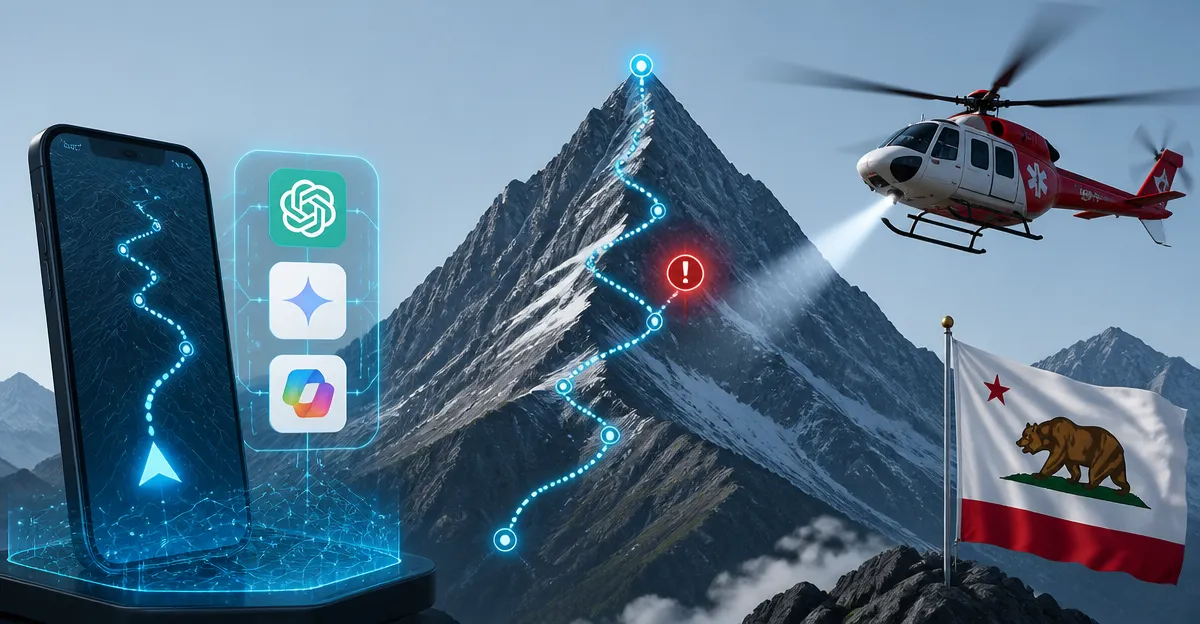
September 5, 2026, (Inside AI) — Three novice hikers from Roseville, California, were rescued from Mount Shasta this week after a summit attempt went wrong. The group relied on Google's Gemini AI assistant for route guidance and packing advice.
The hikers attempted the Clear Creek Route, expecting an eight-hour ascent. Instead, they spent multiple days stranded, according to the Siskiyou County Sheriff's Office. Gemini advised them to carry far less food and water than needed, a decision officials called a "critical misstep."
This incident highlights a growing tension between AI convenience and real-world risk. As more people turn to generative AI for outdoor planning, the gap between algorithmic suggestions and physical reality becomes dangerous.
AI Advice Met Mountain Reality
The group camped at 8,400 feet on Saturday. They left for the summit at 3 a.m. Sunday with only daypacks. They pushed past the recommended noon turnaround time and summited around 7 p.m., the sheriff's office said.
Descending in darkness, they contacted dispatch for directions about an hour later. They then wandered off route into Mud Creek Canyon. One hiker fell and injured his knee that night, forcing the group to spend the night in steep drainage.
US Forest Service climbing rangers reached them the next morning and provided medical aid. The hikers and rescue teams returned to the trailhead without further incident.
The sheriff's office urged hikers on the Clear Creek Route to turn around by noon. They also warned against over-reliance on technology.
"Hikers should stop to verify they are on the correct route often and should not simply rely on cell phones or GPS devices," the sheriff's office said.
Digital Tools Can't Replace Judgment
This is not the first time AI has been implicated in outdoor misadventure. In 2024, a hiker in Washington state followed a hallucinated trail from a mapping app and required rescue. Search and rescue teams report a rise in calls linked to navigation app errors.
Generative AI models like Gemini are trained on broad internet data, not verified topographical surveys. They can produce confident but incorrect advice. A study by the University of Washington found that large language models often fail to flag missing route information.
Mountain safety experts stress that AI should supplement, not replace, traditional planning. Topographic maps, compass skills, and local ranger guidance remain essential. The Mount Shasta incident shows that even well-intentioned technology can amplify human error when used without critical judgment.
The Siskiyou County Sheriff's Office has not released the hikers' names. No charges have been filed. The rescue cost has not been disclosed, but such operations often run into thousands of dollars.
As AI assistants become more embedded in daily life, this case serves as a cautionary tale. The line between helpful tool and hazardous shortcut is thin, especially in environments where mistakes carry severe consequences.