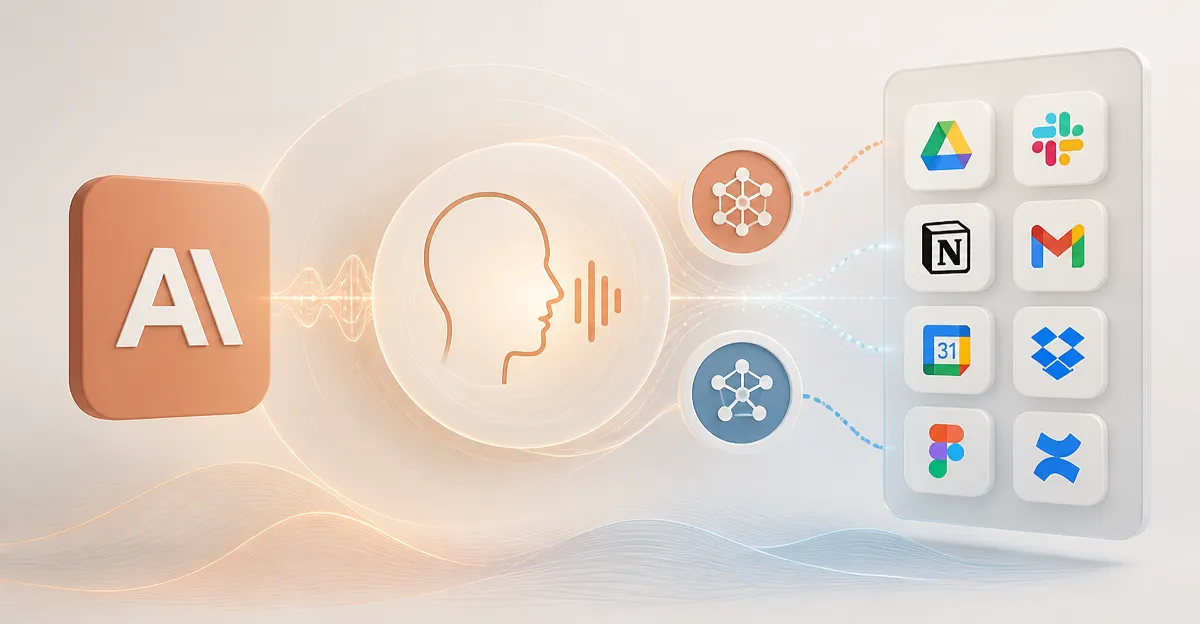
July 24, 2026, (Inside AI) — Anthropic has extended Claude's Voice Mode to its most advanced models, Opus and Sonnet, while also granting the assistant access to connected apps like Gmail and Slack.
The move, announced today, lets users hold spoken conversations with Claude's flagship reasoning and coding capabilities. It also marks a shift from a standalone chatbot to a cross-platform productivity tool that can search emails, review Slack threads, and execute work tasks through natural voice commands.
Voice Mode was previously limited to a single model. Now users can tap Opus for complex analysis or Sonnet for faster responses—all through voice. Anthropic says the experience is designed to feel more conversational, allowing follow-up questions and topic switches without repeating context.
The deeper app integrations are the more consequential upgrade. By connecting to Gmail and Slack, Claude can retrieve information and act on it. For example, a user could ask Claude to find a specific email thread and summarize it, then draft a reply—all hands-free. This capability pushes Claude beyond simple Q&A into agentic territory, where it performs multi-step tasks across services.
Anthropic is framing this as a direct challenge to OpenAI's ChatGPT and Google's Gemini, both of which have been aggressively adding voice and app integration features. The competitive pressure is intensifying as AI assistants evolve from text-based interfaces to multimodal, always-available companions.
The update arrives just months after AMD committed up to $5 billion to Anthropic, with the AI startup planning to purchase up to 2 GW of chips. That capital infusion is likely fueling the infrastructure needed to support real-time voice processing at scale.
From Text to Voice: The Technical Leap
Bringing Opus and Sonnet to Voice Mode isn't just a toggle switch. Voice interaction requires low-latency speech recognition, natural-sounding synthesis, and the ability to maintain conversational context. Anthropic hasn't disclosed the underlying architecture, but the move suggests advances in streaming model inference and integration with speech components.
Opus, Anthropic's most capable model, excels at complex reasoning and code generation. Sonnet balances speed and intelligence. Making both available via voice means users can choose the right tool for the task—perhaps Opus for debugging code aloud or Sonnet for quick email triage.
The app integration layer likely relies on OAuth-based connections, with Claude acting as an orchestrator. Anthropic must navigate the security and privacy implications of letting an AI read and act on personal communications. The company hasn't detailed its security model, but the feature likely requires explicit user permission per app.
Agentic Assistants Collide
Anthropic's move mirrors the industry's rush toward agentic AI—systems that don't just answer questions but take action. OpenAI's ChatGPT can browse the web and interact with plugins. Google's Gemini taps into Workspace apps. Apple's Siri is being rebuilt with App Intents. The battleground is shifting from model quality to ecosystem utility.
Claude's advantage may be its constitutional AI approach, which emphasizes safety and alignment. If users trust Claude more with their email and messages, that could be a differentiator. But Anthropic will need to prove that trust is warranted when the assistant can read and write on their behalf.
The update is rolling out now to Claude's premium users. Anthropic hasn't specified whether free tiers will get access, but the compute costs of running Opus over voice likely make it a paid-only feature for now.
As voice becomes the default interface for AI, the assistants that win will be those that seamlessly blend into daily workflows. Anthropic's latest move shows it understands that race—and is sprinting to keep up.