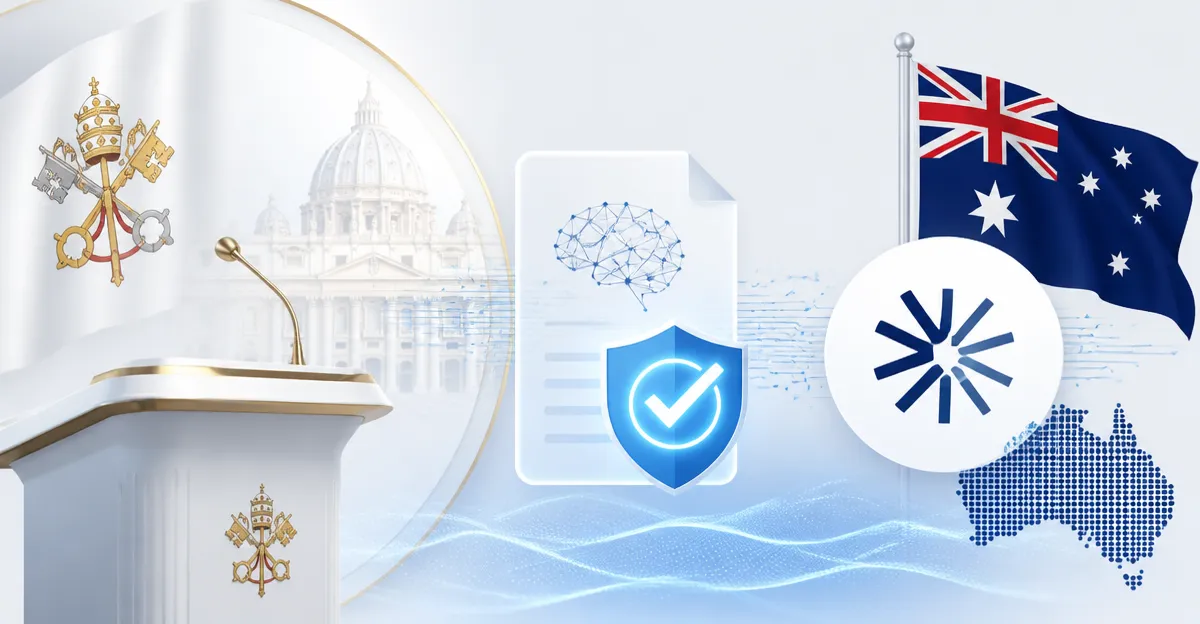
July 21, 2026, (Inside AI) — A collection of speeches and writings by Pope Leo XIV has been officially certified as human-authored by an Australian AI detection company, just weeks after the pontiff issued a stark warning about artificial intelligence.
The certification was carried out by Proudly Human, a firm led by Australia’s former chief scientist, Dr Alan Finkel. The company reviewed the collection, titled Maps of Hope, in collaboration with the publisher, the Australian Catholic University, and Vatican cardinals.
This move comes less than two months after Pope Leo XIV declared AI the greatest threat to humanity. In his first encyclical, Magnifica Humanitas, published in May, he cautioned that AI must be prevented “from dominating humanity” and should remain “human-friendly,” accessible to all, and open to debate.
Certifying the Pontiff’s Pen
Finkel said he had a “great deal of confidence” that Leo’s speeches were human-written. Within a day, Proudly Human certified Maps of Hope as entirely human-created. The process requires authors or their representatives to undergo an ID check and sign a declaration that AI was not used for drafting sentences or paragraphs.
Proudly Human then deploys a suite of AI detection tools. Finkel explained: “We use a suite of four or five of them and our own averaging algorithm, and we test that suite every night to make sure that they’re really continuously fit for purpose.”
He added: “In this case, the book came through, as you would expect, is basically purely human.”
The company’s terms state that certifications can be refused or revoked if authorship is misrepresented. Finkel sees the trust mark as a stopgap where government regulation lags, giving readers a way to know if content is human-made.
“They deserve to know. I actually think it’s a fundamental right [for] human beings have,” he said, stressing its importance for religious figures. “If you’re sitting in a church and you’re expecting that that is the genuine expertise, religious wisdom, of the priest who’s delivering the sermon.”
Beyond the Vatican Walls
Prof Zlato Skrbis, president of the Australian Catholic University, said in a statement that with so much content generated rapidly, it’s valuable to “say with confidence that a work is a product of human reflection and judgment.”
The certification taps into growing demand for provenance tools as AI-generated text floods the internet. Unlike academic plagiarism checkers, Proudly Human’s approach combines multiple detectors with an averaging algorithm—a method that aims to reduce false positives, though experts note no tool is infallible.
Critics argue that such certifications could create a two-tier system where only those who can pay for verification get the “human” stamp. Others question whether detection tools can keep pace with evolving language models. Still, the Vatican’s embrace of the technology signals a pragmatic step toward transparency in an era of deepfakes and synthetic media.
Finkel’s broader mission is to preserve what he calls the heart of human interaction: “The heart of what it is to be human is to engage with other people and to exchange ideas and exchange creative ideas.”
As AI regulation remains fragmented globally, voluntary certification schemes like Proudly Human’s may become a default standard—at least until lawmakers catch up. For now, the Pope’s words carry a double seal: divine inspiration and a digital badge of human origin.