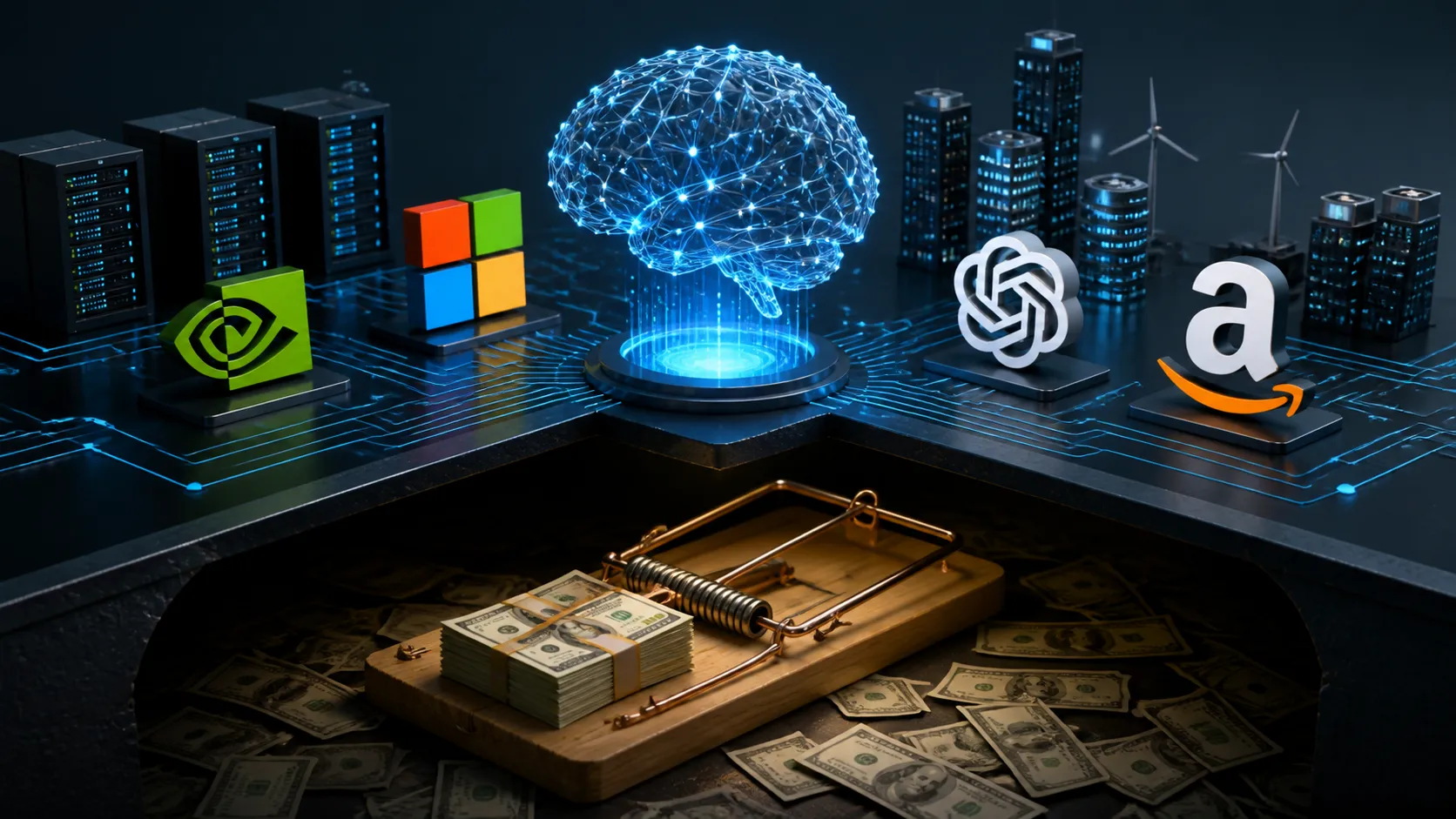
June 19, 2026, (Inside AI) — The AI boom has birthed a modern bezzle—an inventory of undiscovered financial mischief—echoing patterns from past manias. Coined by economist John Kenneth Galbraith in “The Great Crash 1929,” the bezzle thrives when trust and money flow freely. Today, AI enthusiasm is masking accounting tricks, off-balance-sheet risks, and circular funding that could unwind painfully.
The Bezzle’s New Clothes in Tech Finance
Galbraith’s bezzle grows in good times, and AI’s golden era is no exception. Companies are overstating earnings and hiding costs. Vendor-investing has replaced old vendor financing: Microsoft backed OpenAI, which then bought Microsoft cloud services. Nvidia owns over 10% of CoreWeave, a top GPU customer. When OpenAI raised $110 billion in February, $50 billion came from Amazon and $30 billion from Nvidia, with commitments to use their services.
Unrealized gains on AI stakes are inflating profits. In Q1, over half of Alphabet and Amazon’s “other income” came from marking up unlisted investments like OpenAI and Anthropic. Related-party deals are rampant: Cerebras Systems earned most revenue from Abu Dhabi’s G42, a former shareholder. SpaceX acquired xAI at a $250 billion valuation, while Google pays SpaceX nearly $1 billion monthly for compute capacity.
Depreciation Games and Hidden Liabilities
Hyperscalers have stretched GPU depreciation from 3 years to 5–6 years. Investor Michael Burry claims this inflates profits, though defenders say chips can be reused profitably after AI training. Data centers take years to build, and stockpiled GPUs sit as “construction in progress” without depreciation. At end-2025, Alphabet, Amazon, Meta, and Oracle held nearly $220 billion in such assets.
Off-balance-sheet liabilities are ballooning. Broadcom launched a $35 billion special purpose vehicle for AI compute, backed by Apollo and Blackstone. Meta’s $27 billion Hyperion data center uses a variable interest entity from Blue Owl, keeping debt off its books. Morgan Stanley analysts estimate $1.8 trillion in AI-related liabilities are hidden, including $1 trillion in purchase commitments and $800 billion in lease commitments. The International Monetary Fund has flagged these risks.
Cash Burn and the Coming Reckoning
Core AI firms are bleeding cash. xAI’s costs were triple its sales in Q1. OpenAI projected burning $25 billion this year, per The Information. Anthropic may post positive adjusted operating profit but still burn cash. Hyperscalers’ free cash flow could vanish by year-end, says Gerard Minack of Minack Advisors. Alphabet is raising debt and equity; Nvidia launched a $25 billion bond despite $72 billion in cash.
Galbraith warned that in depression, the bezzle is exposed. Audits turn meticulous, and trust evaporates. The AI revolution has yet to face its moment of reckoning, but history suggests it will.