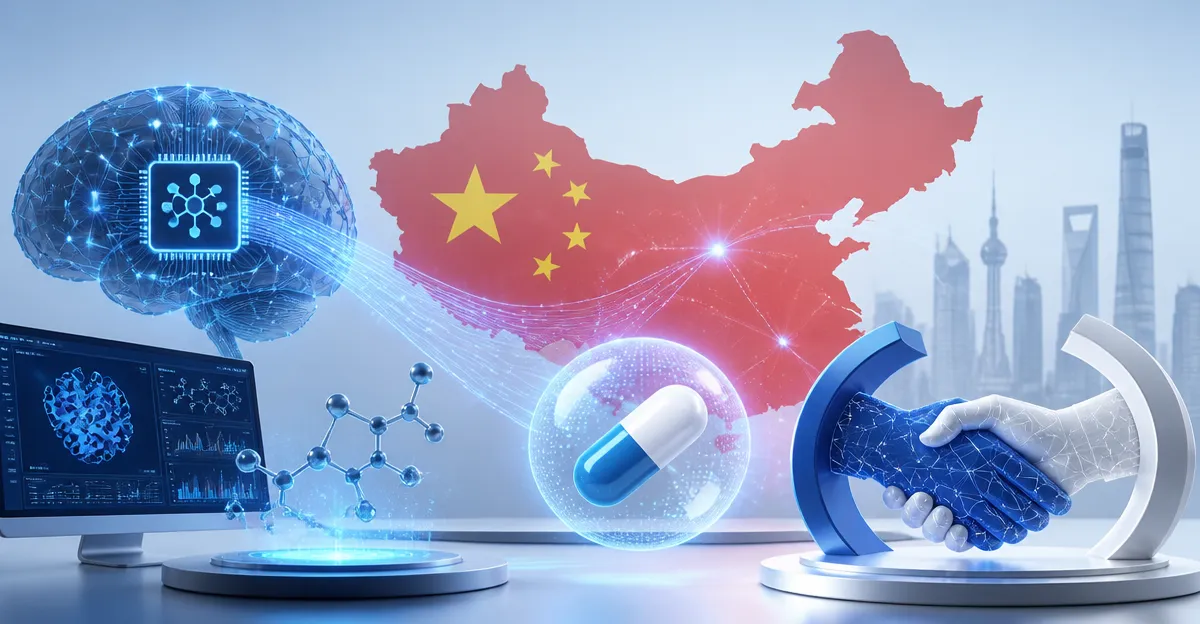
July 13, 2026, (Inside AI) — China’s pharmaceutical sector is accelerating a strategic pivot toward artificial intelligence, aiming to fuel the next generation of blockbuster drug deals after cross-border transactions hit a record $110 billion in the first half of 2026.
The country now accounts for roughly 30% of all new therapies in global development, ranking second worldwide, according to Lan Gongtao, deputy director general of the Department of Drug Registration at the National Medical Products Administration. Speaking at a weekend forum, Lan said China’s industry has reached the top tier in innovation efficiency.
By June 30, 81 deals were sealed, equaling about 80% of last year’s full total, state media reported Monday. The agreements spanned 10 therapeutic areas—oncology, metabolic diseases, immunology, neurology—with buyers from 20 countries, led by the US, UK, France, and Italy.
The shift toward AI-driven drug discovery is not just aspirational. On July 2, CSPC Pharmaceutical Group and AstraZeneca announced a collaboration using CSPC’s proprietary AI molecular design platform to co-develop small nucleic acid drug candidates for two targets. The deal signals how Chinese firms are leveraging homegrown AI to attract global partners.
Read: Bristol Myers Squibb Buys Nvidia’s Latest AI Supercomputer for Drug Research
Industry analysts note that China’s AI drug discovery sector has matured rapidly, buoyed by vast biomedical data, government support, and a growing pool of AI talent. Platforms like CSPC’s are designed to slash early-stage development timelines by predicting molecular interactions and optimizing candidates in silico.
Yet the pivot raises questions about data quality and regulatory alignment. While China’s AI models are trained on extensive patient datasets, international partners often demand rigorous validation against diverse populations. The CSPC-AstraZeneca tie-up may serve as a litmus test for whether AI-discovered molecules can smoothly transition through global clinical trials.
Competing viewpoints emerge. Some experts argue that AI’s real value lies in repurposing failed compounds or identifying novel targets, not just speeding up conventional pipelines. Others caution that the hype around AI could inflate deal valuations without proportional clinical success, echoing earlier biotech bubbles.
Historically, China’s pharma ascent was built on me-too drugs and manufacturing scale. The pivot to AI-driven innovation mirrors a broader national strategy to dominate high-tech frontiers. In 2025, China’s AI drug discovery market was valued at $1.3 billion, with projections to triple by 2030, per a recent Deloitte report.
From Data to Deals: The AI Advantage
At the core of this shift are platforms that integrate multi-omics data, real-world evidence, and deep learning to predict drug-target interactions. CSPC’s platform, for instance, uses generative AI to design small nucleic acid molecules with enhanced stability and delivery profiles—a notoriously difficult class of drugs.
Read: Anthropic Offers $50,000 AI Credits for Rare Disease Research Grants
Such capabilities are drawing Big Pharma. AstraZeneca’s bet on CSPC follows similar moves by Pfizer and Novartis, which have inked AI partnerships with Chinese biotechs in the past year. These deals often involve milestone payments exceeding $1 billion, reflecting high confidence in AI-derived assets.
But the landscape is not without friction. US export controls on advanced chips could throttle China’s AI compute capacity, potentially slowing model training. Additionally, intellectual property frameworks remain a gray area: who owns an AI-invented molecule? China’s patent office has yet to issue clear guidelines, unlike the EU and US.
The Road Ahead: Promise and Pitfalls
Looking forward, China’s AI pharma push will likely hinge on three factors: data accessibility, regulatory harmonization, and clinical validation. The National Medical Products Administration has signaled it may fast-track AI-discovered drugs, but global regulators like the FDA will demand robust evidence.
Meanwhile, domestic competition is intensifying. Startups like XtalPi and Insilico Medicine are racing to build end-to-end AI platforms, while tech giants Tencent and Baidu are developing proprietary drug discovery engines. The resulting ecosystem could make China a powerhouse in AI-driven pharma—or a cautionary tale of overinvestment.
As Lan Gongtao noted, efficiency is key. But in the high-stakes world of drug development, speed must be matched by safety and efficacy. The coming years will reveal whether AI collaborations can truly deliver the blockbusters China envisions.