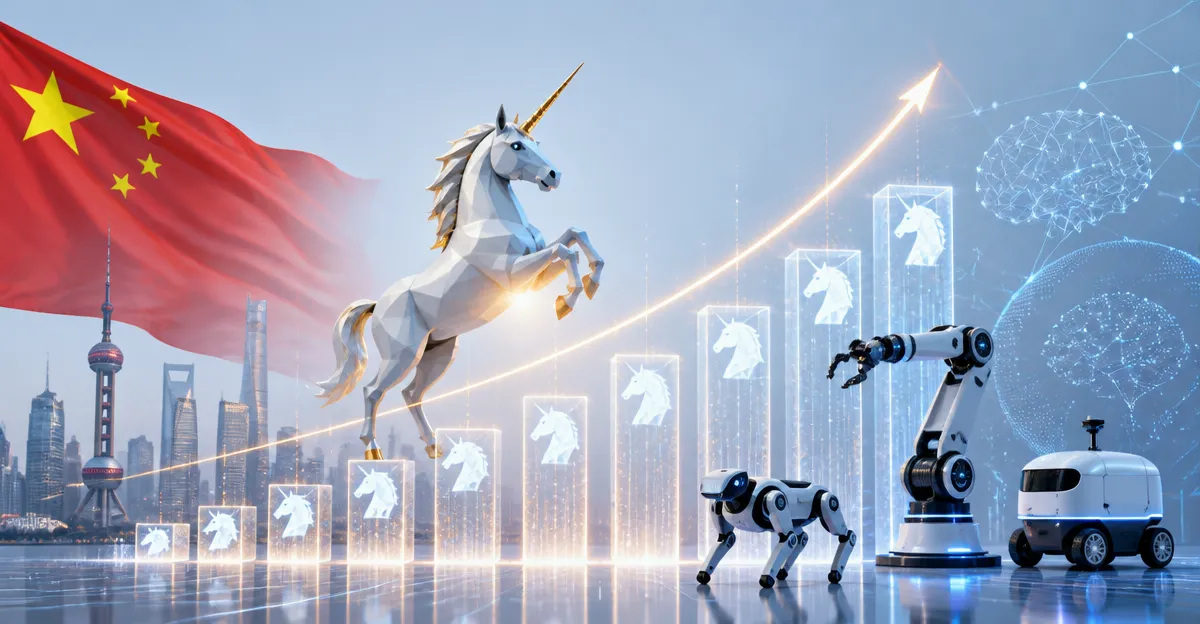
July 7, 2026, (Inside AI) — China’s start-up ecosystem is accelerating at a pace not seen in half a decade. In the first six months of 2026, 67 private companies crossed the billion-dollar valuation threshold to become unicorns, averaging one new unicorn every 2.7 days. This is the fastest rate since the second half of 2021, when 76 unicorns were born, according to a new report from start-up database ITJuzi.
The surge is not broad-based. It is concentrated in two sectors: artificial intelligence and robotics. Together, they accounted for more than 53% of the new unicorns. This marks a sharp pivot from the 2021–2022 cycle, when unicorns emerged across a wide range of industries including new-energy vehicles, biomedicine, and online consumer platforms. The current wave reflects a strategic realignment of capital toward deep tech, driven by government priorities and global competition.
The report highlights a critical nuance: most of these unicorns are still in early growth stages. Roughly 78% were valued between $1 billion and $2 billion. No company reached the $5 billion to $10 billion range, the zone that typically separates standard unicorns from “super unicorns.” This suggests that while investor confidence is high, the path to massive scale remains uncertain for many.
The AI and Robotics Gold Rush
China’s AI sector has been supercharged by breakthroughs in large language models and generative AI, with companies like Baidu, ByteDance, and a host of well-funded challengers racing to commercialize applications. Robotics has seen parallel momentum, fueled by advances in embodied AI and demand for automation in manufacturing and logistics. The government’s “Made in China 2025” initiative and recent policy support for strategic emerging industries have created a fertile environment for these fields.
But the concentration in just two domains raises questions about diversification—and vulnerability. During the 2021 unicorn boom, China saw a broader spread of innovation across consumer internet, electric vehicles, and biotech. That breadth provided a hedge against sector-specific downturns. Today’s narrow focus could amplify risks if AI hype cools or regulatory shifts occur. The report notes that “momentum for some start-ups remains uncertain,” a subtle warning about the durability of current valuations.
Valuation Gaps and Global Comparisons
The absence of super unicorns is notable. In the US, AI start-ups like OpenAI and Anthropic have achieved valuations exceeding $30 billion, while Chinese rivals are still climbing. This gap may reflect differing market structures: US firms often access deeper venture capital pools and global revenue streams earlier. Chinese start-ups, by contrast, frequently rely on domestic markets and state-guided funding, which can limit initial valuation spikes but provide steadier growth trajectories.
Historical patterns offer context. China’s unicorn count dipped after the 2021 peak due to regulatory crackdowns on tech and a slowing economy. The current rebound suggests that investors see AI and robotics as long-term bets aligned with national strategy. However, the ITJuzi data underscores that most of these companies are still proving their business models. The jump from a $1 billion valuation to $5 billion often requires international expansion or platform dominance—both challenging in the current geopolitical climate.
The report did not name specific companies, but industry watchers point to firms in autonomous driving, humanoid robots, and AI chip design as likely candidates. These sectors have seen intense deal activity, with some start-ups doubling valuations in under a year. Yet, the lack of super unicorns may signal that the market is still testing which business models can achieve escape velocity.
Looking ahead, the second half of 2026 will test whether this momentum can be sustained. Global economic headwinds, export controls on advanced chips, and rising competition from US and European AI firms could slow the pace. For now, China’s innovation engine is running at full throttle—but the road from unicorn to super unicorn remains steep and uncertain.