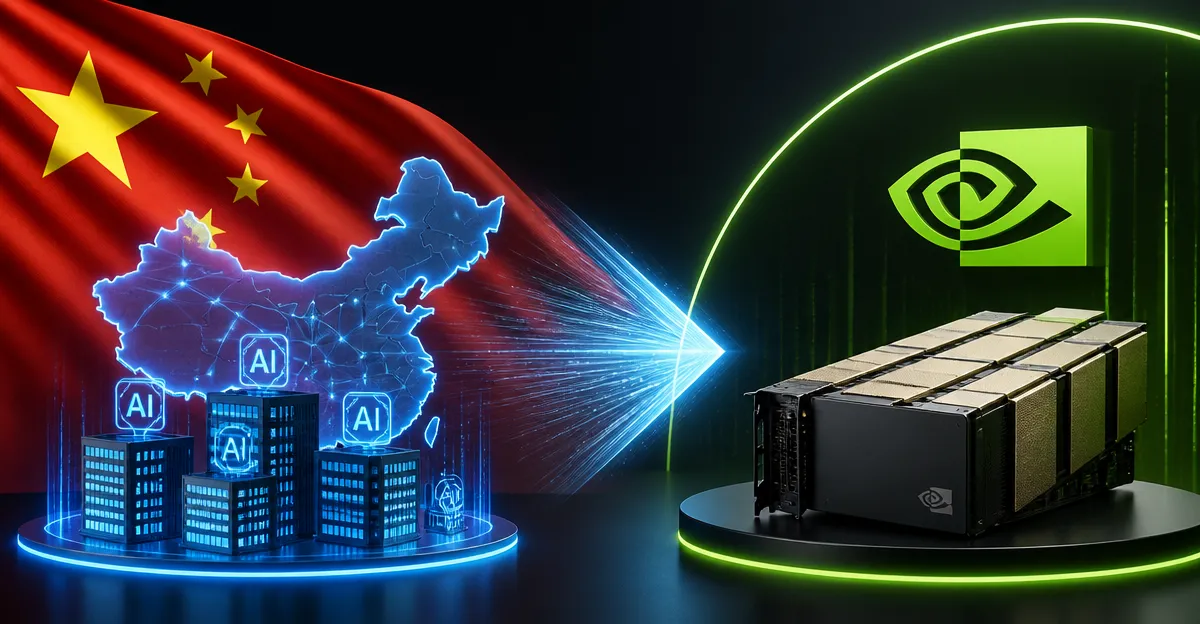
July 9, 2026, (Inside AI) — China is preparing to allow select technology firms to import Nvidia H200 chips, marking a significant shift in its semiconductor strategy. Alibaba Group Holding, ByteDance, and AI startup DeepSeek are among the first to receive government notification of pending approvals, according to sources.
The move ends months of de facto restrictions that blocked Chinese companies from acquiring Nvidia’s most advanced commercially available AI accelerators. Companies will still need to justify why they require the H200 over domestic alternatives, a condition that underscores Beijing’s long-term push for self-sufficiency.
Why Beijing Is Easing Access to Advanced Silicon
The decision reflects a stark reality: China’s homegrown chips cannot yet close the nation’s computing power gap. Shi Shenchang, a lawyer specializing in export controls at Shanghai-based Co-Effort Law Firm, noted the shortfall is unlikely to be resolved soon.
“China may allow H200 imports because domestic chips are unlikely to fill the country’s computing-power gap in the near term,” Shi said.
This pragmatic pivot comes as Chinese AI labs face mounting pressure to train larger models with constrained resources. The H200, built on Nvidia’s Hopper architecture, offers up to 141GB of HBM3e memory and 4.8 TB/s bandwidth—critical for workloads that domestic GPUs from Huawei and Biren struggle to match.
The approval process itself reveals Beijing’s balancing act. Companies must articulate a clear need for foreign silicon, a requirement that serves dual purposes: it prevents frivolous imports while gathering intelligence on exactly where local chips fall short. This data could accelerate indigenous development roadmaps.
The Geopolitical Calculus Behind Chip Imports
Washington’s export controls have long aimed to cap China’s AI capabilities by limiting access to advanced logic and memory chips. The H200, while not the most cutting-edge Nvidia design, still represents a capability leap over the sanctioned A100 and H100 that China previously stockpiled.
Industry analysts view the move as a temporary pressure release. “It’s a recognition that the domestic ecosystem isn’t ready,” said one Beijing-based semiconductor researcher who requested anonymity. “But every H200 that enters China will be reverse-engineered to death.”
Indeed, the approvals coincide with reported breakthroughs at Huawei, whose Ascend 910C is rumored to approach H100 performance. Yet production yields and software maturity remain obstacles. By allowing limited H200 imports now, China buys time for its champions to catch up without ceding too much ground in the global AI race.
The Information first reported the government’s notifications to ByteDance and DeepSeek, while a source familiar with the matter confirmed Alibaba’s involvement to the South China Morning Post. Neither Nvidia nor the Chinese companies have officially commented.
For Nvidia, the development offers a narrow but lucrative channel. The H200 commands premium pricing, and even limited sales to hyperscalers like Alibaba could offset some revenue lost to broader restrictions. However, the company must navigate U.S. regulations that could tighten if Washington perceives a loophole.
DeepSeek’s inclusion is particularly notable. The startup has gained attention for efficient model training on constrained hardware. Access to H200s could accelerate its research dramatically, potentially yielding innovations that ripple through China’s open-source AI community.
The timing also aligns with broader economic pressures. China’s tech sector has faced sluggish growth, and easing chip imports could stimulate AI-driven productivity gains. Meanwhile, the government continues to pour billions into domestic semiconductor initiatives, signaling that today’s imports are a bridge, not a destination.
Looking ahead, the volume of approved imports will be a key metric. If China allows only a trickle, the impact on global AI dynamics may be muted. But if volumes grow, it could reshape the competitive landscape—and invite a swift response from Washington.