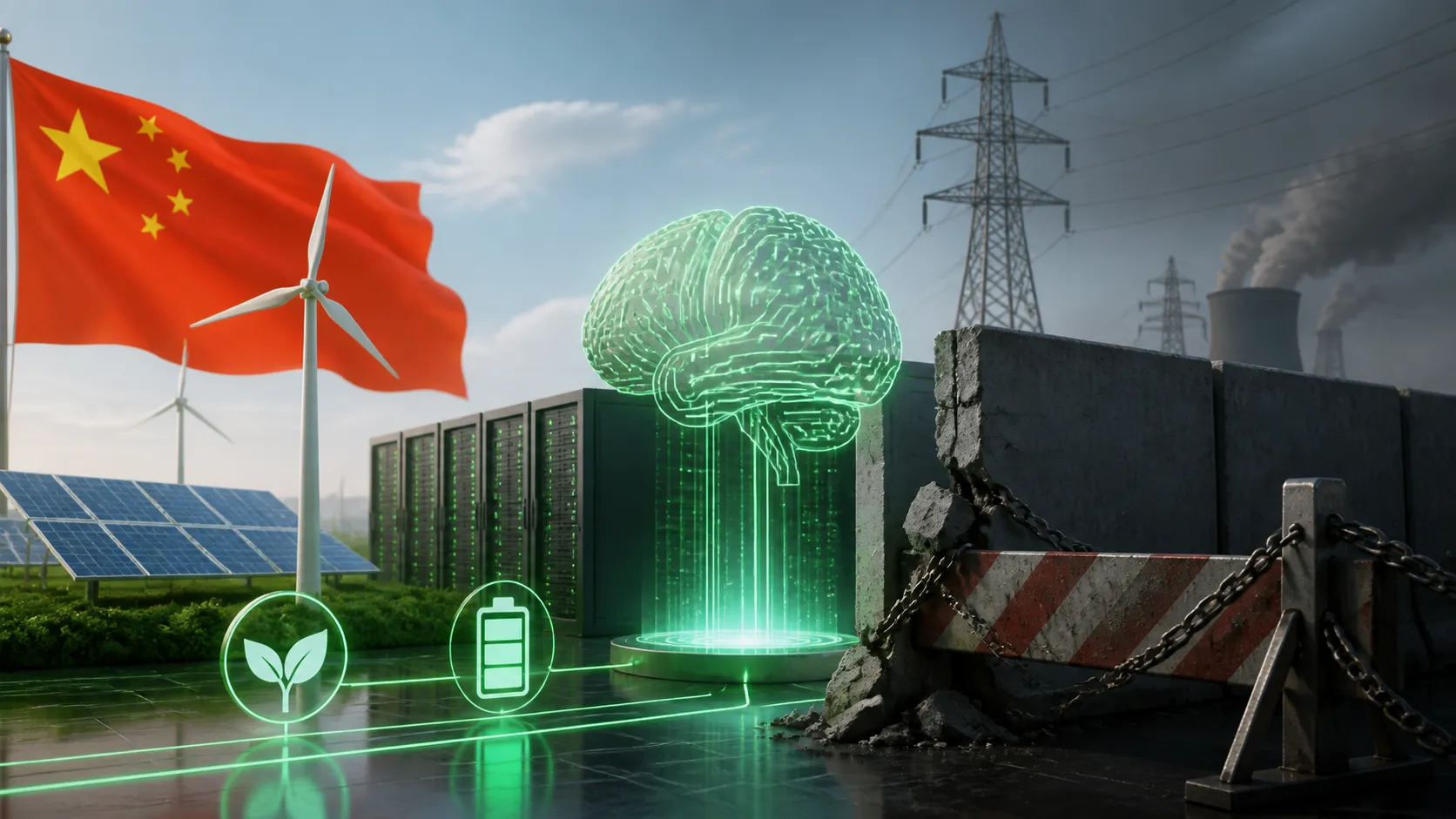
June 22, 2026, (Inside AI) — China’s plan to power its AI data centre boom with green energy is hitting practical barriers. Industry experts at a Beijing conference last week warned that unpredictable peak demand and grid operator resistance are slowing progress, even as the government mandates renewables to supply 80% of the sector’s electricity by 2030.
The 2026 government work report made integrating computing infrastructure with power networks a strategic priority. But the gap between ambition and reality is widening. Data centres consumed just 11% renewables in 2023, and the path to four-fifths is fraught with technical and economic friction.
Demand Forecasting Stumps Green Power Providers
Power demand from Chinese data centres is projected to surge by 300 billion to 500 billion kilowatt-hours between 2026 and 2030, according to Pei Shanpeng, a director at State Power Investment Corp. That increase would represent 18% of total electricity demand growth over the period. The lower end alone equals the UK’s entire annual consumption.
Yet data centres make poor customers for renewable providers. Unlike steady industrial loads like aluminium smelting, AI workloads fluctuate wildly. Pei noted that operators show little flexibility in managing power use.
Read: Why Hong Kong’s AI Success Depends on Solving Its Energy Crisis
“At least for now, they do not appear to be very flexible (in managing power demand),” Pei said at the conference.
“From what we understand, they (data centres) cannot really adjust power consumption load much. GPUs are very expensive, so once they are purchased, operators want to use them as quickly and as intensively as possible.”
This rigidity complicates grid balancing. Renewables like solar and wind are intermittent, and without demand-side flexibility, matching supply to AI’s erratic consumption becomes a high-wire act.
Grid Operators Balk at Direct Green Links
Direct connections between renewable plants and data centres could bypass traditional grids. But grid operators see a threat to their revenue models. Heavy investments in transmission and distribution infrastructure rely on throughput fees. If major customers defect, cost recovery becomes precarious.
“If 15% of the power consumption loads can be adjusted, it will significantly reduce capacity expansion pressure on the grid over the next three to five years,” said Wang Zelin, deputy director at State Grid Jibei Electric Power Research Institute.
That 15% figure highlights a critical lever. Even modest demand flexibility could ease the strain on grids already buckling under AI’s rapid rollout. Some regions face elevated average and peak loads, forcing operators to juggle reliability with rising demand.
Read: Inside SenseTime and HKSTP’s 40,000 Petaflops AI Data Center Bet
Pei emphasized that the green power push targets emissions cuts, not cost savings. Data centre economics are driven by GPU utilization, not electricity prices. This misalignment with renewable providers’ need for predictable off-takers deepens the impasse.
China’s dilemma mirrors global tensions. AI’s insatiable energy appetite is colliding with decarbonization goals everywhere. But the scale here is unmatched. The country’s breakneck data centre buildout has turned a strategic priority into a stress test for its entire power system.
Without breakthroughs in load forecasting or grid cooperation, the 2030 target may remain aspirational. The next few years will reveal whether policy can bridge the gap between AI’s relentless expansion and the grid’s physical limits.