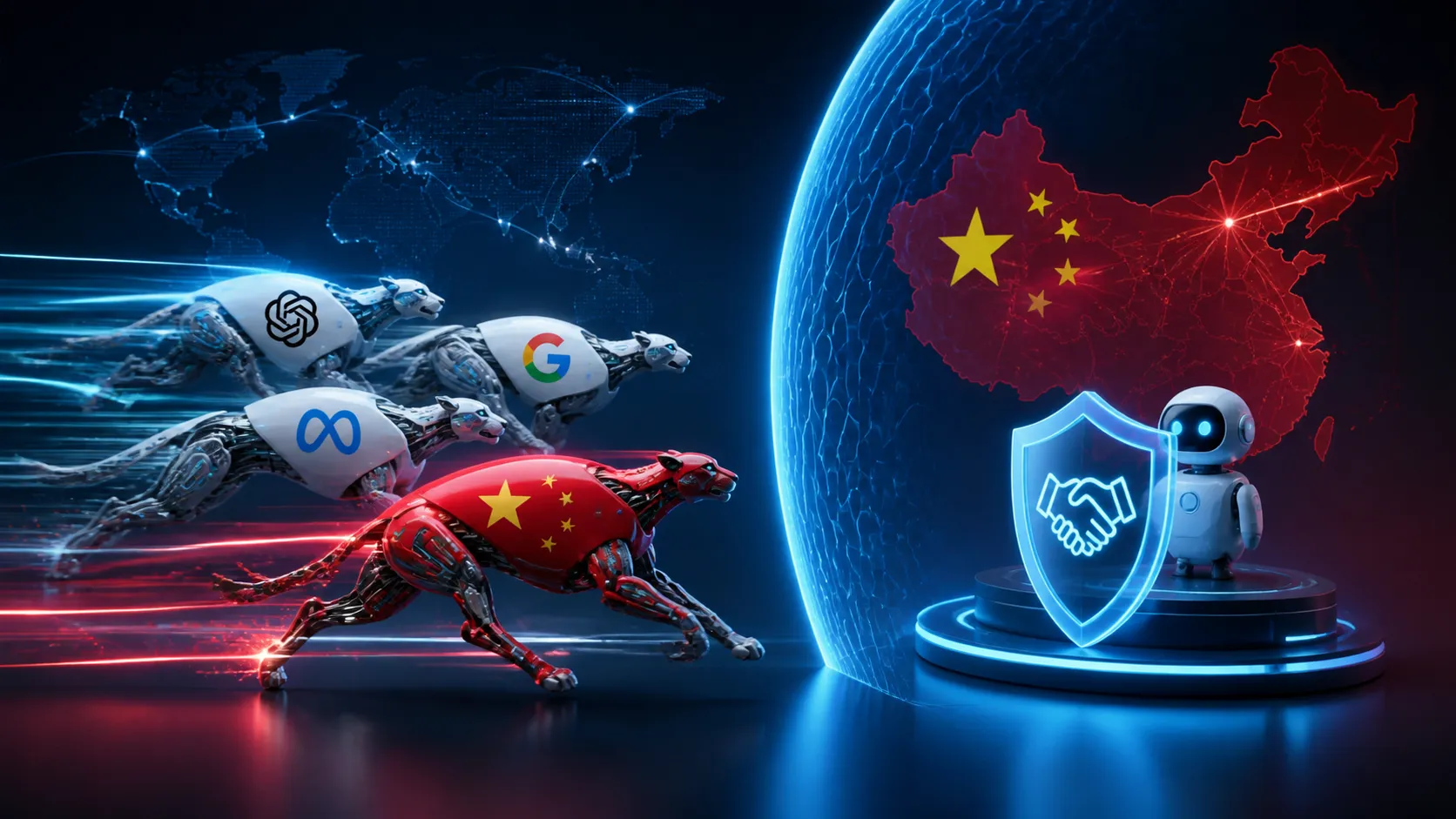
June 16, 2026, (Inside AI) — A sweeping new international poll reveals a striking paradox: China’s AI models are widely seen as the global frontrunners, even in key US-allied nations, yet they also trail badly in public trust.
The Perception Gap: Technological Prowess vs. Reliable Reputation
The survey, conducted by London-based consultancy Public First, gathered views from over 18,000 people across 15 countries. It found that respondents in 11 nations acknowledged China’s AI leadership. These included Canada, Britain, and France, where at least 40% of those polled deemed China outpacing the US in AI capability and innovation.
Germany showed the least faith in US leadership, with only 23% saying America was ahead. Among Americans themselves, nearly a quarter—24%—said China leads, while 51% held the opposite view. Public First did not survey people inside China.
The findings upend typical narratives of US dominance, showing that even populations in close American allies perceive a shifting technological center of gravity.
Read: China Tops Supercomputer List, But AI Race Tells a Different Story
Trust Deficit: Where China’s AI Models Fall Short
Despite the perception of technical superiority, the poll exposed a deep trust gap. Public First measured “net trust” by subtracting the percentage of distrust from trust. The US ranked second with a net trust score of +16, behind only Japan at +22. China placed 10th with a negative value of -8.
This suggests that while many believe Chinese AI can outperform, they remain wary of its safety, transparency, or alignment with their values. The distrust spans geopolitical lines, hinting at broader concerns over data governance and state influence.
Why the Disconnect Matters for Global AI Adoption
The poll underscores a critical challenge for China’s AI ambitions: technical leadership alone may not win global markets if users don’t trust the technology. Over 90% of all respondents said AI will transform the world, but fears persist—and those fears appear to land hardest on Chinese models.
Experts note that trust in AI hinges on factors like regulatory environments, track records of data misuse, and geopolitical tensions. China’s centralized control of tech firms and opaque algorithms likely fuel skepticism, even as its models achieve benchmark-topping results.
Regional Nuances and the Japan Surprise
Japan’s top trust ranking may reflect its reputation for reliable consumer tech and cautious AI deployment. Meanwhile, the US benefits from a strong brand of innovation tempered by democratic oversight, though its lead is far from absolute.
Public First, which has no connection with Anthropic-backed Public First Action, did not probe the reasons behind the trust scores. But the data suggests that perceived capability and trustworthiness do not always move in lockstep.
Read: AI Race Is a Talent Race: China Leads in Researchers, US in Retention
The survey adds a new layer to the global AI race: it’s not just about who builds the smartest model, but who builds one the world is willing to use.