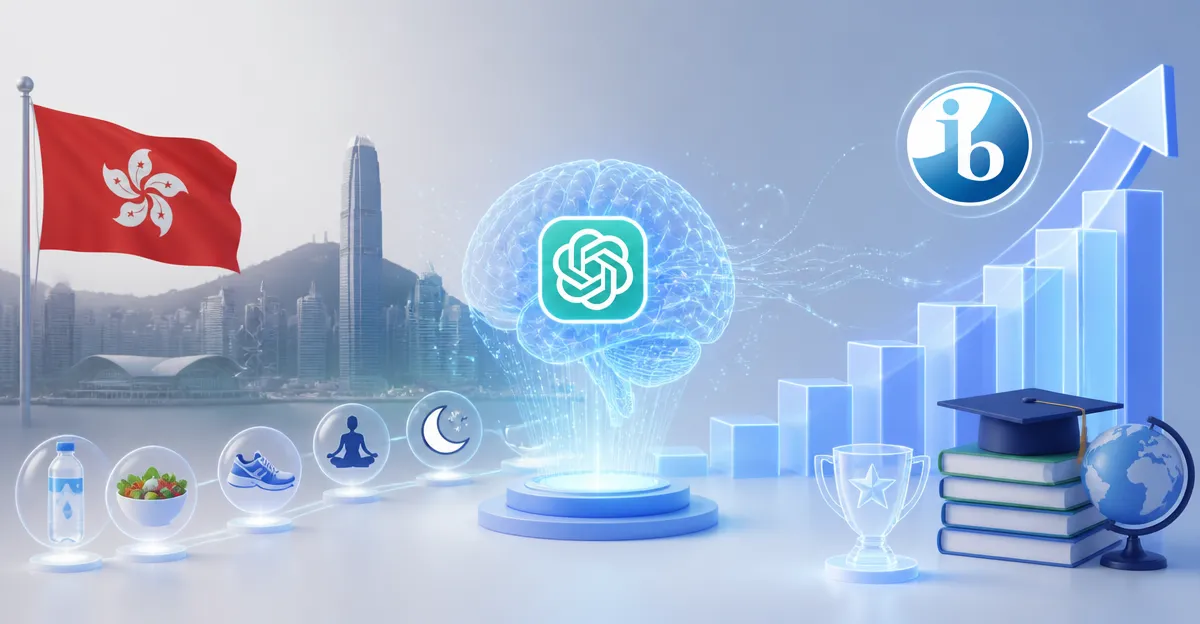
July 7, 2026, (Inside AI) — Hong Kong’s top International Baccalaureate students are crediting a blend of artificial intelligence tools and disciplined self-care for their perfect scores, offering a nuanced counter-narrative to fears that technology breeds academic dishonesty. On Monday, at least 65 pupils from 16 schools achieved the maximum 45 points, with many attributing their success to ethically deployed AI and rigorous well-being routines.
The results spotlight a shift in elite education: rather than banning AI, schools like Diocesan Boys’ School (DBS), Victoria Shanghai Academy (VSA), and Po Leung Kuk Choi Kai Yau School are teaching students to harness it as a critical thinking partner. Top scorers described using AI not to cheat, but to receive instant feedback on essays, clarify complex concepts, and simulate exam conditions — all under teacher guidance.
From Rubrics to Revision: How AI Became a Study Ally
Lucas Chavez Mocan, a DBS graduate heading to the University of Cambridge for engineering, detailed how his English teacher built structured rubrics that both students and AI could interpret. This allowed him to get accurate feedback when the teacher wasn’t available.
“I want to specifically thank my English teacher who taught us how to use AI for studying,” Mocan said.
“My teacher wrote very detailed rubrics so that both we [students] and AI could easily understand them, allowing us to get accurate feedback when the teacher was not available to mark our essays,” he added.
This approach reflects a growing pedagogical trend: using AI to scale formative assessment. Instead of replacing teachers, the technology filled gaps during intensive revision periods. DBS reportedly encouraged ethical AI use, integrating it into coursework while emphasizing original thought. The school’s stance contrasts with earlier blanket bans seen in other regions, where educators feared plagiarism and shallow learning.
Other top scorers echoed Mocan’s sentiment. At VSA, students used AI to generate practice questions and break down difficult topics in physics and mathematics. One student, who requested anonymity, said the tool helped identify weak spots faster than traditional self-assessment. “It was like having a tutor available at 2 a.m.,” they noted.
But the success wasn’t purely digital. Every high achiever interviewed stressed the importance of sleep, exercise, and scheduled downtime. Many followed strict “no-screen” hours before bed and used meditation apps to manage anxiety. This dual focus on AI efficiency and human resilience challenges the stereotype of the burnt-out, caffeine-fueled IB candidate.
Beyond the Scores: A Blueprint for Ethical AI in Education
Hong Kong’s results arrive as the global IB community debates AI’s role. The International Baccalaureate Organization itself has permitted AI use since 2023, provided it’s properly cited and doesn’t replace student analysis. Yet implementation varies wildly. In 2024, a survey by the IB found that 67% of teachers felt unprepared to integrate AI ethically. Hong Kong’s top schools appear to be outliers, investing in teacher training and clear AI policies.
Po Leung Kuk Choi Kai Yau School, another top performer, mandated AI literacy workshops for both staff and students before the exam season. “We treated AI like a calculator — a tool that’s useless unless you understand the underlying math,” a school spokesperson explained. This philosophy aligns with research from the University of Hong Kong, which found that guided AI use improved IB students’ analytical writing scores by an average of 12% without increasing plagiarism risks.
Critics, however, warn that such success stories may widen the digital divide. Not all schools can afford premium AI tools or the training to use them effectively. A 2025 UNESCO report highlighted that 40% of secondary schools in low-income regions lack basic digital infrastructure, let alone AI integration. Hong Kong’s achievement, while laudable, underscores a growing equity gap in global education.
Looking forward, these students plan to carry their AI skills into university. Mocan believes his experience will be crucial at Cambridge, where AI-assisted research is becoming standard. “Learning to collaborate with AI now is like learning to use a library — it’s a foundational skill,” he said. As the IB results show, the question is no longer whether students should use AI, but how to teach them to use it wisely.