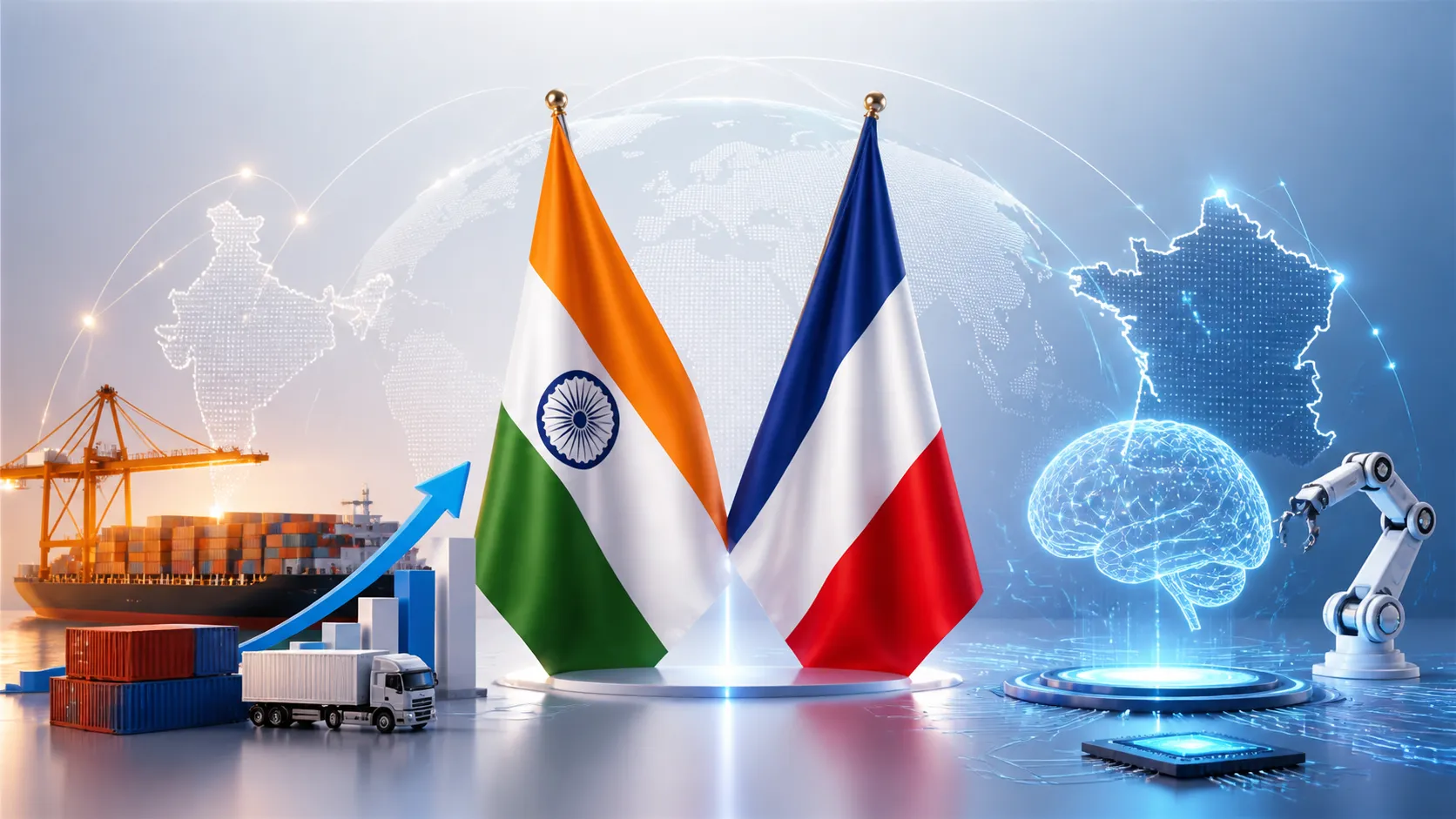
June 15, 2026, (Inside AI) — India and France have set ambitious new targets to deepen their strategic partnership, including a mechanism to double bilateral trade within five years and a dedicated joint working group on artificial intelligence governance. Prime Minister Narendra Modi and President Emmanuel Macron announced these initiatives during a bilateral meeting in Nice, France, on Sunday.
The encounter marked their first since ties were elevated to a ‘special global strategic partnership’ earlier this year. It yielded a raft of agreements spanning trade, defense, space, and technology, with AI emerging as a central pillar of future collaboration.
A Trade Surge and Innovation Blueprint
The leaders agreed to establish a high-level mechanism to double annual bilateral trade from the current $16 billion within five years. They also called for swift implementation of the India-EU Free Trade Agreement, which they see as a catalyst for expanding investment. Cooperation in aviation, railways, and small and medium enterprises will get a boost, alongside a new Dialogue on Economic Security focused on critical mineral supply chains.
An Innovation Roadmap 2030 was adopted to give the partnership long-term direction. It covers deep-tech, semiconductors, agri-tech, med-tech, and renewable energy. The roadmap builds on the joint inauguration of Bharat Innovates in Nice and Modi’s upcoming participation at Vivatech in Paris.
Read: India and Japan Forge Joint AI and Energy Resilience Roadmap
AI Governance Takes Center Stage
Artificial intelligence received particular attention. Both sides agreed to create a Joint India-France AI Working Group to govern the technology’s development and deployment. This move comes as nations worldwide scramble to set rules for AI, balancing innovation with safety. The group will likely tackle issues like data privacy, algorithmic bias, and cross-border data flows.
The Ministry of External Affairs said the leaders discussed expanding cooperation on AI. The joint working group signals a shift from ad hoc collaboration to a structured governance framework. It aligns with India’s broader push to shape global tech norms, as seen in its G20 presidency legacy.
Defense and Space: Co-Production Deepens
Defense ties, already robust, will intensify with a focus on co-design, co-development, and co-production of advanced platforms. Flagship projects include Rafale jets, Scorpene submarines, and Shakti helicopter engines. A new helicopter assembly line in Karnataka, inaugurated in February 2026, exemplifies this trend.
In space, the six-decade-old ISRO-CNES partnership will expand into human spaceflight and space situational awareness. Private sector collaboration in space was also on the agenda, reflecting the global commercial space boom.
Nuclear Energy and Digital Payments Link
Civil nuclear cooperation got a nod with India’s SHANTI Act opening doors for small and advanced modular reactors. Meanwhile, the Unified Payments Interface (UPI) will extend to airports in Nice and Paris, easing transactions for Indian travelers. Foreign Secretary Vikram Misri confirmed the rollout.
Modi thanked Macron for visa-free transit for Indian nationals at French airports, a move to boost people-to-people ties. Education cooperation will see efforts to attract French university campuses to India under the New Education Policy.
Read: India Expert on UN AI Panel Warns Fragmented Rules Could Create Digital Colonies
On global issues, the leaders discussed West Asia and Ukraine. Modi will attend the G7 summit in Evian-les-Bains, where India’s role in substantive discussions was acknowledged. The meeting underscored how the India-France partnership is evolving into a multifaceted alliance, with AI governance as its newest frontier.