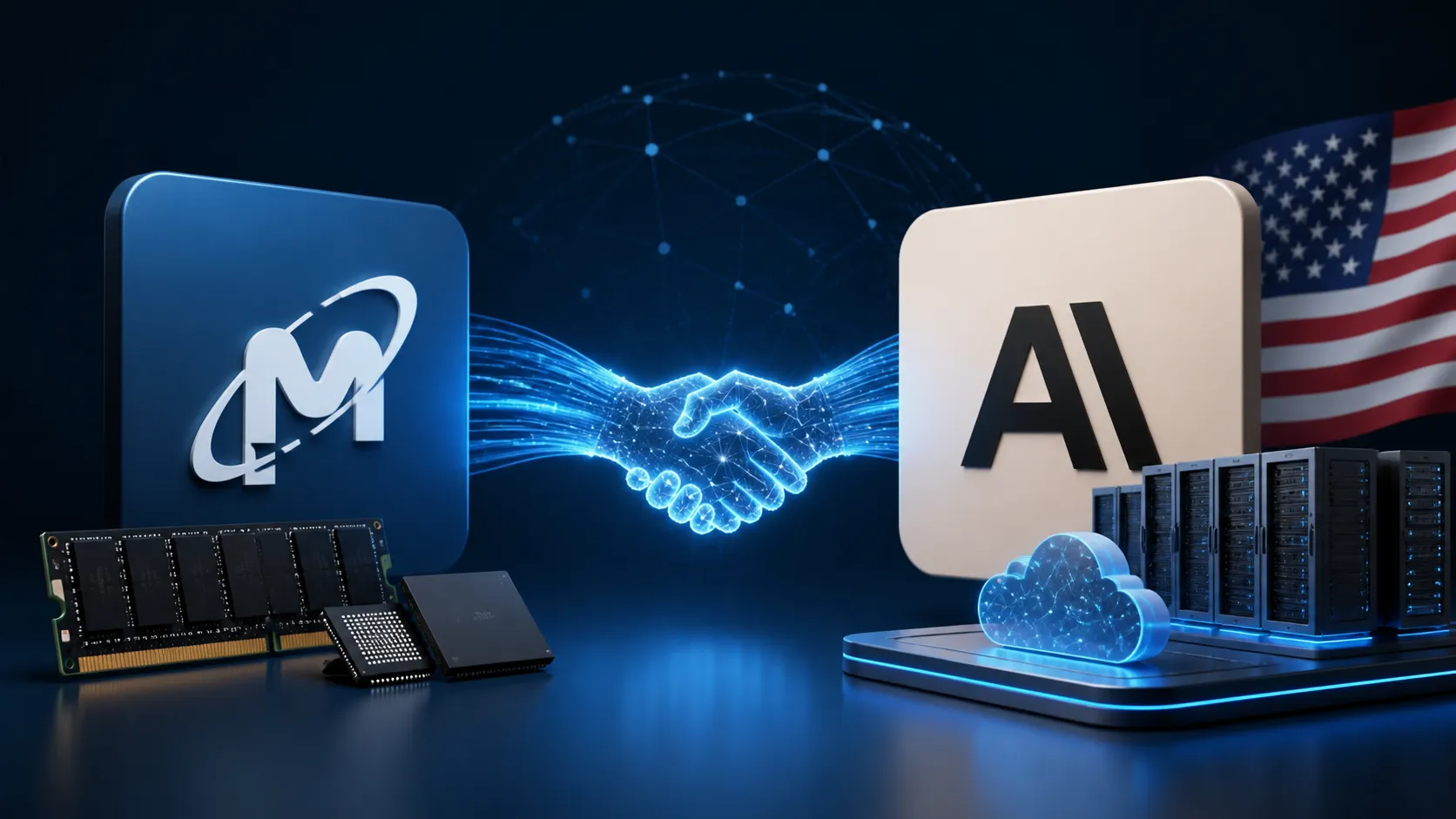
June 23, 2026, (Inside AI) — Micron Technology and Anthropic have signed a strategic AI infrastructure supply agreement, the companies announced Monday. The deal includes Micron’s supply of memory and storage products and a strategic investment in Anthropic’s latest funding round, which is tied to the AI firm’s confidential IPO filing.
The agreement addresses two pressing industry currents: AI developers’ scramble for critical data-center components and memory makers’ push to meet skyrocketing demand for high-bandwidth memory (HBM) and storage. These components are essential for training and serving advanced AI models like Anthropic’s Claude.
Anthropic co-founder and chief compute officer Tom Brown stated the centrality of hardware to the company’s strategy.
“Our compute strategy depends on getting every layer of the stack right, and memory and storage are central to how efficiently we can train and serve Claude,”
The tie-up extends beyond a simple buyer-supplier relationship. Micron said it will collaborate with Anthropic to analyze memory and storage performance across AI workloads and their interaction with the broader infrastructure stack. This joint engineering work could yield optimizations that give Anthropic a competitive edge in model efficiency.
Micron has already deployed Claude models internally for coding and agentic use cases across engineering, manufacturing, and enterprise functions. The company expects to expand those deployments, effectively becoming both a supplier and a customer.
Financial terms of the supply agreement and Micron’s Series H investment were not disclosed. Anthropic’s Series H round raised $65 billion at a $965 billion valuation, and the company confidentially filed for a U.S. IPO on June 1.
Memory’s Mounting Role in the AI Stack
The Micron-Anthropic deal underscores a shift in AI infrastructure: memory is no longer a commodity but a strategic differentiator. High-bandwidth memory, in particular, has become a bottleneck for training large models, with demand far outstripping supply. Micron, alongside rivals SK Hynix and Samsung, is racing to expand HBM production capacity.
Anthropic’s compute strategy mirrors moves by competitors. OpenAI has inked deals with chipmakers and cloud providers, while Google develops custom TPUs. By locking in memory supply and co-engineering solutions, Anthropic aims to reduce latency and cost per query for its Claude models—a critical factor as AI assistants become ubiquitous.
Industry analysts note that such partnerships could reshape supply chains. “We’re seeing AI labs become vertically integrated out of necessity,” said a semiconductor analyst who requested anonymity. “If you control the memory architecture, you control a key lever for performance and cost.”
Anthropic’s Infrastructure Blitz and IPO Path
The Micron agreement is the latest in a series of major infrastructure moves by Anthropic. In recent months, the company has signed deals with CoreWeave for cloud compute, Broadcom for custom chips, and SpaceX for satellite connectivity—building a multi-layered hardware ecosystem.
These agreements come as Anthropic prepares for a public listing. The confidential IPO filing signals confidence in its commercial trajectory, fueled by the viral success of Claude Code, an AI coding assistant. The $65 billion Series H round, one of the largest private funding events in history, values Anthropic at nearly a trillion dollars.
Micron’s investment in that round aligns its financial interests with Anthropic’s growth, while the supply agreement ensures a steady revenue stream from a high-profile AI customer. For Anthropic, the deal secures priority access to memory and storage at a time when lead times for HBM can stretch beyond six months.
The collaboration also highlights the blurring lines between AI developers and hardware providers. As Micron deploys Claude internally, it gains firsthand insight into AI workloads, potentially feeding back into product design. This symbiotic dynamic could accelerate innovation cycles for both companies.