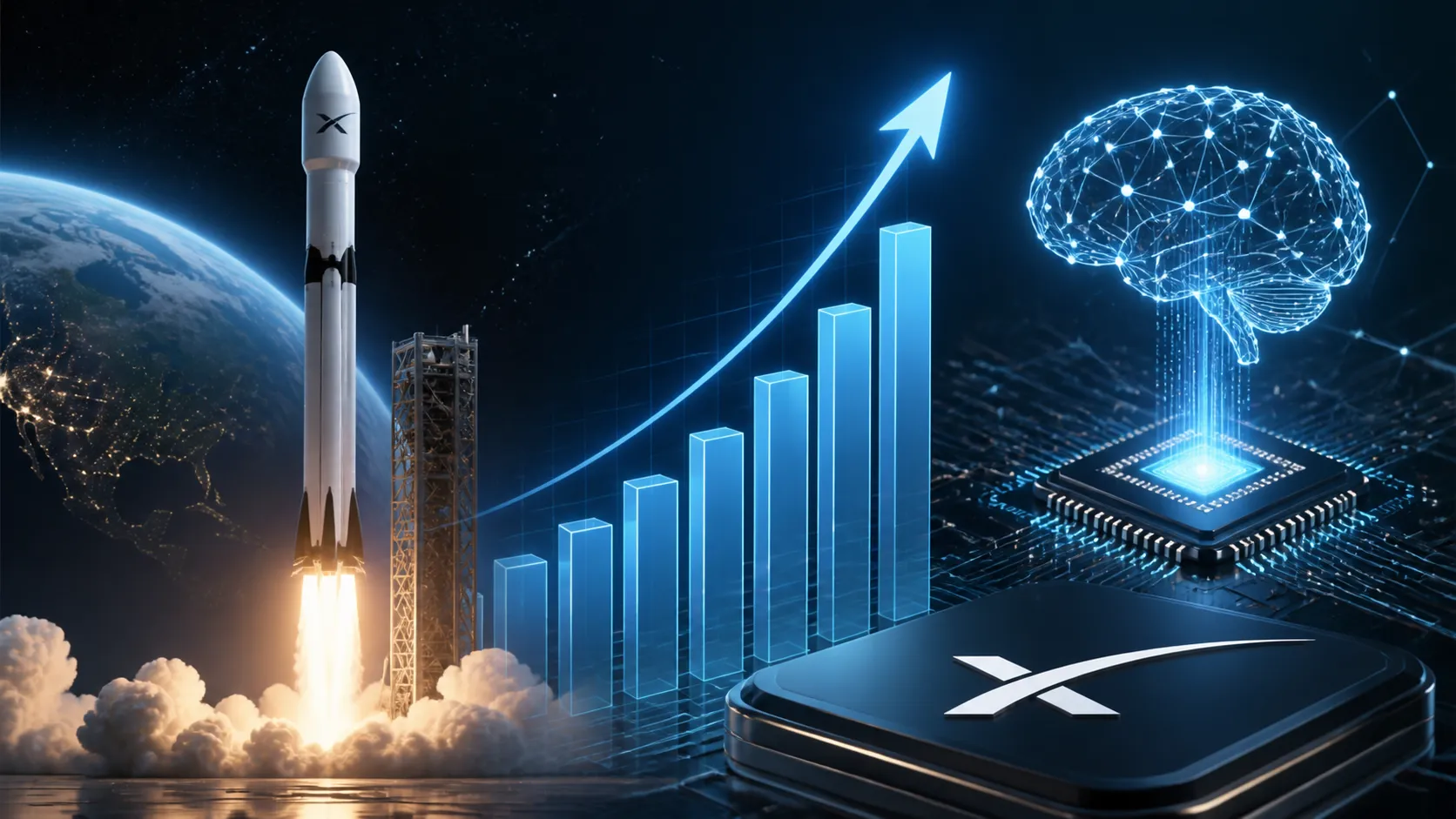
June 20, 2026, (Inside AI) — SpaceX’s historic initial public offering has ignited a surge in investor appetite for space-based artificial intelligence, as the company pitches orbital data centers as the solution to AI’s crippling energy demands.
The Power Crunch Driving AI to Orbit
AI is the dominant capital theme of the decade, yet it faces a fundamental global constraint: power. America’s grids cannot support the exponential growth of AI data centers. Musk’s proposed solution is to deploy massive computing infrastructure into low-Earth orbit.
Orbital data centers would harness continuous solar energy, exploit the natural vacuum of space for thermal cooling, and utilise the existing Starlink constellation for communication. The IPO prospectus details a phased rollout beginning with 12 prototype units by 2028.
A Vertically Integrated Monopoly Emerges
SpaceX has become a vertically integrated monopoly spanning space transport, global broadband and AI compute infrastructure. If Musk’s orbital AI network reaches scale, global AI companies could face an insurmountable cost disadvantage.
Industry analysts warn that competitors may be locked out of the orbital economy. “SpaceX controls the launch, the network, and now the compute layer,” said Dr. Elena Torres, space policy expert at Georgetown University.
China’s Stalled Orbital Ambitions
China is not standing still. However, without reusable rockets comparable to SpaceX’s Falcon 9, the cost to orbit remains much higher, and state-owned launch schedules are saturated with national priorities.
Consequently, China’s path to orbital AI depends on the maturation of its private commercial space sector. Firms like LandSpace and iSpace are developing reusable launchers, but are years behind.
The Geopolitical Stakes of Off-World Compute
The race for orbital AI infrastructure mirrors terrestrial tensions over semiconductor supply chains. Control of space-based compute could redefine digital sovereignty, giving the U.S. an unassailable lead in both AI capability and energy independence.
Critics question the environmental impact of frequent launches and the risk of space debris. SpaceX’s filing acknowledges these challenges but offers scant mitigation details beyond “adaptive traffic management.”
What the IPO Means for Investors
The IPO, the largest in aerospace history, values SpaceX at over $500 billion. Early backers include sovereign wealth funds and major tech pension funds. Retail investors gained access through a novel direct listing structure.
Analysts remain divided. Some see a transformative infrastructure play; others fear a speculative bubble detached from near-term revenue. The prospectus projects orbital AI services contributing 30% of revenue by 2032.
As the trading debut approaches, one thing is clear: the convergence of AI and space has moved from science fiction to financial reality.