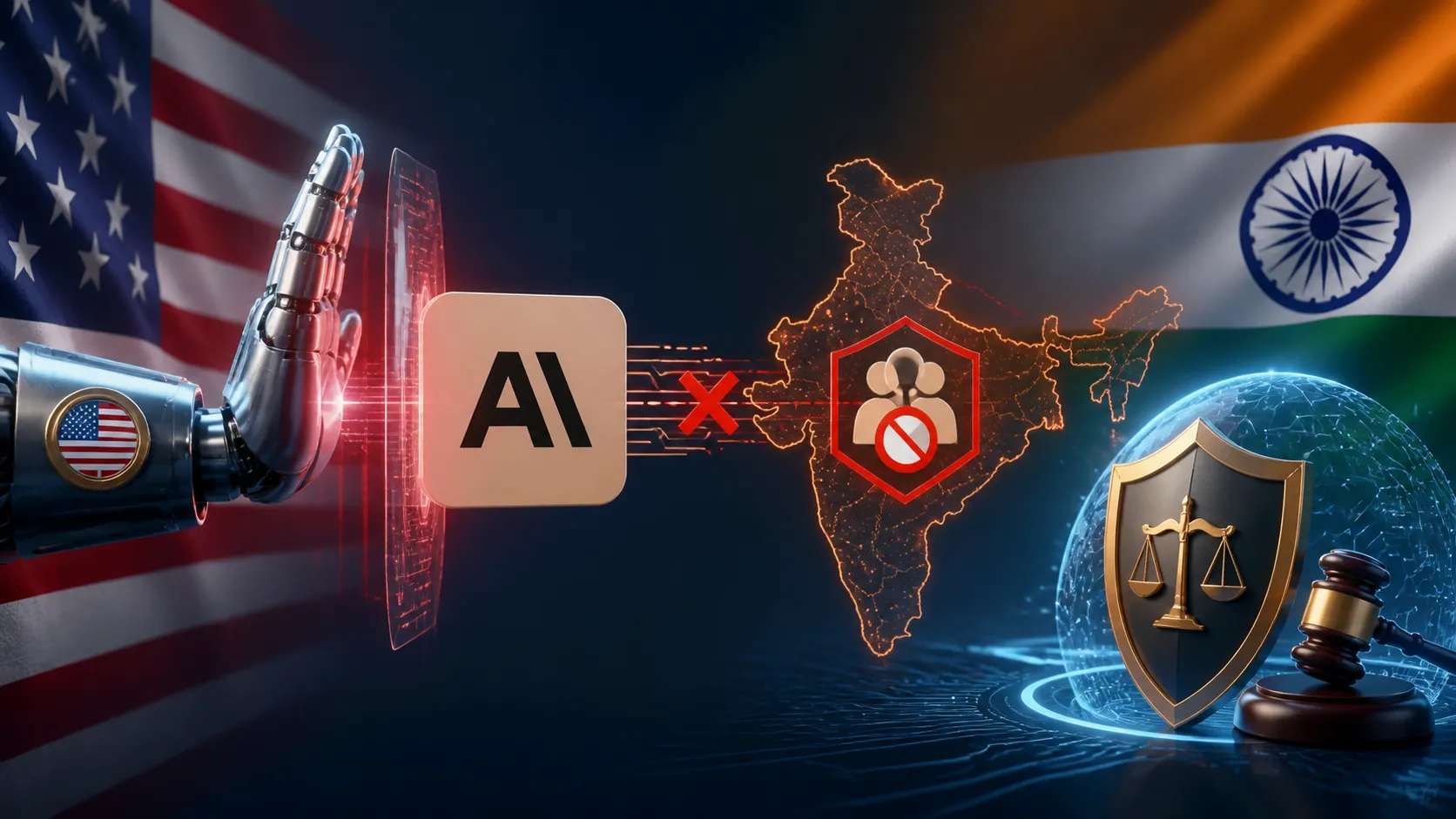
June 15, 2026, (Inside AI) — On June 12, the United States government issued an export-control directive forcing Anthropic to suspend access to its advanced AI models, Fable 5 and Mythos 5, for all foreign nationals, including users in India. The order also applied to Anthropic’s own foreign-national employees. While other models remained available, the company publicly disputed the directive but complied, cutting off Indian customers overnight.
This wasn’t a tariff or sanctions list. It was a domestic legal instrument that reached across borders, disabling a commercial service almost instantly. The episode exposes a harsh truth: globalization now runs on law, not just markets. For India, the lesson is clear. Technological self-reliance alone isn’t enough. Without a corresponding legal doctrine, the country remains vulnerable to foreign legal commands that can switch off critical services.
The Jurisdictional Shockwave
The vulnerability wasn’t primarily technological. It was jurisdictional. An American administrative order, operating within its own statutory framework, extinguished access for users worldwide in hours. This is lawfare: using legal tools to achieve strategic ends that once required harder instruments. The digital economy’s chokepoints—advanced semiconductors, frontier AI models, cloud infrastructure—sit physically and legally within a few jurisdictions. Whoever controls the jurisdiction controls the off-switch.
Sridhar Vembu, founder of Zoho, called technology the “ultimate weapon” and argued that national sovereignty now depends on technological capability. He urged reliance on domestic and open-source models. But that captures only half the exposure. The other half is legal, demanding attention from policymakers and lawyers, not just engineers.
Four Pillars of an Indian Lawfare Doctrine
A serious Indian response would rest on four elements. First, defensive insulation. The European Union’s Blocking Statute restricts compliance with specified foreign extraterritorial measures. China has its own counter-sanctions framework. India has the Digital Personal Data Protection Act and IT Rules, but no instrument clarifying the status of a foreign directive that alters conduct affecting Indian users. That uncertainty is itself a vulnerability. A narrowly tailored framework should establish that foreign legal commands don’t automatically acquire force in India without testing against Indian law.
Second, redundancy. India doesn’t need to win a hundred-billion-dollar frontier-model race. It needs to eliminate single points of failure. Through UPI, Aadhaar, and ONDC, India has shown digital public infrastructure can be built at national scale. The same logic should extend to compute capacity, open-weight models, cloud diversity, and procurement strategy. Vembu’s preference for smaller models fits naturally here as one component.
Third, leverage. Lawfare isn’t only defensive. India’s domestic market is itself a source of jurisdictional power. Any platform operating here accepts Indian law as the price of entry. Reciprocity should become part of regulatory thinking. A provider that can be ordered to disconnect Indian customers without notice is an unreliable counterparty. Procurement frameworks and sectoral regulations should recognize and price that risk.
Fourth, the forum dimension. Trade law, investment treaties, the WTO, and emerging technology governance arrangements are arenas where legal argument substitutes for harder pressure. India understands this logic in other domains. It must bring the same seriousness to technology, data, and AI governance, where its posture has too often been reactive.
A Narrower, More Defensible Argument
None of this requires decoupling. The point isn’t isolation from global technology markets. It’s narrower: no state should allow essential services to depend entirely on another country’s administrative machinery. The dispute between Anthropic and the US government may resolve. But the vulnerability will return, in other technologies, through other legal instruments, because the underlying logic now favors it.
Globalization promised borders would matter less. This moment reveals they didn’t disappear. They migrated into law, code, and infrastructure, where they’re harder to see and easier to weaponize. India’s challenge is to stop being the object of other states’ lawfare and start acting as the author of its own.
Aditya Kashyap, a practising advocate at the Supreme Court of India, and Kartikey Singh, a New Delhi-based lawyer, argue that technological self-reliance without a legal doctrine is an incomplete shield. The Anthropic episode is a clear illustration of that structural reality.