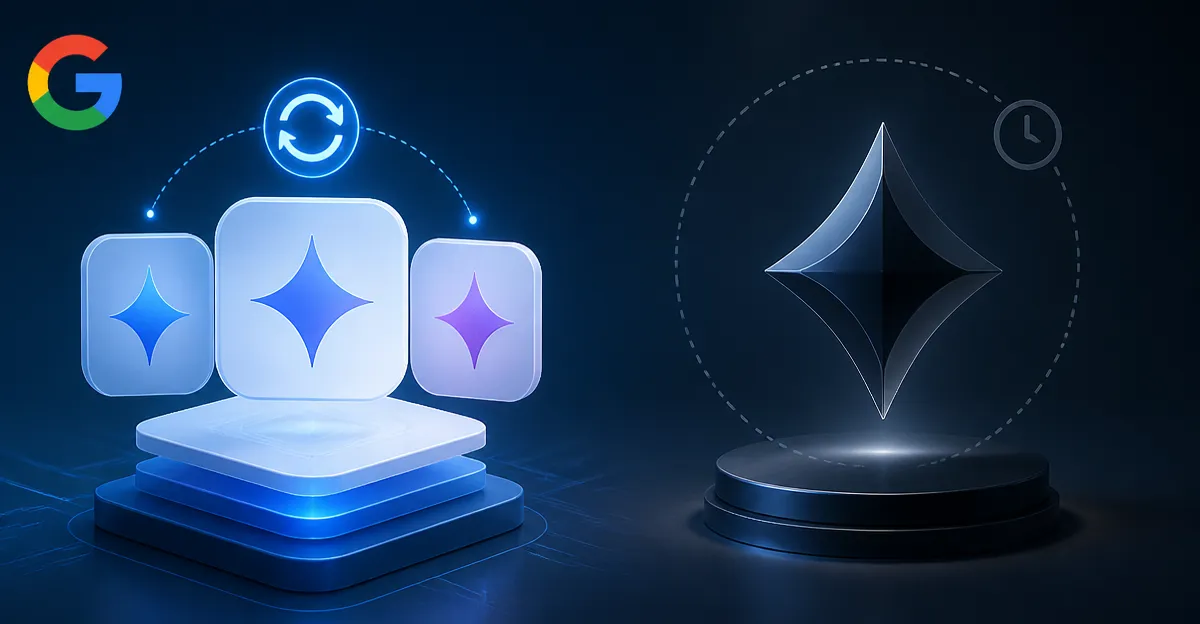
July 21, 2026, (Inside AI) — Google released three new lightweight Gemini AI models today, but the flagship Gemini 3.5 Pro remains delayed, missing its June target. The update comes just a day before Alphabet’s Q2 earnings call, where CEO Sundar Pichai will likely face tough questions about the hold-up.
The new models—Gemini 3.6 Flash, Gemini 3.5 Flash-Lite, and Gemini 3.5 Flash Cyber—are cost-efficient variants for less demanding tasks. Flash Cyber is explicitly built for cybersecurity, a niche where Google sees a competitive edge.
Yet, the absence of Gemini 3.5 Pro is the real story. Originally announced at Google I/O in May for a June launch, the model has stalled. Sources say it’s falling short on internal benchmarks, especially in coding—a critical enterprise use case. This delay hands rivals like Anthropic and OpenAI a clear advantage.
Anthropic’s Mythos 5 and Fable 5 models were recently flagged as a national security risk by the U.S. government. OpenAI’s GPT-5.6 launched earlier this month after a similar security review. Google’s silence on Pro timing raises concerns about its ability to keep pace.
Google is leaning hard on pricing to maintain momentum. Pichai claims enterprises could save over $1 billion annually by shifting workloads to Gemini. Google DeepMind staff echoed this, calling Flash Cyber “a cost-efficient and highly capable alternative to large, costly cybersecurity models.”
The delay underscores a broader industry tension: balancing safety with speed. As models grow more powerful, governments are stepping in. The U.S. has requested delays from both OpenAI and Anthropic for security vetting. Google’s Pro model may be caught in the same regulatory headwinds, though the company has not confirmed this.
Historically, Google’s Gemini 3 family launch last November briefly put it ahead of the pack, triggering an internal “code red” at OpenAI. But the landscape shifts fast. Anthropic’s recent releases have set a new bar, and OpenAI’s GPT-5.6 is already in the wild. Google’s pricing strategy may not be enough if its top-tier model lags in capability.
Google DeepMind confirmed training has started on Gemini 4, signaling long-term ambition. But for now, the market is watching the Pro delay. Alphabet’s earnings call on Wednesday will be a critical moment for Pichai to address the slippage and reassure investors.
For cybersecurity, the Flash Cyber model is a notable addition. It’s designed to be a leaner, cheaper alternative to sprawling security models. Google’s bet is that many enterprises don’t need the biggest model—they need a specialized, affordable one. This aligns with the industry’s shift toward smaller, task-specific models that can run efficiently at scale.
The coding shortfall in Pro is particularly painful. Enterprise AI adoption hinges on reliable code generation. If Google can’t match rivals on this front, it risks losing ground in one of the most lucrative AI segments. The delay may be a sign that Google is unwilling to ship a subpar product, but it also leaves a gap that competitors are eager to fill.
Google’s strategy appears twofold: flood the market with affordable, specialized models while perfecting the flagship. But in a race where perception matters as much as performance, a delayed Pro model fuels the narrative that Google is falling behind. The upcoming earnings call will reveal whether Pichai can flip that script.