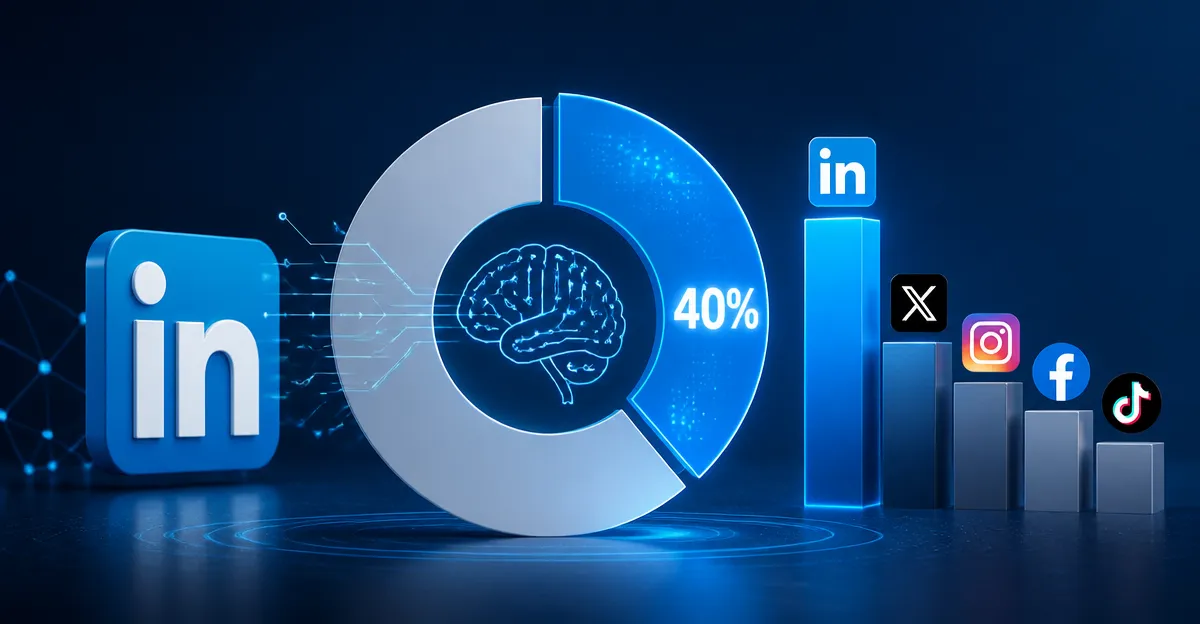
July 16, 2026, (Inside AI) — More than 40% of long-form posts on LinkedIn are now fully AI-generated, making it the most AI-saturated major social platform, according to a new study by detection startup Pangram. The research, based on over a million posts across LinkedIn, X, Reddit, Substack, and Medium, found that the Microsoft-owned network accounted for nearly two-thirds of all AI-generated content flagged.
The findings arrive as synthetic text becomes a mainstream feature of online communication, not a fringe phenomenon. Pangram’s analysis points to LinkedIn’s own AI writing tools—like its ‘Enhance post’ feature—as a key driver normalizing machine-authored content on the platform.
Yet the study also reignites debate over the reliability of AI detection. Researchers caution that detection scores should be treated as indicators, not proof, given known issues with false positives, particularly for non-native English speakers.
How LinkedIn Became the Epicenter of Synthetic Posts
Pangram scanned over a million items and found that long-form content—posts exceeding 250 words—was most likely to be AI-generated. Across four of the five platforms studied, one in four long-form items (25.72%) were fully machine-written. LinkedIn led this trend, with its professional, advice-heavy format seemingly inviting AI assistance.
Read: LinkedIn and Adobe Launch Free AI Marketing Courses as Demand Spikes 113%
“AI writing is now a problem everywhere on social media,” said Max Spero, CEO and co-founder of Pangram. He noted that this aligns with broader web trends, where researchers estimate 35% of newly published websites are AI-generated or AI-assisted.
LinkedIn’s embrace of generative AI tools has been explicit. Features like collaborative articles and AI-powered profile suggestions blur the line between human and machine contributions. The study suggests these tools have accelerated the platform’s AI saturation, turning it into a testing ground for synthetic professional content.
Reddit’s Spam Filters Hold the Line—But Only Just
In stark contrast, Reddit showed the lowest combined share of AI-generated content at just 4.4%, despite having the highest scan volume. 98.1% of replies were human-authored. However, top-level posts told a different story: 11.6% were AI-written, on par with X/Twitter’s 10.0%.
Pangram attributes Reddit’s lower numbers to its aggressive spam policies, which effectively eliminate accounts using AI for bulk replies. But the report warns that these defenses falter against top-level posts, which have far greater audience impact and can slip past volume-based moderation like rate-limiting.
Substack emerged as an outlier. There, longer, more substantial posts were slightly less likely to be AI-generated than shorter ones, suggesting a writerly culture that resists automation. The platform’s subscription model may incentivize authentic voice over algorithmic efficiency.
Spero struck a cautiously optimistic tone: “An internet that is completely flooded with undisclosed AI content is bleak, but we don’t believe it’s inevitable. We hope that by providing transparency to AI-generated content online, we can give internet users back some control of how they spend their attention.”
Read: AI-Generated Ads Perform Worse Than Human-Made Ones, Research Shows
Critics, however, urge skepticism. AI detectors have a history of high false-positive rates, especially penalizing non-native English writers. A Stanford study previously showed that some detectors misclassified over half of essays by non-native speakers as AI-generated. Pangram’s numbers, while striking, may overstate the problem if such biases persist.
The study’s release comes amid growing pressure on platforms to label AI-generated content. The European Union’s AI Act and proposed U.S. legislation are pushing for watermarking and disclosure mandates. LinkedIn has not yet commented on whether it will introduce AI labels, but the data may force a reckoning over how professional networks maintain trust.
For users, the line between human insight and machine synthesis grows thinner. As AI writing tools become embedded in social platforms, the study serves as a snapshot of a rapidly shifting landscape—one where authenticity is increasingly a premium.








