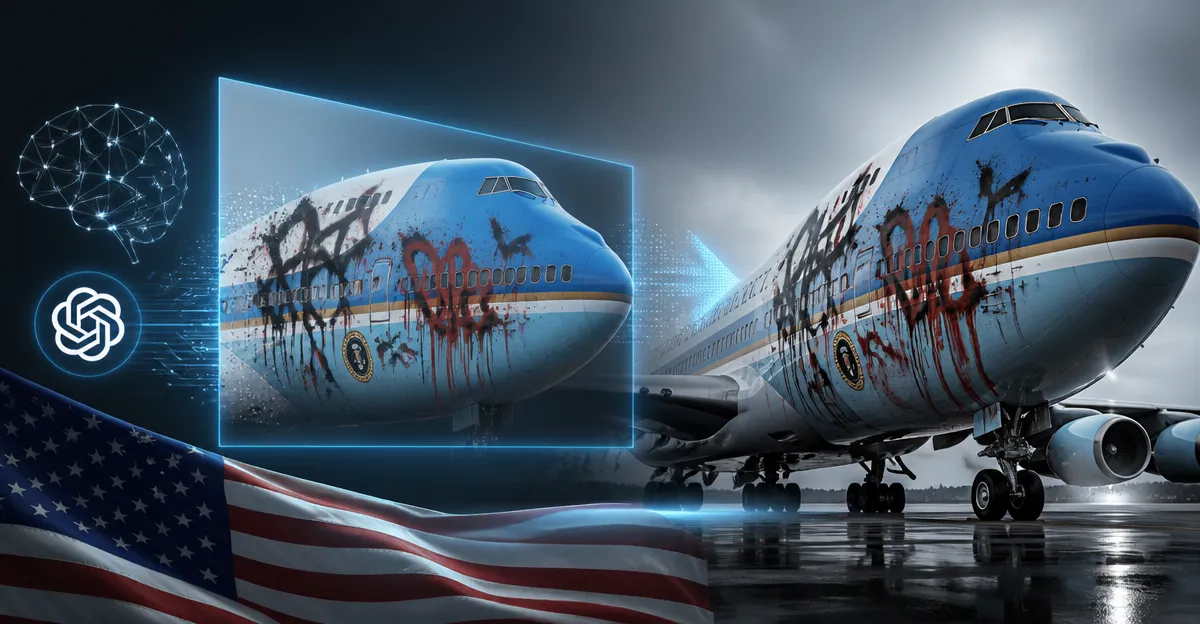
July 6, 2026, (Inside AI) — President Donald Trump shared an AI-manipulated image on Sunday depicting Barack and Michelle Obama waving from Air Force One, the plane digitally defaced with graffiti, the Associated Press reports. The doctored photo shows the former first couple on the steps of a baby-blue-and-white jet, its fuselage tagged with “Yes We Can,” “Obama,” “BLM,” and Arabic script reading “Alhamdulillah,” meaning “praise be to God.”
This is not Trump’s first use of altered imagery targeting the Obamas. In February, he posted a widely condemned image portraying them as primates in a jungle, which he later deleted after bipartisan backlash. A staffer was blamed, and Trump did not apologize. The latest post revives a pattern of deploying generative AI to amplify racially charged narratives, experts say.
The graffiti trope has long been weaponized in American politics to associate Black communities with crime and decay. By merging it with Air Force One, a symbol of presidential authority, the image creates a layered visual attack. The inclusion of “Alhamdulillah” adds another dimension, linking the Obamas to Islam in a way that critics call a dog whistle to anti-Muslim sentiment.
The Technology Behind Political Deepfakes
While the White House did not confirm the image’s origin, forensic analysis suggests it was likely created with consumer-grade generative AI tools. Platforms like Midjourney and Stable Diffusion can now produce photorealistic edits in seconds. The Obama image exhibits telltale signs: inconsistent lighting on the figures, unnatural shadow blending, and slight warping around the graffiti text.
Read: How AI Deepfakes Are Fueling Punjab’s Political Firestorm Ahead of 2027 Elections
This incident underscores a growing crisis: AI-generated disinformation is outpacing detection. A 2025 Stanford Internet Observatory study found that political deepfakes increased by 400% during the last election cycle. Most were crude but effective, designed to provoke emotional reactions rather than withstand scrutiny. Trump’s post, shared to his 150 million followers, exemplifies this strategy.
“These images are not meant to deceive experts,” says Dr. Joan Donovan, a disinformation researcher at Boston University. “They’re meant to signal to a base that’s already primed to believe the worst about their opponents.” The AP noted that neither the White House nor the Obamas’ spokesperson responded to requests for comment.
A Pattern of AI-Enabled Provocations
The Sunday post is part of a broader escalation. Last month, Trump shared an altered image of Obama’s presidential library in Chicago, depicting it surrounded by garbage. He captioned it: “The Obama Library ten years from now will be a ‘Mecca’ for those who hate America!” The use of “Mecca” drew sharp criticism for its religious insensitivity.
Trump also revived a feud with Italian Prime Minister Giorgia Meloni, posting an older photo with the caption “RESTRAINING ORDER NEEDED.” The AP reported that Meloni previously called Trump’s claims about her “completely fabricated,” saying, “Italy and I never beg.” Italian Foreign Minister Antonio Tajani canceled a planned Washington visit in response.
These posts arrive as Trump debuts a new Air Force One, a Boeing 747-8 valued at $400 million, gifted by Qatar and repainted in navy-blue, red, and gold. The contrast between the real jet’s stately livery and the graffiti-smeared parody is stark. Trump spent Sunday at his Virginia golf club after a July Fourth speech marking America’s 250th anniversary. He departs Monday for a NATO summit in Turkey.
Civil rights groups have condemned the imagery. NAACP President Derrick Johnson stated in a recent press release, “Using AI to revive racist caricatures is not free speech—it’s digital blackface.” Yet legal recourse is murky. Section 230 shields platforms, and deepfake laws vary by state. Only 10 states have criminalized malicious AI-generated imagery as of 2026.
Read: Thailand Denies AI-Generated Image of Macron Kneeling Before King
The historical parallel is striking. In the 1990s, manipulated photos of politicians were rare and required skill. Today, anyone with a prompt can create propaganda. A 2024 Pew Research survey found that 63% of Americans believe AI will make it harder to trust what they see online. Trump’s posts validate that fear, turning the presidency into a meme factory that blurs the line between satire and slander.
As the 2028 election looms, the weaponization of generative AI in politics will likely intensify. Platforms face pressure to label AI content, but enforcement is inconsistent. X, where Trump posted, uses “Community Notes” rather than proactive moderation. The note on Trump’s image simply reads, “This is an AI-generated image,” with no context about its racist undertones. For now, the digital smear campaign continues unchecked.