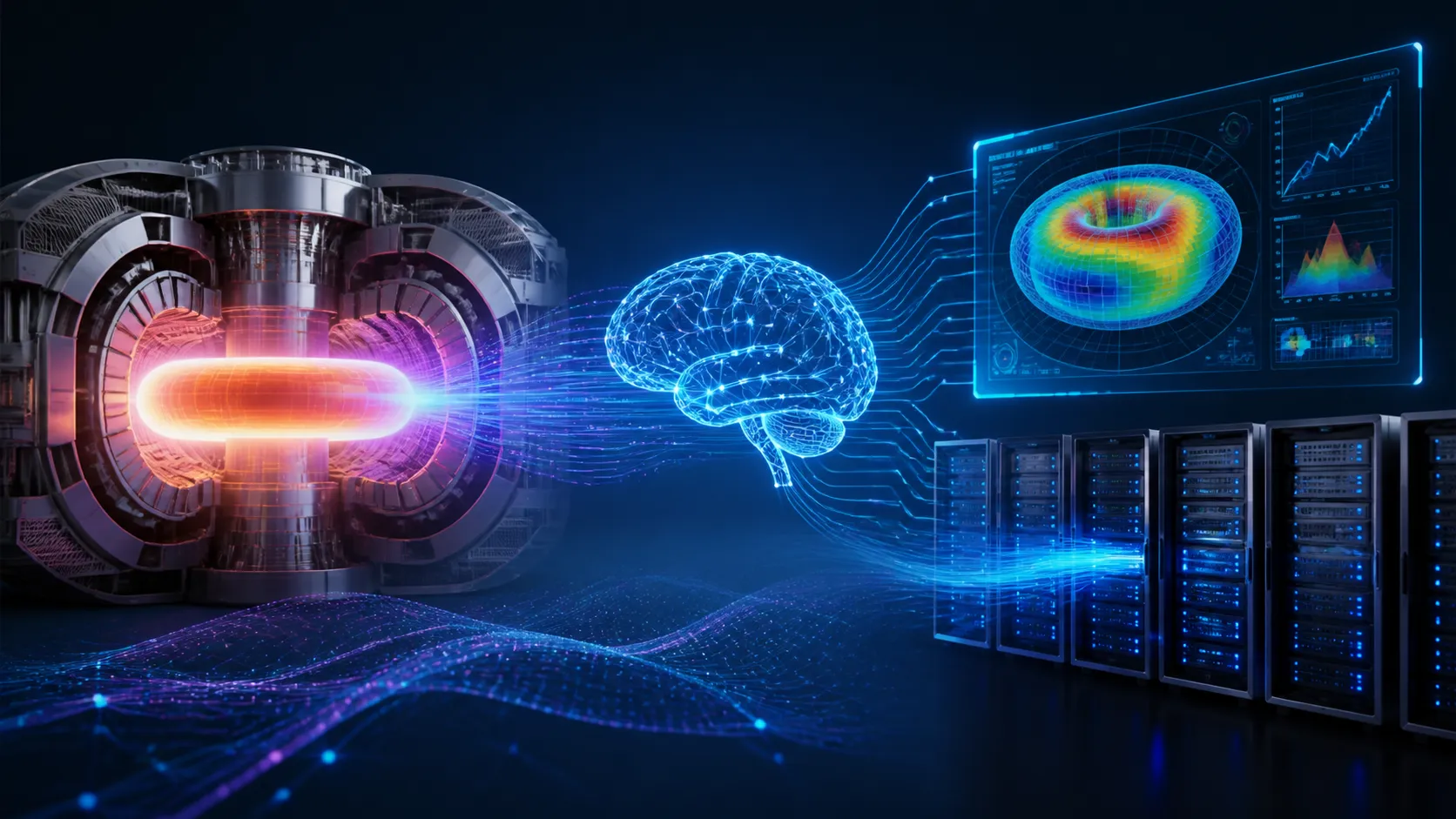
June 21, 2026, (Inside AI) — A Beijing start-up called VeloAlpha launched in April to solve a critical bottleneck in fusion energy development: slow, costly simulation software. Its flagship product, FusionAlpha, uses AI to let reactor designers test concepts virtually before building physical prototypes.
The Software Gap Holding Back Fusion
FusionAlpha is a simulator that helps developers test reactor designs on computers, avoiding expensive physical experiments. Xie Huasheng, a fusion theorist and plasma simulation scientist, founded the company after years of watching the industry struggle with inadequate digital tools.
Xie described a long-standing problem in fusion simulation.
“Fusion simulation software has long faced an ‘impossible triangle’,” Xie said. Existing tools, he argued, tend to be either accurate but computationally expensive, fast but unreliable, or simple in principle but too crude to allow accurate extrapolation and guide next-generation reactor design.
Read: China’s Fysics AI Launches Physics-Based World Model, Bypassing US AI Road Maps
This trade-off has forced researchers to pick two of three desirable traits: speed, accuracy, or physical fidelity. The result is a patchwork of tools that slow down innovation in a field already notorious for long development timelines.
AI Reshapes Plasma Modeling
VeloAlpha claims to break this triangle by embedding AI into the simulation core. Xie said over a dozen physics design and analysis models have seen sharp performance gains, driven by refined mathematical structures and advances in artificial intelligence.
“We are now at a turning point,” Xie said, noting that the performance of more than a dozen physics design and analysis models had improved sharply, driven by refined mathematical structures and advances in artificial intelligence that improved research efficiency.
The company likens its approach to electronic design automation (EDA) software in the semiconductor industry. Chipmakers use EDA to test and optimize designs long before fabrication. FusionAlpha aims to do the same for fusion reactors, slashing the need for costly physical trials.
Fusion replicates the sun’s power by forcing light atomic nuclei to merge, releasing massive energy. On Earth, scientists heat fuel into an extremely hot, electrically charged gas called plasma and must hold it stable long enough for the reaction to sustain itself.
Simulating plasma behavior accurately is notoriously difficult because of complex turbulence and electromagnetic interactions. Traditional methods rely on brute-force computation or simplified models that miss key physics. AI-driven surrogates can learn from high-fidelity simulations and then predict outcomes much faster.
Industry observers note that several labs have already experimented with machine learning for plasma control. However, VeloAlpha is one of the first start-ups to commercialize a full-stack design simulator specifically for fusion reactor engineering.
Read: AI Founders Who Rejected Bezos-Backed Prometheus Unveil Physics Model
Competing Forces in Fusion Simulation
While VeloAlpha enters a niche market, it faces indirect competition from national labs and open-source projects. The US Department of Energy’s Exascale Computing Project has funded advanced plasma codes. In Europe, the ITER organization relies on a suite of in-house tools. Some critics argue that AI-based simulators may lack the rigorous validation needed for safety-critical reactor design.
Xie counters that FusionAlpha is not a black box. The models retain physical constraints and are trained on verified data from tokamaks and stellarators worldwide. The company plans to publish benchmark results later this year.
Funding details remain undisclosed, but Xie confirmed the start-up has secured seed investment from Chinese venture capital firms focused on deep tech. The team includes plasma physicists, AI researchers, and former EDA engineers.
If successful, FusionAlpha could accelerate the timeline for commercial fusion by enabling faster iteration on reactor concepts. It may also lower the barrier for private fusion ventures that cannot afford massive supercomputing resources.
Yet the ultimate test will be whether the simulator’s predictions match real-world plasma behavior. As history shows, fusion has a way of humbling even the best models. For now, VeloAlpha represents a pragmatic bet that software, not just hardware, can bring the stars down to Earth.