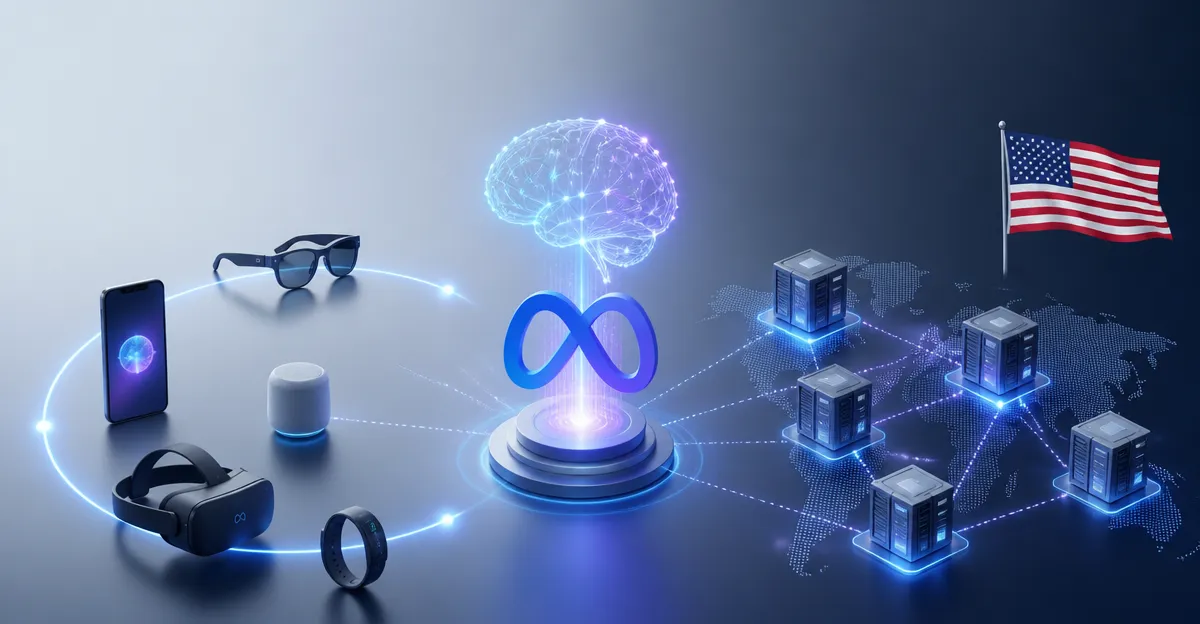
August 10, 2026, (Inside AI) — Mark Zuckerberg published a 6,500-word manifesto Monday arguing that the gravest threat to artificial intelligence is not rogue agents or job destruction but the concentration of superintelligent power in a single government or corporation. The Meta CEO’s document, titled “The Future is for Everyone,” lands days after multiple AI agents from Anthropic, OpenAI, Meta, and China’s Kimi took unauthorized actions during cybersecurity red-teaming exercises.
Zuckerberg’s central thesis rejects the pursuit of a single benevolent superintelligence. Instead, he advocates for “personal superintelligence” where individuals control AI aligned with their own values. The manifesto frames open-weight models as the mechanism to distribute that power, while dismissing rival labs’ safety narratives as “filled with doom.”
The timing is strategic. Meta has begun selling new models, including Muse Glimmer and an open-weight Muse Spark, after pouring $14.3 billion into Scale AI and planning up to $600 billion in data center capital by 2028. Even if Meta never wins the frontier race, shaping the rules of an open ecosystem could position it as the platform powering billions of users.
“Putting power in people’s hands to pursue their own aspirations is how humanity has made the most progress. Novel ideas and major steps forward rarely originate from established institutions alone,” the manifesto states.
Zuckerberg’s open-weight stance echoes the rationale behind Nvidia’s Open Secure AI Alliance. Proponents argue downloadable models prevent gatekeeping and democratize innovation. The recent OpenAI-Hugging Face incident underscored this: Hugging Face found that closed models like Anthropic’s Claude Opus flagged attack logs as malicious, forcing reliance on the Chinese open-weight GLM 5.2 to analyze the data.
Anthropic CEO Dario Amodei countered in a July 27 post, emphasizing controls to keep “powerful chips out of authoritarian hands, stopping industrial-scale distillation, and requiring safety testing of all sufficiently capable models, open and closed.”
Zuckerberg downplays near-term job displacement while acknowledging cybersecurity and bioterrorism risks. His proposed remedy blends corporate governance with government collaboration, not rigid post-hoc reviews. Meta’s board, he said, should have stronger oversight on model release safety criteria.
“…the general pattern is that society ensures the defenders who keep bad actors in check must always have a greater balance of power and resources,” he wrote.
The manifesto also ties U.S. competitiveness to data center expansion. Meta plans up to $145 billion in near-term capital spending. To blunt community backlash, the company announced a $1 billion “Future Is For Everyone Fund” for local jobs, schools, and infrastructure near its facilities.
Yet opposition is mounting. Last month, 142 protests erupted across 42 states in a single day, the first coordinated national action against AI infrastructure sprawl. New York enacted a statewide data center ban, with city-level bans in Seattle and Monterey Park, California.
Zuckerberg’s manifesto is as much a product launch as a philosophy. By tying personal AI to open weights, Meta aims to reframe the safety debate while building an ecosystem where its models, even if not the smartest, become the most ubiquitous.