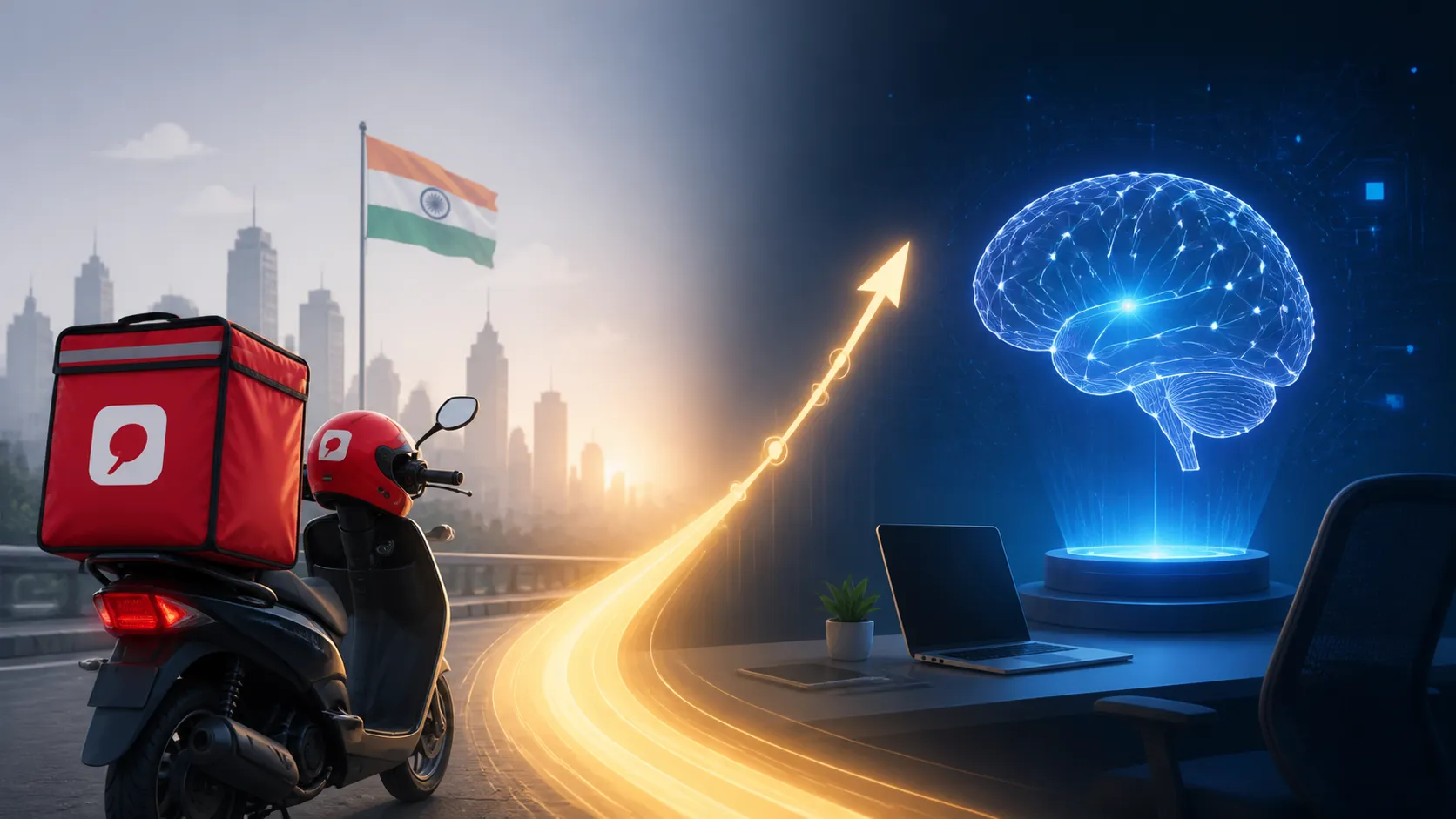
July 4, 2026, (Inside AI) — A former Zomato delivery partner who once earned Rs 1,500 a day navigating Kolkata’s streets is now the founder and CEO of two AI startups, challenging the industry’s one-size-fits-all approach with a vision for truly personalized artificial intelligence. Suraj Biswas, 28, leads both Assessli and Dots-in from Bengaluru, while keeping Assessli rooted in West Bengal. His journey from a small town in Nadia district to the startup ecosystem defies the stereotypical founder narrative.
Biswas’s path began in Chakdaha, a place he describes as “not the kind of place people expect founders to come from.” After studying Genetics at Gurunanak Institute of Pharmaceutical Science and Technology in Kolkata, he abandoned his childhood dream of becoming a doctor due to circumstances. To support himself, he delivered food for Zomato, a period he recalls with pride rather than shame.
“My daily earnings were between Rs 1000-1500. I remember it clearly, not with shame, but with pride,” Biswas told Hindustan Times. That experience, far from being a setback, became the crucible for his entrepreneurial vision.
The Genesis of Individual-Centric AI
Biswas’s frustration with the education system’s failure to personalize learning sparked a deeper inquiry into AI’s limitations. “It wasn’t one single moment. It was a slow accumulation of frustration and conviction,” he said. He observed that students weren’t failing due to incapability but because the system treated everyone identically.
Read: Global AI Models Struggle
This critique expanded to AI at large. “Why does AI, the most powerful technology in human history, still not understand the individual human?” Biswas asked. He noted that existing models learn population-wide patterns but fail to model specific individuals—their state, causation, and biology. “That gap felt like the biggest unsolved problem in technology. And nobody was working on it.”
In 2021, without investors, a co-founder, or even an office, Biswas founded Assessli to tackle this very problem. He later launched Dots-in, continuing his research into what he calls LBM—a technology intended to become core infrastructure for individualized AI. His work aligns with a growing but niche field in AI research that emphasizes personalization over aggregation, reminiscent of early work on user modeling and adaptive systems but with a modern, deep learning twist.
Navigating Credibility Gaps and Personal Loss
Building a startup from scratch brought immense challenges. “The first was credibility. When you come from a small town, study at an unknown college, and deliver food on a bike, nobody takes your pitch seriously,” Biswas said. Funding foundational AI research, which demands years of development without quick returns, tested his resilience.
Just as Assessli began gaining recognition, tragedy struck. Biswas’s father, a house painter, died in January 2024, two days after completing paperwork for an ISI Kolkata grant. “He sacrificed his own comfort his entire life for my future. And I couldn’t give him the moment of seeing the full fruit of that sacrifice,” Biswas reflected. This loss fueled his non-profit initiative, Indots, which supports children whose parents may not witness their success.
Biswas also mourned his abandoned medical dream: “I wanted to become a doctor. I was drawn to biology, to understanding how the body works, how the mind works. That path closed.” Yet, his biology background now informs his AI work, bridging disciplines in a way that echoes the interdisciplinary roots of AI pioneers.
Read: GPN-Star Learns from Evolution
Today, Biswas’s biggest hurdle is communicating the long-term vision of LBM, which he says is harder than marketing a product. His advice to aspiring entrepreneurs is to start without waiting for perfect conditions. “I came from a small town, studied at an unknown college, delivered food for money. None of that disqualified me,” he asserted, challenging the notion that one’s starting point dictates their ceiling.