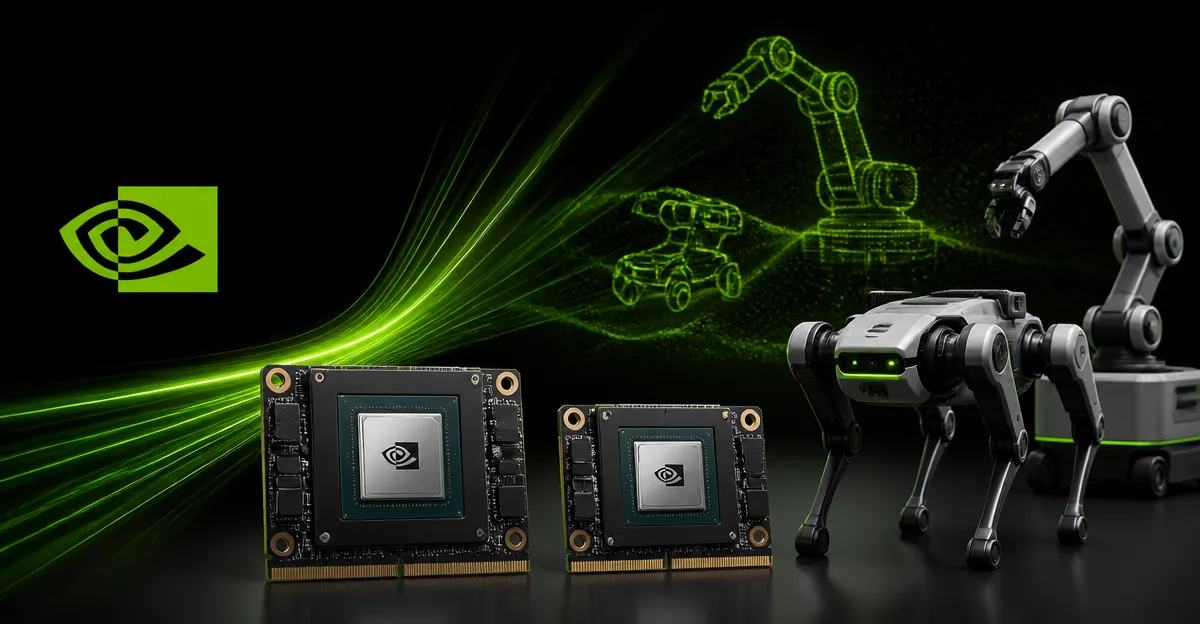
July 16, 2026, (Inside AI) — Nvidia has introduced two new compute modules, the Jetson Thor T3000 and T2000, to accelerate the next wave of robotics and edge AI. The announcement was made on July 15, targeting a market that is rapidly shifting from research to real-world deployment.
The modules are built on the Jetson AGX Thor architecture and are already being adopted by major players including Agile Robots, Amazon Robotics, 1X, Boston Dynamics, Hitachi, and Techman Robot. Nvidia says the hardware is purpose-built for humanoid and autonomous systems.
The T3000 delivers 865 FP4 teraflops of AI compute in a compact form factor roughly half the size of the Jetson T5000. It pairs an Nvidia Blackwell GPU with an eight-core Neoverse Arm CPU, 32 GB of LPDDR5X memory, and 237 GB/s of memory bandwidth. Connectivity includes 25 GbE.
Despite its smaller footprint, Nvidia claims the T3000 achieves inference performance comparable to the T5000 for multimodal workloads—including large language models, vision language models, and world foundation models. The company also highlights integrated functional safety and support for Nvidia Halos, a full-stack safety system for robots working alongside humans.
Read: China Humanoid Makers Face Challenge of Putting Robots to Work
The entry-level T2000 offers 400 FP4 teraflops and 16 GB of memory, targeting developers of visual AI agents and autonomous mobile robots. Both modules are expected to launch in Q1 2027, with the T3000 available sooner in emulation mode via JetPack 7.2.1.
The Economics of Shrinking Robotics Compute
Nvidia’s push into smaller, cheaper modules comes as memory prices soar and robotics companies seek to scale. By delivering near-T5000 performance in a smaller package, the T3000 could significantly reduce bill-of-materials costs. This mirrors trends in industrial PCs, where compact, integrated systems have gradually replaced bulkier alternatives.
However, Nvidia faces growing competition. Qualcomm’s RB6 platform and Intel’s Meteor Lake edge processors are also vying for the robotics market. Meanwhile, startups like Hailo and Mythic are pushing ultra-low-power AI accelerators. Nvidia’s advantage remains its unified CUDA software stack and the Jetson ecosystem, which supports everything from prototyping to production.
Safety and the Humanoid Race
The integration of Halos signals Nvidia’s bet on humanoid robots moving from labs to factory floors. Safety certification is a major hurdle for collaborative robots, and Nvidia’s end-to-end approach could accelerate deployment. But competitors like Boston Dynamics (which uses Nvidia hardware) and Tesla’s Optimus are also advancing quickly.
Deepu Talla, Nvidia’s vice president of embedded and edge computing, said in a statement:
Read: Unitree CEO Says Robots Are Nearing a ‘ChatGPT Moment’
“The new Jetson AGX Thor is powering the next generation of humanoid and robotic systems.”
Yet some industry analysts caution that the 2027 launch timeline may allow rivals to catch up. The robotics market is evolving rapidly, and a two-year gap between announcement and availability could test developer patience.
Nvidia also announced GeForce NOW in India, bringing cloud gaming to the region—a separate but synergistic move to expand its AI infrastructure reach. As robotics and edge AI converge, Nvidia’s modular strategy aims to lock in developers with scalable hardware and a common software foundation.