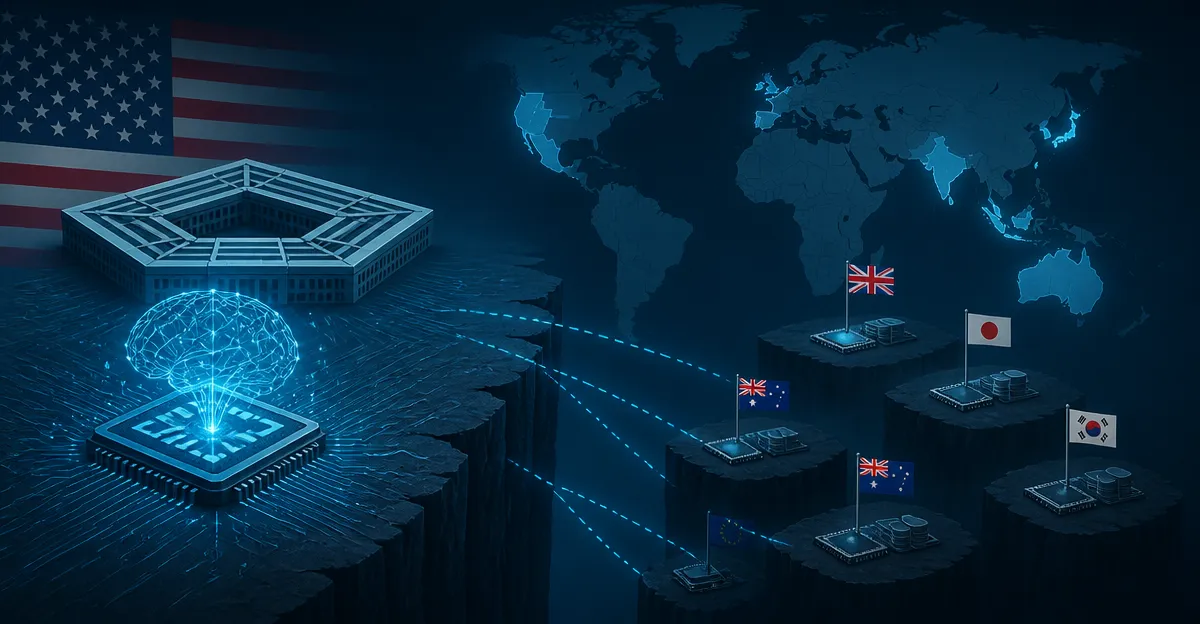
September 9, 2026, (Inside AI) — The Pentagon's most senior artificial intelligence official says Washington's closest allies cannot match the speed, scale, or experience of the U.S. military's AI push. The gap is forcing the Department of War to intervene directly with Nato and Five Eyes partners to prevent them from repeating American missteps.
Cameron Stanley, chief digital and artificial intelligence officer, delivered the assessment Tuesday at the Billington Cybersecurity summit. His remarks framed allied AI adoption as a resource problem, not a talent problem.
"They don't have the resources that we do, they don't have the experience that we do, they don't have the scale that we do," **Stanley said.**
He confirmed Washington is "actively working with a number of our partners" across Nato and the Five Eyes alliance of the U.S., U.K., Canada, Australia, and New Zealand. The goal, Stanley said, is to ensure allies "don't make the same mistakes that we make."
The warning lands less than a year into Stanley's tenure. Since January, his office has launched GenAI.mil, an internal chatbot platform that Stanley says has reached 1.7 million users, and Agent Network, a system built to compress the time between intelligence collection and a commander's decision.
Pentagon secretary Pete Hegseth has directed Stanley's office to report AI deployment speed as a monthly metric. The directive is part of a broader push to expand military computing power across the force.
Speed Is the Pentagon's New Battlefield Metric
Stanley's appearance centered on operational tempo. He described watching a commander halt a scheduled briefing, take a 30-second phone call, and issue an order on the spot. No formal decision brief. No review of the room's security clearance level.
He called the moment "revolutionary."
"I know it sounds simplistic," **Stanley explained.** "It's only simplistic because we're good at it now."
The word is not new for Stanley. Project Maven, the Pentagon's original AI targeting program launched in 2017, evolved into the Palantir-built Maven Smart System. Stanley called Maven "revolutionary" at Palantir's AIPCon 9 conference in March, noting it let commanders move from target identification to strike launch within a single platform.
During the U.S. air campaign against Iran earlier this year, Stanley said at a May conference that Maven helped strike more than 13,000 targets over the first 38 days.
Civilian Casualty Questions Shadow the AI Offensive
The campaign has drawn sharp scrutiny. More than 120 members of Congress signed a letter demanding answers from the Pentagon about civilian casualties and AI use. The letter followed a 28 February strike on an elementary school in Minab. Iranian officials say the strike killed at least 168 people, many of them children.
Stanley did not address the letter directly. He closed with a warning about institutional inertia.
"The way we've always done it is the most risky course of action," **Stanley said.**
He added that the department must "think differently" if it wants AI tools in the hands of warfighters faster. The remarks signal a continued emphasis on deployment speed, even as oversight questions mount.