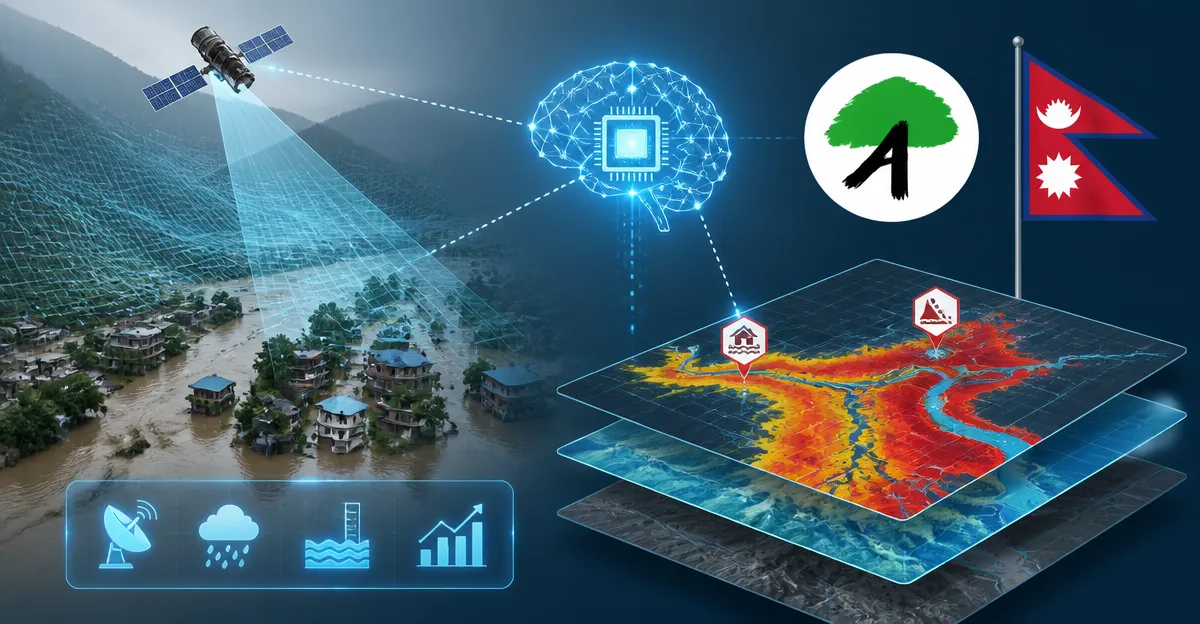
September 19, 2026, (Inside AI) — As climate-driven disasters intensify across the Himalayas, a leading ecologist argues that artificial intelligence could become a critical tool for mapping hazards and predicting floods like those that recently devastated parts of Nepal and Tibet. Kamal Bawa, founder of the Bengaluru-based Ashoka Trust for Research in Ecology and the Environment (ATREE), said AI can process satellite imagery and terrain data to identify high-risk zones before disaster strikes.
Bawa, a distinguished professor of biology at the University of Massachusetts, Boston, has spent decades studying biodiversity and climate change in the Himalayas. His comments come as the region reels from catastrophic flooding that swept through Nepal and southern Tibet in recent weeks, killing dozens and displacing thousands. The floods, triggered by heavy monsoon rains and glacial melt, exposed gaps in early warning systems across the fragile mountain ecosystem.
ATREE's Himalaya Initiative, which Bawa leads, aims to integrate ecological research with advanced technologies to build resilience in one of the world's most climate-vulnerable regions. The program focuses on understanding how shifting weather patterns, retreating glaciers, and changing land use interact to amplify disaster risk.
Bawa pointed out that AI's ability to analyze vast datasets from satellites, weather stations, and ground sensors could help authorities pinpoint areas prone to landslides, flash floods, and glacial lake outbursts. Such mapping, he said, is essential for evacuation planning and infrastructure development.
Read: AI's Measurable Impact on Global Challenges Documented in Decade Review
"AI can be used to map hazards during disasters like the recent Nepal floods," Bawa said.
The recent Nepal-Tibet floods underscore the urgency. In August 2026, unusually intense rainfall caused rivers to overflow, sweeping away homes and roads in Nepal's Sindhupalchok district and parts of Tibet's Shigatse region. According to sources, local governments struggled to issue timely warnings because monitoring networks are sparse and data-sharing across borders remains limited.
Bawa's work at ATREE has long emphasized community-based conservation, but he now sees technology as a force multiplier. The Himalaya Initiative collaborates with geospatial analysts and data scientists to develop predictive models that can forecast flood paths and identify vulnerable settlements. These models rely on machine learning algorithms trained on historical flood data, rainfall patterns, and topographic maps.
While AI offers promise, experts caution that its effectiveness depends on data quality and infrastructure. Many remote Himalayan communities lack reliable internet and power, making real-time alerts difficult. Bawa acknowledged these challenges but remained optimistic that low-cost sensors and mobile technology could bridge the gap.
Beyond disaster response, Bawa said AI is transforming biodiversity conservation. Researchers are using AI-powered camera traps and acoustic sensors to monitor wildlife populations, detect poaching, and track habitat changes. At ATREE, such tools have helped document species in the Eastern Himalayas and assess the impact of climate change on migration patterns.
Bawa's credentials lend weight to his views. He has published over 200 research papers, authored 10 books, and edited two international journals on biodiversity. His accolades include the Gunnerus Prize in Sustainability Science, the MIDORI Prize for Biodiversity, and the Linnean Medal. He is widely regarded as a pioneer in integrating ecology with social justice.
The Himalaya Initiative also trains local researchers and engages policymakers to ensure scientific findings inform disaster management plans. Bawa stressed that technology alone cannot solve the crisis. Political will, cross-border cooperation, and investment in rural infrastructure are equally vital.
Read: UN's First Scientific AI Report Urges Governments to Act Before It's Too Late
As the region braces for more extreme weather, Bawa's call for AI-driven hazard mapping resonates with a growing chorus of scientists. They argue that early warning systems, bolstered by AI, could save lives and reduce economic losses. The Nepal floods, which caused an estimated $200 million in damage, highlight the cost of inaction.
In the coming months, ATREE plans to pilot an AI-based flood forecasting tool in select Himalayan watersheds. If successful, the model could be scaled across Nepal, India, and Bhutan. Bawa hopes such initiatives will spur governments to adopt technology-driven disaster preparedness.
For now, the focus remains on recovery and rebuilding. But Bawa's vision extends beyond immediate relief. He envisions a future where AI helps communities anticipate disasters rather than merely react to them, turning the Himalayas from a zone of risk into a model of resilience.