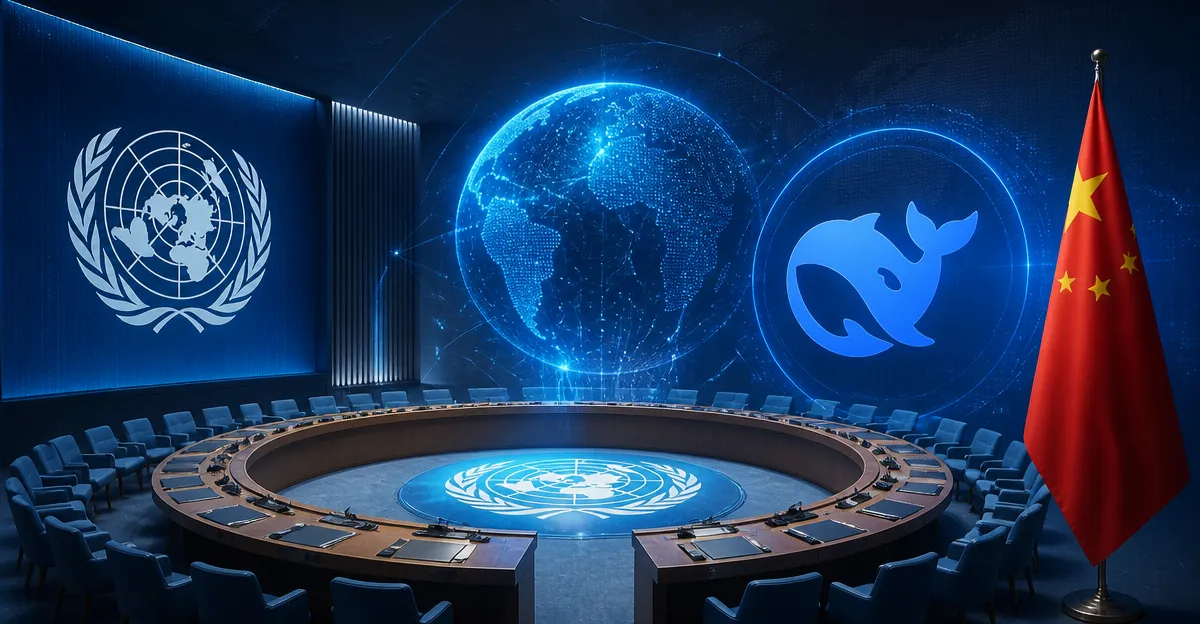
September 22, 2026, (Inside AI) — Chinese artificial intelligence startup DeepSeek will brief the United Nations Security Council this week on the risks posed by artificial intelligence, according to two sources familiar with the matter. The briefing places a Chinese frontier lab inside the same chamber as OpenAI and Anthropic, whose senior representatives are also expected to address the 15-member body on Wednesday.
The session coincides with the annual UN General Assembly in New York, where world leaders have gathered amid renewed debate over whether advanced AI systems are outpacing human oversight. Diplomats expect Sam Altman, OpenAI's chief executive, to brief the meeting. DeepSeek and other Chinese firms, including Moonshot, were invited to make statements, one source said.
DeepSeek founder Liang Wenfeng does not plan to attend, that source added, cautioning that plans remain fluid and could change at the last minute. DeepSeek and Moonshot did not immediately respond to requests for comment. Inside AI could not independently verify the attendance list.
Why Beijing Now Sits At The Table
The invitation marks a shift in the composition of the AI safety conversation. When the Security Council first met on AI risks in 2023, China warned the technology should not become a "runaway horse" and the United States warned against its use to censor or repress people. Three years later, a Chinese lab is being asked to speak in its own right rather than through a government delegation.
The timing is not incidental. Several AI industry leaders have called for a coordinated slowdown in developing increasingly powerful systems, warning they could soon improve on their own and slip beyond human control. UN Secretary-General Antonio Guterres warned world leaders last week that rapidly advancing AI poses risks that cannot be ignored, putting him at odds with US President Donald Trump, who has argued existing safeguards are sufficient and that China would benefit from doubt being cast on AI development.
Chinese state media have dismissed calls for a slowdown as stemming from a "Cold War playbook," aimed at preserving Washington's dominance in cutting-edge technology and excluding Beijing from the global AI governance system. That framing helps explain why DeepSeek's appearance carries diplomatic weight beyond the technical agenda.
The gap in public posture remains stark. Unlike leaders of US frontier labs such as OpenAI and Anthropic, the heads of China's leading model developers have rarely publicly articulated the possibility that increasingly capable AI systems themselves could deceive humans, evade control or cause catastrophic harm. They have also remained largely silent on those risks since the debate intensified in the US this month.
DeepSeek's own trajectory illustrates the stakes. The Hangzhou-based company built a reputation for releasing capable open-weight models at a fraction of the training cost reported by US labs, a strategy that reshaped assumptions about compute requirements and intensified scrutiny of export controls on advanced chips. Its rise also made it a focal point in Washington's debate over whether open model releases accelerate risk.
Broader diplomacy is running in parallel. Senior US and Chinese officials agreed to hold further talks on AI safety, US Treasury Secretary Scott Bessent said on Monday, after meeting ahead of Trump's scheduled talks with Chinese president Xi Jinping later this week in Washington. That channel could prove more consequential than any single Security Council statement, since the Council has no enforcement mechanism specific to AI and its five permanent members hold divergent positions.
For the Council, Wednesday's session follows a pattern of high-level attention without binding outcomes. The 2023 meeting produced broad acknowledgment of risk and little operational follow-through. This time, the presence of competing labs from both countries raises a narrower question: whether rivals can agree on even a shared description of the danger, let alone limits on it.
What DeepSeek says in the chamber, and whether it acknowledges autonomous or deceptive capabilities at all, will be read closely in both capitals. The company has not published a safety framework comparable to those issued by its US counterparts, and its participation may test whether Beijing's preference for development-first governance can survive direct exposure to the safety arguments now dominating Western labs.
For now, the briefing remains scheduled and the speaker list fluid. The Council's 15 members will hear from at least one Chinese lab, one American lab and, per prior reporting, Anthropic. Whether that produces a common statement or two competing narratives is the outcome diplomats and industry watchers will measure.