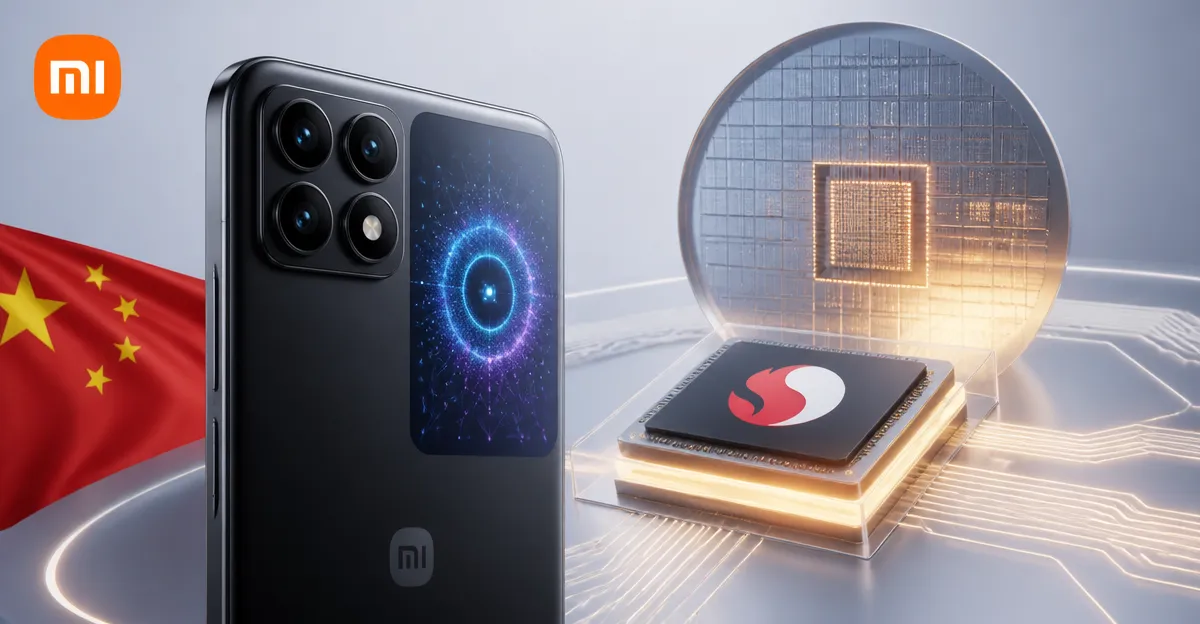
September 24, 2026, (Inside AI) — Xiaomi has launched the Xiaomi 18 Pro in China, pricing it from RMB 5,999. The handset is the first device to run Qualcomm's sixth-generation Snapdragon 8 Elite platform, built on a 2nm process node. Qualcomm's chip runs at a peak CPU frequency of 5GHz and carries a marked jump in on-device AI throughput.
The launch lands in a smartphone market that has spent two years arguing about whether generative AI belongs in hardware at all. Xiaomi's answer is literal: a flat, integrated back display that generates its own tiny applications. The panel measures just 0.99mm per side, giving the phone a four-sided bezel that is effectively invisible at arm's length.
Those AI-generated apps include timers, habit trackers, and recipe recommendations. They are not downloaded from a store. The phone composes them on demand, which shifts the software model from installed utilities toward generated ones. That is a meaningful architectural bet, and it depends entirely on how much inference the 2nm silicon can sustain without draining the battery.
Xiaomi has hedged that risk with a 7,000mAh cell, one of the largest in a mainstream flagship. The camera array pairs two 200-megapixel Leica sensors, continuing a partnership that has become central to Xiaomi's premium positioning. The combination of a 5GHz CPU, dual 200MP sensors, and a persistent secondary display suggests the company expects heavy local AI workloads rather than cloud offload.
Read: Qualcomm Unveils Camera-Equipped Earbuds Concept with Snapdragon Sound Elite Gen 2
Qualcomm's 2nm Bet Meets China's Flagship Race
The 2nm designation matters beyond marketing. Shrinking transistors to that scale typically delivers either more performance at the same power or the same performance at lower power. Qualcomm has chosen the first path with a 5GHz peak, a figure that would have been unthinkable in a phone chip five years ago. The tradeoff is thermal management, and Xiaomi's large battery may be as much about heat headroom as runtime.
Rivals are watching closely. Samsung, Apple, and Chinese peers including Huawei and Vivo all compete in the same premium tier, and each has staked out a different AI story. Apple has pushed private cloud compute. Huawei has leaned on domestic silicon. Xiaomi's approach is the most visible: put the AI output on the outside of the phone, where everyone can see it.
The pricing at RMB 5,999 positions the 18 Pro below many imported flagships while offering specifications that match or exceed them. That undercutting strategy has worked for Xiaomi before, but the 2nm chip is likely expensive, and margins on a device with dual 200MP sensors and a 7,000mAh battery will be thin.
One open question is developer access. Xiaomi has not detailed whether third parties can build for the back display or whether the AI-generated apps remain a closed system. If the panel stays proprietary, its utility may plateau quickly. If Xiaomi opens it, the back display could become a genuine platform rather than a novelty.
The launch also tests consumer appetite for generated interfaces. Most AI phone features so far have been assistants, summarizers, or photo editors. A display that invents small apps in real time is a different proposition, and it raises familiar questions about reliability and predictability. Users generally want tools that behave the same way twice.
Xiaomi has not disclosed global availability or a release date outside China. Given the company's history, an international rollout is likely, but regulatory scrutiny of AI features varies by market. The 18 Pro will first be judged by Chinese buyers, who have shown strong demand for high-specification phones at aggressive prices.
For Qualcomm, the design win is a proof point for its 2nm roadmap. For Xiaomi, it is a claim to the front of the AI hardware race. Both companies now need the back display to be more than a demonstration.