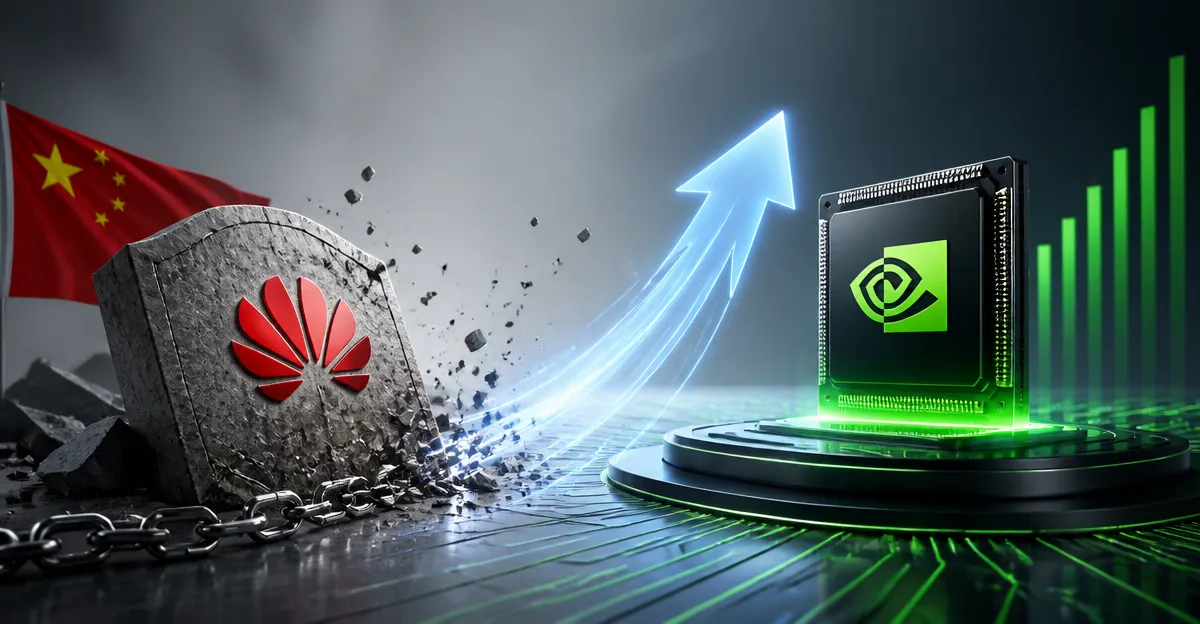
September 24, 2026, (Inside AI) — Huawei's September 17 announcement that it will launch two new artificial intelligence chips in 2027 marks a decisive shift for the Chinese technology giant. Once a telecom equipment maker fighting for survival under Western sanctions, Huawei now positions itself as a direct challenger to Nvidia, the $5.5 trillion AI chip leader.
The company plans to release the Ascend 960DT in the first quarter of 2027 and the Ascend 960PR in the third quarter, according to David Wang, one of Huawei's rotating chairs, who spoke at a Shanghai event. The chips represent the company's most aggressive move yet into the AI accelerator market, which Nvidia has dominated for years.
Huawei's transformation did not happen overnight. Years of heavy spending on research and development have eroded profitability and expanded its balance sheet. But that investment has equipped the company to compete in a market where Nvidia's grip has seemed unbreakable.
The timing matters. Western sanctions have cut Huawei off from advanced chipmaking tools and American technology. Yet the company has continued to develop AI chips, suggesting its internal design capabilities have matured. The Ascend lineup, which already includes earlier models, has become a cornerstone of China's push for technological self-reliance.
Read: Huawei Ascend 960 SuperPoD Challenges NVIDIA AI Dominance
Nvidia's $5.5 trillion valuation reflects its near-monopoly on AI training and inference hardware. The company's H100 and A100 chips power most large language models and AI services worldwide. But export controls have limited Nvidia's access to Chinese customers, creating an opening for domestic alternatives.
Huawei's new chips could fill that gap. The 960DT and 960PR are expected to target data center workloads, though specific performance details remain undisclosed. The company has not released benchmarks or pricing information.
The announcement also signals Huawei's broader ambition. The company has moved from telecoms equipment to smartphones to cloud computing and now AI chips. Each transition required massive capital investment and long-term planning. The result is a company with deep technical expertise and a willingness to absorb short-term losses for strategic gains.
Profitability has suffered. Huawei's margins have narrowed as it poured money into research. Its balance sheet has grown larger and more complex. But those sacrifices have built capabilities that few Chinese firms can match.
The AI chip market is not just about hardware. Software ecosystems, developer tools, and customer support matter just as much. Nvidia's CUDA platform has become an industry standard, and switching costs are high. Huawei will need to offer compelling alternatives to win over customers.
Still, the Chinese market is large enough to sustain a domestic challenger. Government support, national security concerns, and a desire for supply chain resilience all favor Huawei. The company's existing relationships with Chinese cloud providers and enterprises give it a ready customer base.
Read: Huawei Sets Commercial Launch Dates for Ascend 950 AI Cluster Cloud Service
Analysts have noted that Huawei's chip ambitions face significant hurdles. Manufacturing advanced AI chips requires cutting-edge fabrication, which China still struggles to access. The company may rely on older process nodes or work with domestic foundries like SMIC.
Those constraints could limit performance. But for many AI workloads, especially inference, older nodes can still be competitive. Huawei may target applications where absolute performance matters less than cost, availability, and local support.
The announcement also raises questions about Nvidia's future in China. Export restrictions have already reduced Nvidia's Chinese revenue. If Huawei can deliver viable alternatives, Nvidia's market share could shrink further.
Nvidia has responded by developing chips specifically for the Chinese market that comply with export rules. But those chips are less powerful than the company's top-tier products. Huawei's new offerings could exploit that gap.
The broader implications extend beyond China. If Huawei succeeds, it could encourage other countries to seek alternatives to American technology. The AI chip market could fragment into regional blocs, with different standards and supply chains.
That outcome would reshape the global tech industry. Nvidia's dominance has been a unifying force, but it has also created dependencies. Governments and companies increasingly view those dependencies as risks.
Huawei's move is part of a larger trend. Countries around the world are investing in domestic semiconductor capabilities. The United States, Europe, Japan, and South Korea have all launched initiatives to boost local production.
The AI chip race is now a geopolitical contest. Huawei's announcement shows that sanctions have not stopped China's progress. Instead, they have accelerated efforts to build independent capabilities.
Huawei's path forward will not be easy. It must overcome technical challenges, build software ecosystems, and convince customers to switch. But the company has shown resilience before. Its transformation from telecoms survivor to AI challenger is already underway.