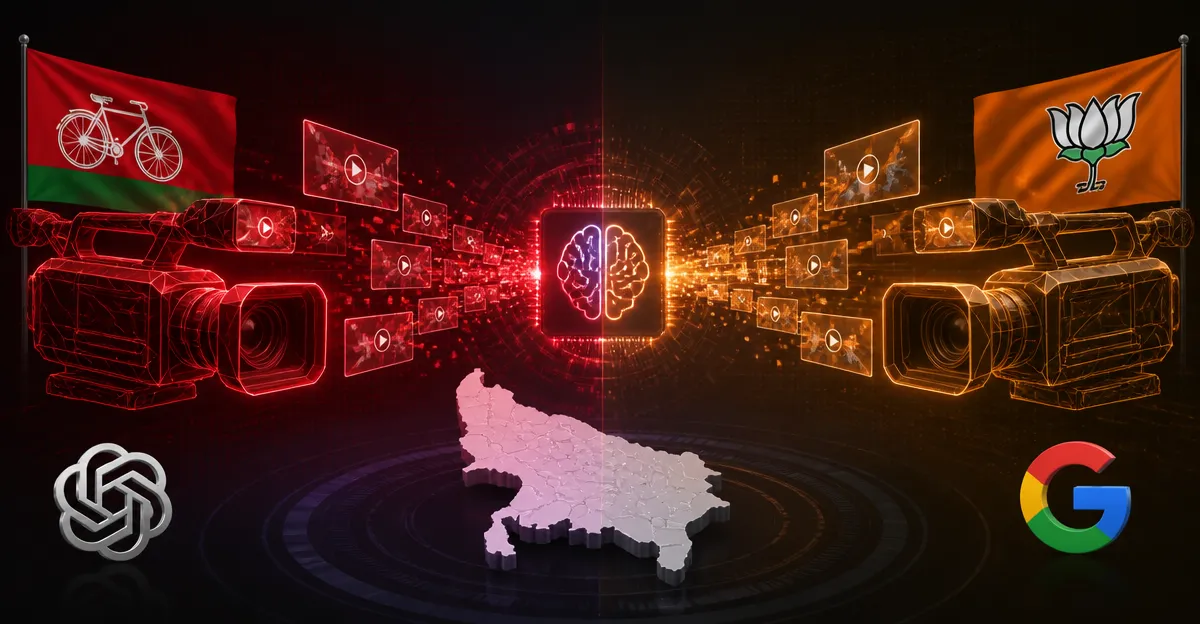
September 24, 2026, (Inside AI) — A new front has opened in India's most populous state. In Uttar Pradesh, where assembly elections are due in early 2027, the ruling Bharatiya Janata Party (BJP) and the opposition Samajwadi Party (SP) are trading accusations over the use of AI-generated videos, with both sides denying responsibility for derogatory content while simultaneously showcasing such material in public.
The dispute escalated on August 31, when SP president Akhilesh Yadav played an AI video at a press conference featuring a character resembling Chief Minister Yogi Adityanath. The video touched on allegations of theft in Ram Temple donations, price rise, and women's safety. Yadav claimed he received the video from an unidentified source. At the same press conference, he also showed another AI video that he alleged was circulated by the BJP, blaming him for crimes against women and riots.
Yadav cautioned the BJP against what he called the use of public money for such activities. "Don't play childish games; the government shouldn't waste its money. If you do it, we will play along with you," he said, calling for an investigation into the social media handles that circulated the videos.
The BJP has denied producing or uploading any derogatory AI videos on its official handles. "There is nothing wrong in using AI tools but misuse should not take place and it should not be derogatory. We also use AI tools but BJP did not make or upload any derogatory videos on its official handles," BJP spokesperson Rakesh Tripathi told Inside AI. He added that the SP chief himself had been shown playing derogatory AI videos during press interactions.
Read: AI Fears Enter Midterm Campaigns as Voters Weigh Data Centers and Existential Risk
SP spokesperson Rajendra Chaudhary countered that the BJP started the AI war by making derogatory statements about Akhilesh. "We are not making the videos. Offended by the BJP, our workers just sent the videos and we just played them," he said.
Grassroots Satire Or Coordinated Campaign?
Since the initial exchange, Akhilesh Yadav has repeatedly used AI videos to attack the government. On September 10, he showed a clip featuring characters resembling Adityanath and Gorakhpur MP Ravi Kishan dancing, juxtaposed with actual videos of people complaining about civic amenities. A week later, another AI video portrayed an Akhilesh character as a revolutionary questioning a Yogi lookalike, ending with a claim that a PDA (Pichde, Dalits, Alpsankhyak) government would be formed in 2027.
On September 19, Yadav defended the strategy. "This is a new kind of election; these are new times. We have to fight on the ground as well as on digital platforms. The battle must be fought on both fronts - we cannot afford to falter when it comes to narrative and perception," he said. He argued that if the opposition did not create its own digital content, party workers could become demoralised when confronted with videos produced against them.
SP leaders maintain that the AI videos are not officially produced by the party. Instead, they say workers and supporters create such content and forward it to the leadership. This approach, they argue, protects creators from potential police action. The party has thus decided to have its leaders play the videos at its office rather than upload them directly.
On Monday, Yadav unveiled another AI video, a hip-hop song clip centred on him and the SP. "We do not want to create negative songs, nor do we want to be left behind. While others might be producing songs using money or government budgets, our party workers are creating them free of cost. They are deeply attached to the party, which is why they are expressing their sentiments through these songs," he said.
The BJP's social media campaign in UP also uses memes and videos, with a major theme being a comparison between the previous SP regime and BJP rule since 2017. An AI video circulated through the UP BJP social media platform recently took a swipe at seat-sharing between the SP and the Congress while targeting Akhilesh.
Read: Pakistan Bans Officials From Using Public AI Tools for Classified Data
AI Lowers Barrier To Political Satire
The use of AI-generated content in political messaging is not unique to India. In the 2024 US presidential election, AI-generated videos of President Joe Biden and former President Donald Trump circulated widely, though many were debunked. In India, the 2024 general elections saw a surge in AI-generated content, including deepfake videos of politicians. However, the UP case is notable for the direct involvement of a major party leader in showcasing such content.
An SP leader, speaking on condition of anonymity, said the 2027 contest is likely to be fought not only through rallies and conventional media but also through short videos designed for rapid circulation. "AI lowers the barrier to producing political satire. A recognisable face can be converted into a fictional character, placed in an invented situation and given scripted dialogue within minutes and connects better with the masses," the leader said.
Legal experts point out that India's IT Rules, 2021, require social media platforms to remove content that impersonates others, but enforcement is weak. The lack of clear regulations on AI-generated political content means parties can exploit loopholes. The Election Commission of India has not yet issued specific guidelines on AI-generated campaign material for the 2027 polls.
As the election approaches, the AI video war is likely to intensify. Both parties are investing in digital teams and AI tools. The SP's strategy of playing videos at press conferences rather than posting them online may be a way to avoid legal scrutiny. The BJP, meanwhile, continues to use AI for memes and comparisons, though it denies making derogatory content.
With less than a year to go before the polls, the battle for narrative and perception in UP is being fought not just on the ground but also on digital platforms, where AI-generated content is emerging as a potent, and controversial, tool.