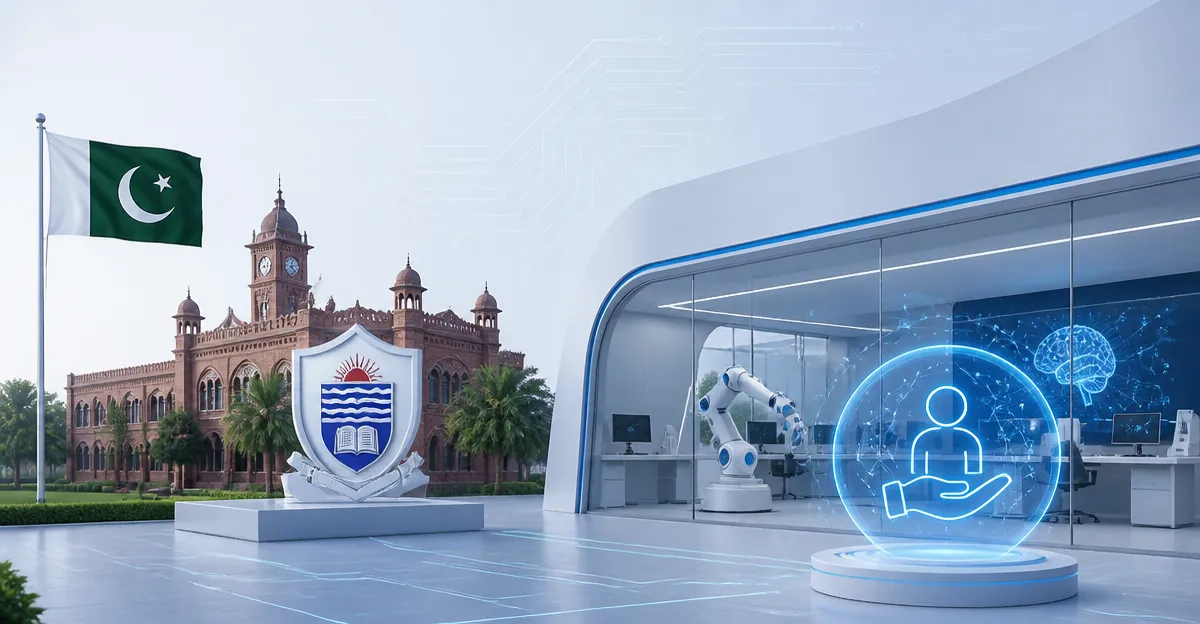
October 3, 2026, (Inside AI) — The University of the Punjab will inaugurate its Human-Centered Artificial Intelligence Laboratory on October 7, a facility established at its Faculty of Computing and Information Technology. The project is a joint effort between Punjab University, Türkiye's Turkish Cooperation and Coordination Agency (TIKA), and the Ministry of Culture and Tourism of Türkiye.
The lab will support researchers, faculty, and students from Pakistan and Türkiye, providing a base for joint research and academic activities in artificial intelligence. It will include modern computing systems and server infrastructure.
The inauguration ceremony will feature a senior Turkish delegation. TIKA Vice President Ali Erçan and Punjab University Pro-Vice Chancellor Professor Dr. Mahmood Saleem are expected to attend. The event will begin with refreshments from 12:00 p.m. to 12:20 p.m., followed by the recitation of the Holy Quran. Professor Dr. Mahmood Saleem will deliver the welcome address at 12:30 p.m. Officials will brief attendees on the laboratory's development, previous activities, and future research plans. The ceremony will conclude with commemorative gifts for the Turkish delegation and a group photograph.
This initiative builds on an academic cooperation agreement signed between Punjab University and Türkiye's Yıldız Technical University. The agreement focuses on human-centered artificial intelligence research and education. Under the deal, both universities will work on joint research projects and postgraduate programs, support student and faculty exchanges, and share academic resources.
Read: MIT Transit Lab wins $2.1M from Google.org to build AI platform for public transit agencies
Over the next five years, the universities aim to produce more than 10 joint research papers and support at least five jointly funded external research projects. The agreement also sets a target of more than 20 MPhil and PhD research papers. Yıldız Technical University will share research resources and academic materials with Punjab University. It will also provide teaching experience related to human-centered artificial intelligence and support Punjab University faculty members teaching relevant AI courses, helping them develop their knowledge and teaching skills.
Human-centered AI prioritizes systems that augment human capabilities, respect ethical considerations, and align with societal values. This collaboration positions Punjab University and Türkiye as emerging players in a field increasingly dominated by major tech hubs in the United States, China, and Europe.
While the partnership signals growing South-South and South-North cooperation in AI, it remains to be seen how these academic efforts translate into practical applications. The lab's success will depend on sustained funding, access to cutting-edge hardware, and the ability to retain talent in a competitive global market. Neither university has disclosed specific funding amounts or the source of external research grants.
Read: HBR Research Reveals AI Intensifies Work and Erodes Judgment
Inside AI could not independently verify the total investment or the operational timeline beyond the initial five-year targets. The inauguration marks a concrete step in Pakistan-Türkiye academic ties, but the broader impact on regional AI ecosystems will require long-term commitment and measurable outcomes.

Shamil has a low tolerance for AI that only works in controlled demos. He covers agentic systems and generative AI with the skepticism of someone who has seen too many “revolutionary” tools quietly disappear six months after launch.