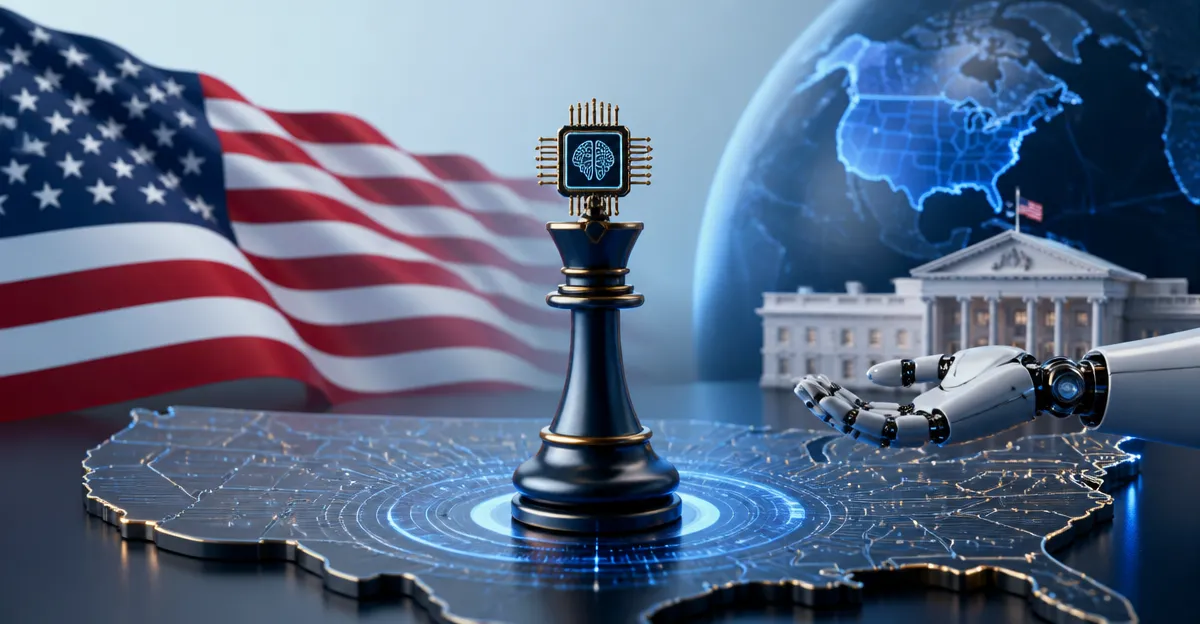
October 4, 2026, (Inside AI) — President Donald Trump named four officials on Sunday to lead a newly created "super intelligence force," a White House initiative aimed at protecting American interests in artificial intelligence. The president announced the appointments in an Oct. 4 post on Truth Social, according to sources familiar with the matter.
The force will be led by National Intelligence Director Jay Clayton, alongside Federal Trade Commission Chairman Andrew Ferguson, Office of Personnel Management Director Scott Kupor, and Pentagon research and technology official Emil Michael. The group's exact mandate remains undefined, but its creation signals a push to coordinate AI policy across intelligence, trade, workforce, and defense agencies.
The announcement follows Trump's earlier pledge to form an AI force and appoint an AI czar, describing AI as "the next Industrial Revolution, or Internet." The move comes just days after he convened tech leaders, including Meta CEO Mark Zuckerberg and SpaceX CEO Elon Musk, at a White House summit where they signed a joint commitment to implement "robust internal processes and controls to ensure that their technology behaves as intended."
Trump's light-touch regulatory stance has drawn scrutiny. Speaking to reporters on Sept. 29, he defended expanding data centers, saying China "will take every data center that we don't want... because that's great for China."
"Well, it's great for us, and we're leading by a lot, and we're going to keep it that way," Trump added.
Public sentiment, however, appears less optimistic. A Quinnipiac University poll released last week found that 73% of Americans worry AI could threaten human survival, with 81% saying safety matters more than innovation. A CNN poll from last month showed 71% believe the federal government isn't doing enough to regulate AI. And a University of Massachusetts Amherst survey in late August found only 11% of Americans would support building a data center in their community, while 65% opposed it.
House Democratic leader Hakeem Jeffries voiced concerns in an Oct. 1 interview, saying, "We've got to be concerned that guardrails that are rigid are put into place so that we don't see rogue AI agents behaving in a manner inconsistent with human values."
The appointments raise questions about how the force will balance innovation with safety. None of the named officials have deep backgrounds in AI safety research. Clayton, a former SEC chairman, brings securities and intelligence experience. Ferguson has focused on antitrust and consumer protection. Kupor has led federal workforce modernization. Michael, a former Uber executive, now oversees Pentagon research and technology.
Their combined portfolios suggest the force may prioritize economic competitiveness and national security over strict regulation. That aligns with Trump's remarks at the summit, where he said, "It's going to be very, very safe. And there's a self-policing, and there's also a group-policing, and it's going to be great."
Critics argue self-policing has historically failed in other tech sectors. The 2016 Facebook-Cambridge Analytica scandal, for example, exposed gaps in voluntary data protections. More recently, AI-generated deepfakes have disrupted elections worldwide, prompting calls for mandatory watermarking and transparency rules.
The force's formation also comes as global AI governance fragments. The European Union's AI Act, phased in since 2024, imposes risk-based requirements on high-risk systems. China has enacted strict algorithmic recommendation rules. The United States, by contrast, still lacks a comprehensive federal AI law, leaving a patchwork of state and agency actions.
Trump's appointees will need to navigate that fragmented landscape. They must also address growing public anxiety about data centers, which consume vast amounts of water and electricity. Local opposition has stalled projects in Virginia, Georgia, and Arizona. If the force promotes rapid expansion without community engagement, it could face political backlash.
For now, the White House has not detailed the force's budget, timeline, or reporting structure. It remains unclear whether it will have regulatory authority or serve only as an advisory body. Inside AI could not independently verify those operational details.
What is clear is that Trump wants a unified front on AI. By elevating intelligence, trade, personnel, and defense officials, he signals that AI policy is not just a tech issue but a core national security concern. Whether that approach reassures the public or deepens skepticism will depend on the force's first moves.