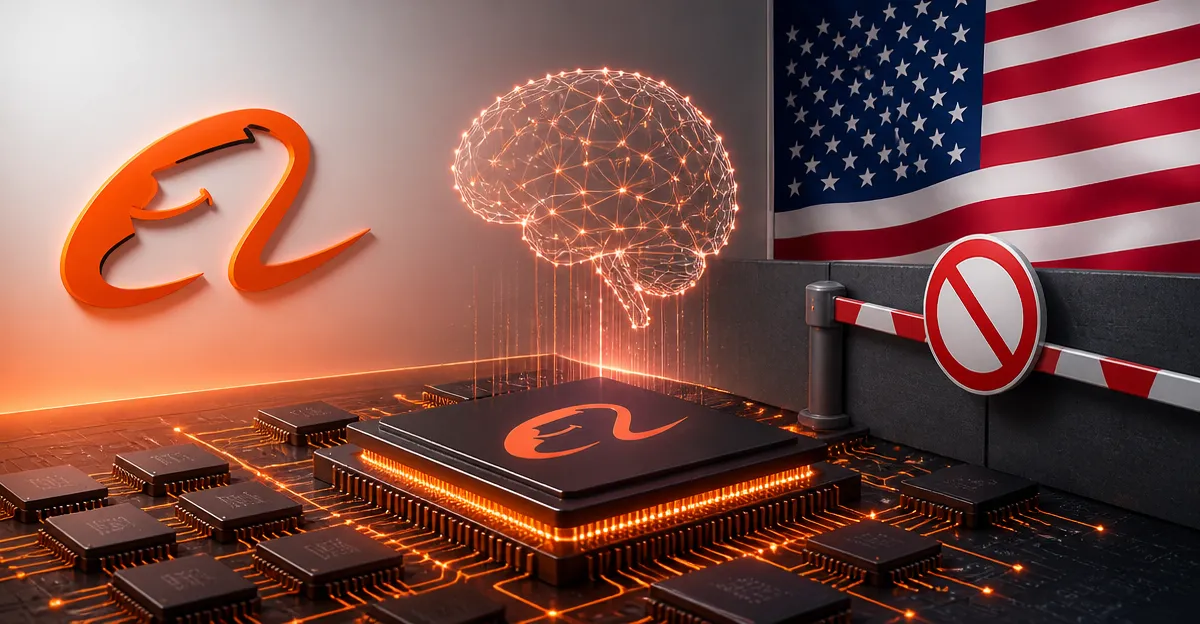
November 19, 2026, (Inside AI) — Alibaba Group is training its next-generation artificial intelligence model on proprietary chips built by T-Head, its in-house semiconductor unit, CEO Eddie Wu confirmed on Thursday in Hong Kong. The disclosure marks the first time Alibaba has publicly acknowledged that a frontier-scale model is being trained on its own silicon rather than on hardware from U.S. suppliers such as Nvidia.
The move comes as Washington continues to tighten export controls on advanced AI processors, limiting what Chinese firms can legally buy. T-Head, which recently received approval for an initial public offering in Hong Kong, has spent years developing server-grade chips that could reduce Alibaba's exposure to those restrictions.
"We plan ..." Wu said, according to sources, without completing the sentence in the excerpt released to media.
Alibaba's decision to train a flagship model on T-Head silicon is significant for two reasons. First, it signals that Chinese cloud providers now consider domestic chips mature enough for the most demanding workloads. Second, it gives T-Head a marquee customer just as the unit prepares to list shares, a timing that could shape investor appetite for the IPO.
Read: xFusion Clears Shenzhen Review for $1.2 Billion AI Server IPO
Nvidia has historically supplied the bulk of AI accelerators used by Alibaba Cloud, the company's computing arm. U.S. rules introduced in 2022 and expanded since then have restricted exports of the most capable chips to China, forcing buyers to rely on downgraded variants or older inventory. Those restrictions have accelerated a domestic chip race involving Huawei, Cambricon, and T-Head.
Training a frontier model requires thousands of chips running in parallel for weeks. Whether T-Head's hardware can match Nvidia's performance on such workloads remains an open question. Alibaba has not disclosed the model's size, the number of chips used, or the training duration.
The announcement also lands during a delicate period for Alibaba's cloud business. The company has been restructuring its operations and seeking to reassure investors about its AI strategy. Training on in-house silicon could lower costs over time, but it also carries execution risk if the chips prove less reliable than established alternatives.
Wu's comments were made at an event in Hong Kong, where Alibaba has increasingly centered its investor relations. The CEO did not provide a timeline for the model's release or specify which product line it would power.
T-Head's IPO approval adds a financial dimension. A successful listing would give Alibaba a public currency for its chip ambitions and a way to raise capital for further semiconductor development. However, the unit will face scrutiny from investors who want evidence that its chips can compete commercially, not just inside Alibaba.
For now, the disclosure offers a rare glimpse into how Chinese tech giants are adapting to a constrained supply chain. Alibaba is not alone in pursuing this path, but it is among the first to confirm that a next-generation model is being trained on domestic silicon.
Read: SMIC: AI Chip Supply Chain to Stay Tight Through 2027
The company is expected to share more details at its upcoming cloud summit. Until then, the incomplete quote from Wu leaves key questions unanswered: how large the model is, how many T-Head chips are involved, and whether the training run has completed.

If a research paper dropped this week, Mahesh has already read it. He covers AI tools and vibe coding for builders who need to know what is worth their time and what is not.