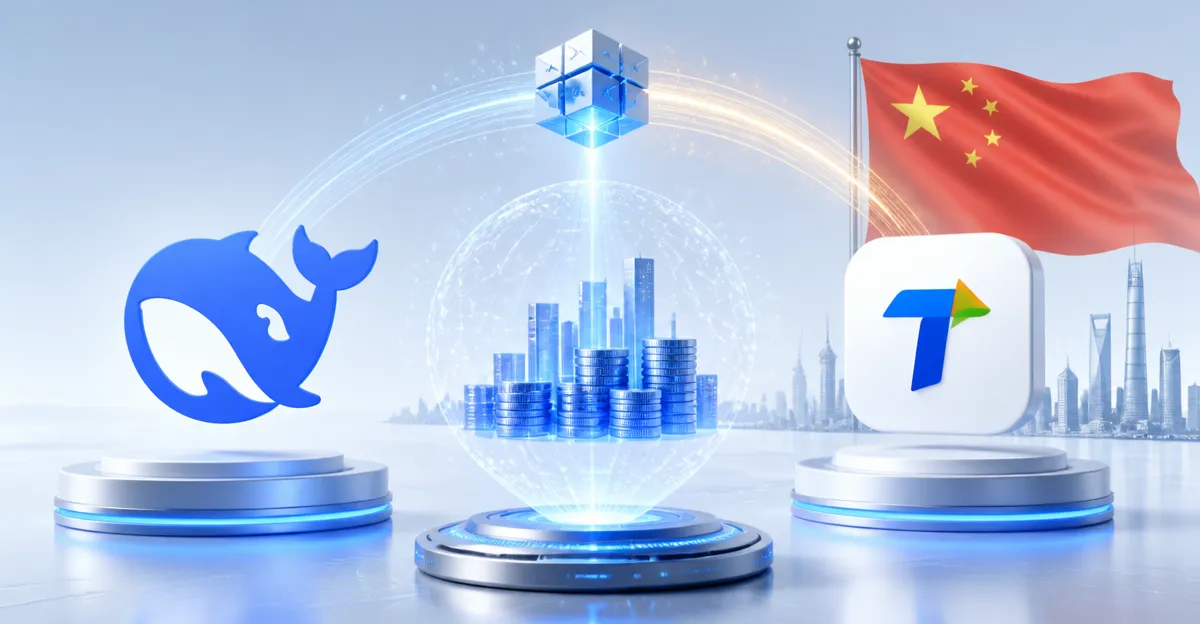
October 6, 2026, (Inside AI) — Chinese artificial intelligence developer DeepSeek is finalizing a funding round of at least 80 billion yuan ($11.93 billion), according to sources familiar with the negotiations. The round is backed by Chinese technology conglomerate Tencent, a move that would make it one of the largest private capital raises ever completed by an AI startup in Asia.
The deal, which remains subject to final documentation, values the Hangzhou-based company at a level that would place it among the most valuable private AI firms globally. The capital injection arrives as competition intensifies between Chinese and American developers over model performance, compute access, and enterprise market share.
DeepSeek first drew international attention in early 2025 when it released a series of open-weight reasoning models that matched or exceeded the performance of leading Western systems on several public benchmarks. The company claimed its training runs cost a fraction of those disclosed by American labs, a claim that triggered a sharp selloff in U.S. technology stocks and prompted widespread debate about the efficiency of large-scale model training.
Tencent's participation carries strategic weight beyond the balance sheet. The Shenzhen-based company operates WeChat, China's dominant messaging platform with more than 1.3 billion monthly users, and has been integrating AI assistants across its social, gaming, and cloud businesses. A closer relationship with DeepSeek could give Tencent preferred access to frontier models while providing DeepSeek with distribution at a scale no independent AI lab in China currently enjoys.
Read: Anthropic IPO Filing Reveals $2 Trillion Valuation Target and Catastrophic AI Risk Warnings
The funding also reflects a broader shift in China's AI financing landscape. After a period of regulatory tightening that slowed investment across the technology sector, capital has returned to AI developers with force. Alibaba, Baidu, and ByteDance have all expanded their model programs, and the Chinese government has signaled support for domestic AI infrastructure as part of its broader technology self-reliance agenda.
Compute remains the central constraint. U.S. export controls have limited Chinese firms' access to advanced semiconductors from Nvidia, pushing developers toward alternative chip designs and domestic suppliers such as Huawei. DeepSeek has not disclosed the hardware configuration behind its models, and questions persist about how much of its reported efficiency stems from algorithmic innovation versus restricted access to top-tier GPUs.
The new funding is expected to address that gap. A portion of the capital will likely fund compute procurement, including domestic accelerators and cloud capacity, according to sources. DeepSeek has also been hiring aggressively for roles in model training, infrastructure engineering, and product development, though the company has not publicly confirmed headcount figures.
For Tencent, the investment fits a pattern of backing external AI talent while building internal capabilities. The company has developed its own Hunyuan model family and has invested in multiple AI startups across China. Its involvement in DeepSeek's round could complicate relationships with other portfolio companies that compete directly with DeepSeek in the enterprise and consumer markets.
Regulatory approval is not guaranteed. Large investments involving China's most prominent AI firms typically require review by state market regulators, and the process can take months. Neither DeepSeek nor Tencent has issued a public statement on the transaction. Inside AI could not independently verify the final terms of the deal.
The reported valuation would place DeepSeek in rare company. Few private AI labs globally have raised at this scale, and fewer still have done so while maintaining an open-weight model strategy that distributes core technology freely. That approach has earned DeepSeek a large developer following but has also raised questions about long-term monetization.
Read: Kimi K3 Enters OpenAI's Enterprise Codex Channel via Baseten
Enterprise adoption in China has grown steadily, with DeepSeek models appearing in products from cloud providers, automakers, and financial institutions. The company has not disclosed revenue figures, and its business model remains less defined than that of competitors who charge directly for API access.
If completed, the round would give DeepSeek substantial runway to pursue next-generation models while deepening ties with one of China's most powerful technology platforms. It would also sharpen the divide between AI ecosystems in the U.S. and China, each now supported by distinct capital pools, chip supply chains, and regulatory environments.
Observers will watch whether the deal closes at the reported figure and whether Tencent secures board representation or commercial exclusivity terms. Either outcome would reshape competitive dynamics in a market where distribution and compute access increasingly determine which models reach scale.