October 7, 2026, (Inside AI) — A Danish artificial intelligence startup claims it predicted the failure of a high-profile Novartis drug trial months before it happened, and now the pharmaceutical industry is quietly testing whether machine learning can rescue it from a decades-long crisis of clinical attrition.
BioinvestGPT, based in Copenhagen, told sources it ran a simulated trial in July for Novartis' experimental del-desiran, a treatment for a rare muscular dystrophy. The simulation predicted an insignificant clinical benefit. When the actual late-stage trial missed its goal last month, Novartis shares fell 11%, erasing roughly $30 billion in market value.
The startup says it has now correctly forecast the outcomes of five of six major drug trials, including successes for Moderna and Merck's melanoma vaccine and Vaxcyte's pneumococcal vaccine. It also flagged weak clinical benefit for AstraZeneca and Ionis' heart drug Wainua.
The stakes extend far beyond one company's scorecard. The global biopharmaceutical industry spends roughly $140 billion annually on human clinical testing. Only about 12% of drug candidates win regulatory approval, a rate that has barely moved in decades. Investment in AI drug discovery more than doubled to $8.4 billion in 2025 compared to 2023, according to a recent McKinsey report.
Read: New AI Model GPN-Star Learns from Evolution to Decode Human Genome
Virtual Patients, Real Predictions
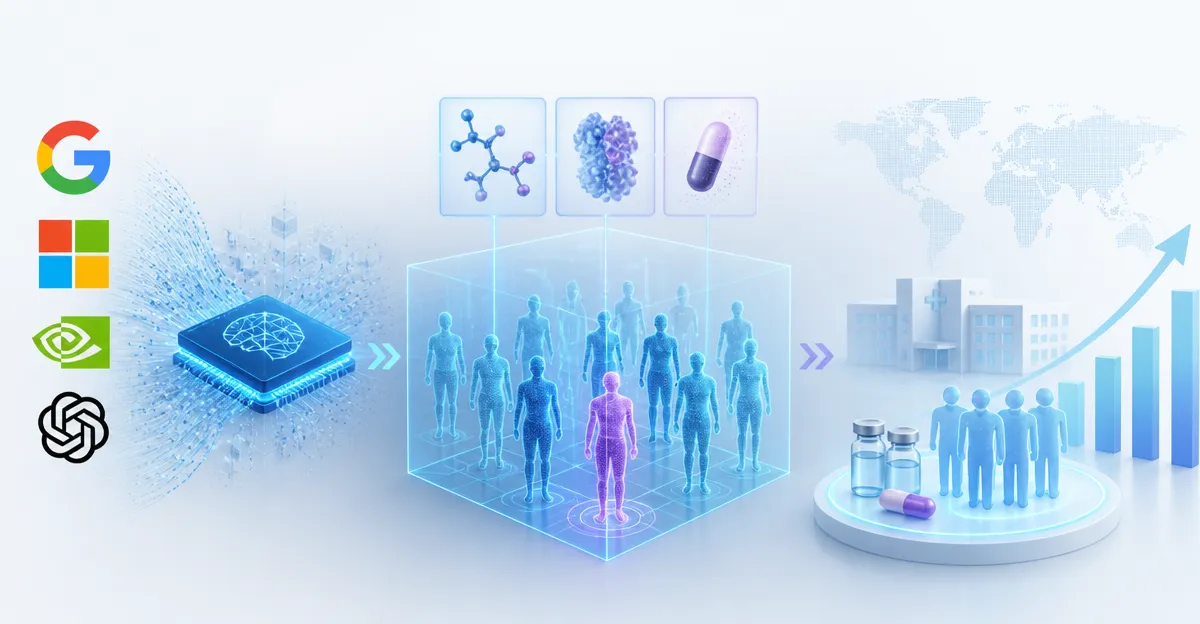
BioinvestGPT's approach uses DNA sequencing to construct a simulated human body matching the eligibility criteria of a specific trial. A virtual trial then runs using a model of the test drug.
"We can pinpoint the reason why a drug is effective and safe, and in many cases, why not," said Bragi Lovetrue, who co-founded BioinvestGPT with his wife Idonae Lovetrue in 2024.
The company has published forward-looking predictions for trials expected to report results before year-end. It forecasts failure for two Phase 3 trials of Biogen's litifilimab in the most common type of lupus, and for Phase 2 studies of Takeda's zasocitinib in Crohn's disease and ulcerative colitis.
Not everyone in the industry accepts these projections. Takeda research chief Andy Plump defended the company's drug, noting that its target was identified through human genetics analysis and machine learning optimized the molecule's structure.
"I have immense confidence in this mechanism," Plump said. "I don't think we are near being able to use tools like AI to make definitive predictions."
Diana Gallagher, Biogen's head of clinical development for multiple sclerosis, immunology and Alzheimer's, said the company uses every tool available, including AI. She noted that only two biologic drugs have been approved for lupus, and algorithms relying on historical data could be biased toward predicting negative results.
The simulations are not infallible. BioinvestGPT predicted positive results for Novartis' pelacarsen, a drug that lowers lipoprotein(a) levels. Novartis said in September the drug failed to reduce heart attack or stroke risk in a late-stage trial.
Read: Why Frontier AI Still Hallucinates in 2026 and What to Do About It
A subsequent analysis showed the model got the mechanism wrong by not accounting for genetically determined variations in lipoprotein size, Lovetrue said.
QuantHealth, a Tel Aviv-based AI simulation platform, has published its own simulations of ulcerative colitis and cholesterol drug trials. Its chief medical officer, Francisco Beca, framed the issue in ethical terms.
"We shouldn't only ask how to run trials faster. We should ask how to run fewer trials that are going to fail," Beca said. "Is it still ethical in 2026 to expose patients to a trial that most likely will fail? With the advancement of this technology, come 2027, 2028, or 2029, probably the answer is going to be that it no longer is."
McKinsey partner Alex Devereson said pharmaceutical companies are "dipping their toes" into AI trial modeling, using the technology internally or with partners to assess drug candidates before committing capital.
Regulatory momentum is building. US health regulators last week announced initiatives aimed at speeding drug trials. A federal health official said the program could create a pathway for predictive AI in clinical development.
For now, the technology remains a supplement to human trials, not a replacement. The industry's fundamental goal remains proof of superior clinical benefit compared to standard care. AI may help identify which programs deserve that expensive proof, but the final test still runs through real patients.