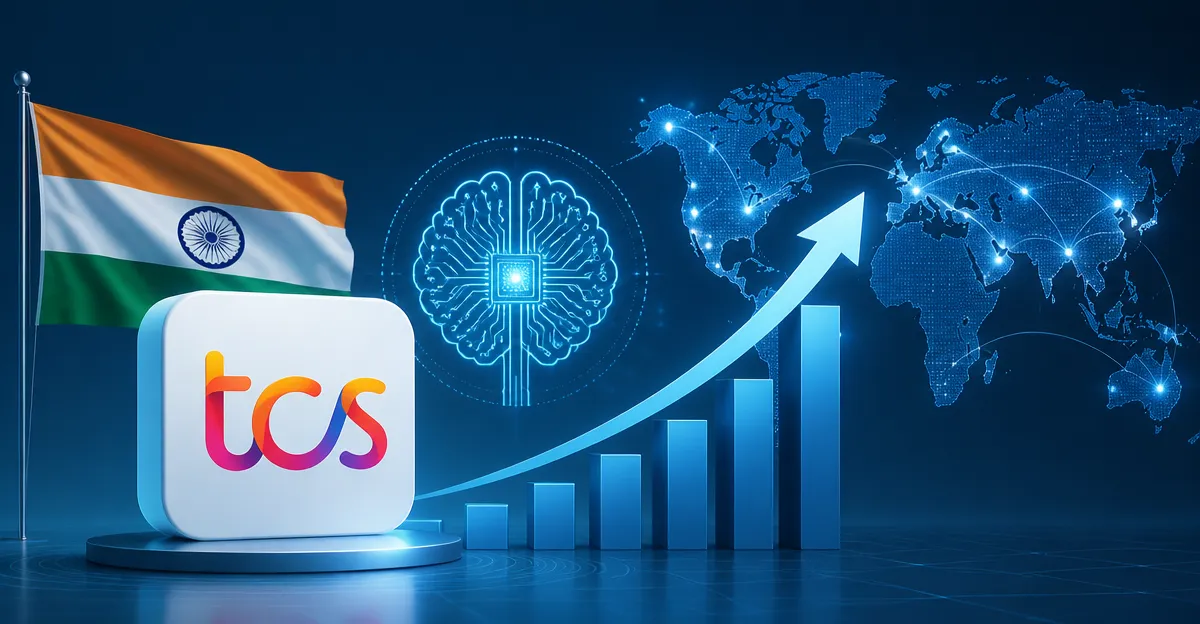
October 9, 2026, (Inside AI) — Shares of Tata Consultancy Services jumped 5.2% to 2,183.90 rupees on Friday after the Indian IT giant disclosed that its annualized artificial intelligence revenue reached $3.1 billion in the July-September quarter, a nearly 20% sequential increase. The rally lifted the Nifty IT Index by as much as 3.1%, as investors bet that India's $315 billion software services sector is finally converting years of AI experimentation into billable contracts.
The number matters because it reframes a debate that has dogged Indian IT for two years. Generative AI was widely expected to cannibalize the traditional managed-services work that firms like TCS, Infosys, and Wipro built their fortunes on. Instead, TCS is reporting that AI-led transformation deals are expanding the pie, at least for now. The company's AI revenue run rate has grown from a standing start to more than $3 billion annualized in roughly three years, a scale few enterprise software vendors have matched.
Margin Pressure Meets Megadeal Momentum
The growth is not free. Analysts at Emkay Global Financial Services noted that TCS is spending heavily on acquisitions, frontier AI partnerships, talent, and new business lines including data center services, global capability centers, mid-market offerings, and sovereign cloud. Those investments are expected to weigh on near-term margins. Emkay maintained an "add" rating and a target price of 2,600 rupees, implying further upside from Friday's close.
Morningstar took a more cautious view on valuation even while praising execution.
Read: Tech Stocks Slide as OpenAI Revenue Miss Sparks AI Spending Concerns
"We like TCS' leadership in AI implementation, and we see a clear path to further scale AI revenue as it lands more megadeals to modernize managed-services processes," Morningstar analysts said.
The research firm cut its fair value estimate to 2,360 rupees from 2,400 rupees, citing a higher probability of an extended slowdown among consumer-facing clients due to macroeconomic volatility. That revision captures the central tension in TCS's story: AI demand is real, but it is not yet large enough to fully offset weakness in discretionary spending across retail, banking, and consumer goods verticals.
The AI revenue figure also deserves scrutiny. TCS does not break out what counts as "AI revenue" in its filings, and the definition can include everything from pure-play generative AI development to traditional automation and analytics work rebranded under the AI umbrella. Inside AI could not independently verify the composition of that $3.1 billion figure. Investors should watch whether the company discloses more granular detail in its full quarterly results.
Meanwhile, a regulatory headwind emerged in the United States. The US government suspended TCS and several other technology firms from the Permanent Labor Certification (PERM) program, which companies use to sponsor foreign workers for green cards. TCS said it does not expect the suspension to have any material impact on its workforce strategy or client engagements. The company relies heavily on local hiring in the US and on offshore delivery centers in India, which may soften the blow.
The broader context is that Indian IT firms are racing to reposition themselves as AI-native service providers before their traditional labor-arbitrage model erodes. TCS has struck partnerships with frontier AI labs, invested in talent reskilling at scale, and pursued acquisitions to fill capability gaps. Rivals Infosys and Wipro are pursuing similar strategies, making the next few quarters a test of who can convert AI hype into durable revenue.
Read: OpenAI Revenue Falls Short as AI Infrastructure Financing Faces $1.5 Trillion Gap
For now, the market is rewarding TCS for showing measurable progress. The 5.2% jump is a vote of confidence that AI can be a growth engine rather than a disruptor for India's largest IT exporter. Whether that confidence holds depends on whether TCS can keep scaling AI revenue without sacrificing the margins that have long made it a favorite among institutional investors.