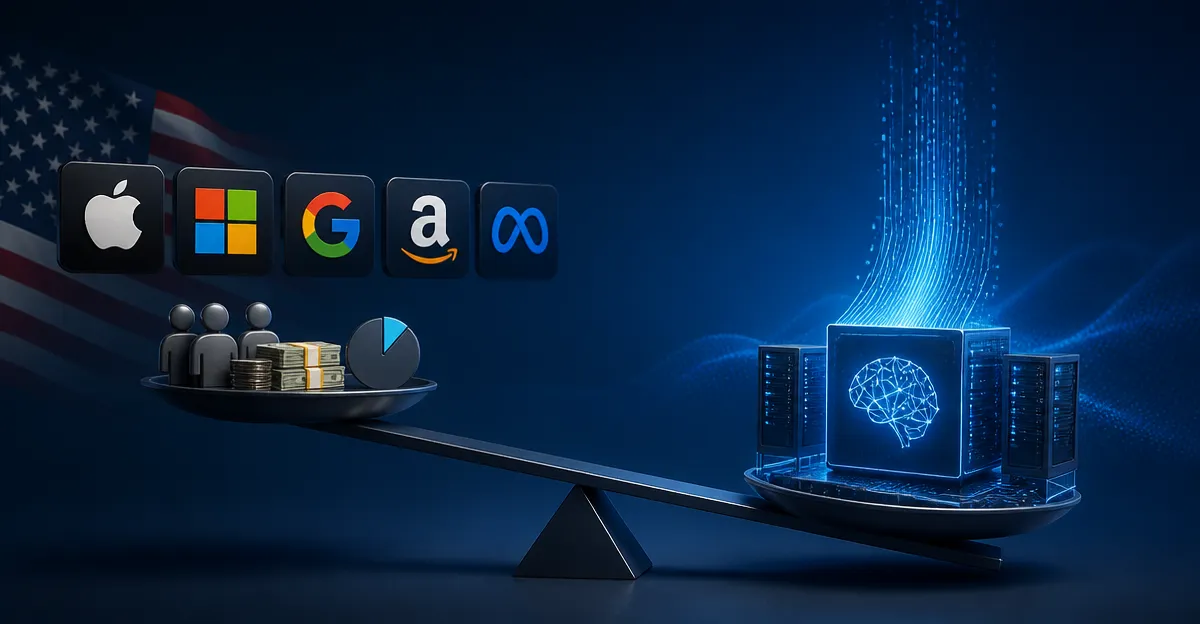
October 30, 2026, (Inside AI) — The five largest United States technology companies are generating record cash from their businesses, yet they are returning the smallest share of it to shareholders in at least 15 years. The reason is a surge in artificial intelligence capital spending that has overwhelmed buybacks and pushed combined free cash flow into negative territory for the first time.
According to an analysis of LSEG data and corporate financial reports, Microsoft, Alphabet, Amazon, Meta, and Oracle returned just 9.3% of operating cash flow as dividends and buybacks in the first nine months of 2026. That is down sharply from 27.4% a year earlier. Operating cash flow rose 29% to a record $542.9 billion. Capital spending, however, doubled to $556.9 billion, exceeding cash generation for the first time in data going back to 2011.
The result is a combined free cash flow deficit of $14 billion, compared with a surplus of $143.5 billion a year earlier. Buybacks bore the brunt of the adjustment. The five companies cut repurchases 83% to $13.6 billion from $81.8 billion. Dividends, which investors treat as a commitment, rose modestly to $37 billion from $33.9 billion.
This shift matters because buybacks have quietly flattered per-share earnings for years. When companies retire shares, profits spread across fewer shares, lifting earnings per share even without profit growth. Alphabet reduced its share count by 9.5% between the end of 2020 and 2025 through buybacks, according to ING. That alone provided a boost of roughly 2% a year to earnings per share. Without that lift, per-share earnings must come from actual profit growth. That is a harder test, and it arrives just as depreciation charges on new data centers begin to rise.
Buybacks Vanish As AI Bills Come Due
Alphabet and Meta have not repurchased a single share in 2026, after buying back $66.5 billion in the first nine months of last year. Amazon pays no dividend and has not bought back shares since 2022. Microsoft accounted for nearly all of the remaining repurchases among the five, and it cut its buybacks to $4.4 billion in the September quarter from $5.7 billion a year earlier.
Some companies are no longer covering their payouts from what their businesses earn after capital spending. With combined free cash flow negative, the five companies' $50.6 billion in payouts was effectively funded from cash reserves, borrowing, or share sales. Amazon's capital spending of $75.9 billion in the third quarter was almost 80% more than the $42.4 billion its operations generated, and it raised $48.1 billion of long-term debt in the quarter. Alphabet's free cash flow was also negative, and it raised about $12.4 billion from share sales and $29 billion from debt.
The loss of buybacks matters more than the dollar figures suggest. Investors care "so much more about EPS than FCF," Mark Schilsky, a technology sector specialist at JPMorgan, said in a client note last week. Technology and communication services stocks, which account for about 43.5% of US market value, delivered a shareholder yield of just 0.28% in July, against 1.99% for the rest of the market, MSCI found.
There is no end in sight. Amazon said it still expects about $220 billion of capital spending this year, and the other companies have signaled further increases. That leaves Big Tech shareholders with a different bargain from the one they signed up for, accepting less cash today in exchange for a bet that AI will eventually generate enough profit to make up for it.
"For the last 15 years, companies increasingly returned excess capital to shareholders through buybacks and dividends," said Ehren Stanhope, co-head of investment management at Franklin Templeton. "The current regime may increasingly be characterized by greater equity and debt issuance, a request of capital from investors."
The shift is not merely a financial engineering story. It signals that the AI buildout has reached a scale where it is consuming the very cash flows that once supported shareholder returns. For years, buybacks provided a reliable floor under technology valuations. Now, with repurchases nearly gone and free cash flow negative, investors are increasingly dependent on heavy AI investments delivering enough profit growth to justify current valuations. That is a higher-stakes bet, and it comes as depreciation from new data centers begins to weigh on earnings.
Related developments bear watching. Oracle, which has ramped up AI-related capital spending, has also seen its free cash flow pressured. The broader market has taken notice. Technology and communication services stocks now offer a shareholder yield well below the rest of the market, a reversal from the past decade. If AI profits fail to materialize on schedule, the lack of buyback support could amplify any downturn. For now, the five firms are betting that scale will win. Shareholders are along for the ride, with less cash in hand and more riding on the promise of artificial intelligence.